All species › Hedgehogs, shrews and moles › Hedgehogs › Eastern European Hedgehog
Eastern European Hedgehog | Erinaceus concolor
Erinaceus concolor | Erinaceus concolor
Erinaceus concolor is the hedgehog of Anatolia and the Levant. Until about 2000 this name also covered the hedgehog of eastern Europe; that has since been split off as Erinaceus roumanicus, and concolor now covers only the south-eastern populations. Older literature and older records under the name concolor may therefore refer to roumanicus.

Tracks
The signs correspond to those of other Erinaceus species. The dropping is 3 to 5 cm long, about 1 cm thick, cylindrical and blunt at both ends, black and glossy when fresh, and full of shiny beetle remains; it lies in the open on a path, a paving slab, a mown patch or in the middle of a farm track and is never buried. In damp sand or mud the print is visible: small relative to the animal, about 2.5 to 3 cm, with five toes and sharp, far-projecting claws; the trail is irregular and the prints lie far apart. In short grass and watered gardens there are snout pokes, conical holes of 1 to 2 cm, dozens together. Characteristic of this species is the burrow: unlike the West European Hedgehog, which usually uses a leaf nest under a brush pile, concolor digs tunnels sometimes over 1.5 m long and up to 75 cm deep, and also uses rock crevices and existing holes. The entrance is often at the foot of a terrace wall, under a bramble or in a ditch bank. Other signs: trodden passages under wire and fences, and at night the snuffling and rustling of a foraging animal, audible up to about ten metres. The species regularly eats small vertebrates such as snakes and lizards, but this seldom leaves traces.
In its habitat

Head close-up

Identification
A sturdy hedgehog of 20 to 26 cm, usually 550 to 800 g, with some heavy animals up to 1.5 kg. The dorsal spines are up to 37 mm long, smooth and banded buff and black. Characteristic is a white patch across the chest, contrasting with the dark brown hair of belly and flanks. The face is dark brown with a long, pointed muzzle; the ears are small to medium-sized and barely project above the spines in profile. The hind foot measures about 41 mm, the tail 2 to 3 cm. In the field the animal is rounded, short-legged and dark; the pale underside is visible only when the animal rolls up, climbs over an edge or lies on its side.
Similar species
There is no reliable field character separating this species from the Northern White-breasted Hedgehog (Erinaceus roumanicus). Both are brown hedgehogs with a pale chest; the differences given in the literature, such as skull shape, the C-heterochromatin banding of the karyotype and the DNA, are not field characters. The distinction rests on locality: roumanicus is the European species, concolor the Anatolian-Levantine one; concolor occurs in Turkey, the Levant and on a few Greek islands. In Turkey the ranges follow the boundary between the continents: a karyotype study (Arslan et al. 2008) found roumanicus in Thrace (European Turkey) and concolor in Anatolia, with the Bosphorus and the Dardanelles as the divide. A hedgehog from mainland Thrace, Greek or Turkish, is therefore a roumanicus. Older records from Austria, Poland, Ukraine and Romania still stand in databases under the name concolor; they belong to roumanicus. The West European Hedgehog does not occur in this area. In the Levant concolor lives alongside two hedgehogs that look clearly different: the Long-eared Hedgehog (Hemiechinus auritus), with much longer, more pointed ears, long legs and a plain white belly, and the Desert Hedgehog (Paraechinus aethiopicus), with large ears, a dark mask and a broad white forehead band. Both are smaller and lighter and live in drier areas; where fields and gardens give way to steppe, they become the hedgehog species present.
Habitat
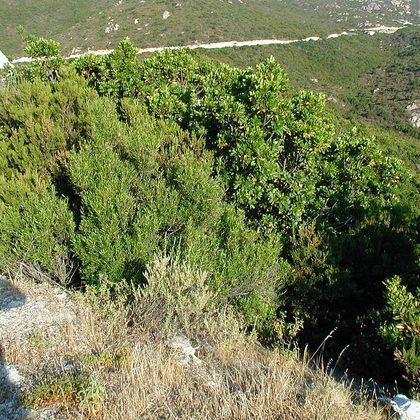
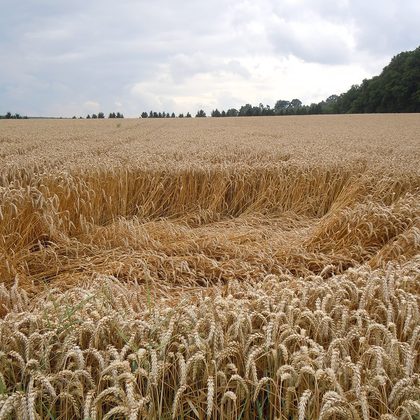
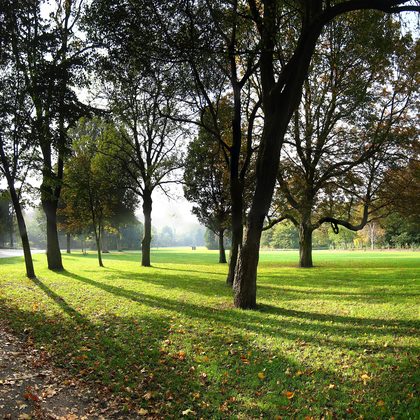
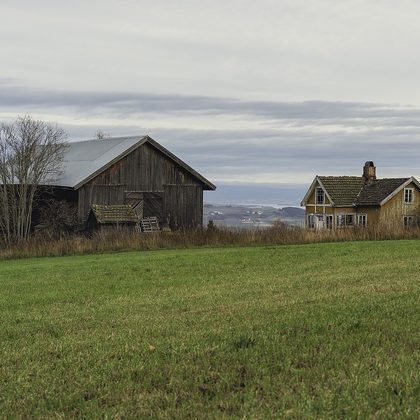
Deciduous woodland and woodland edges, scrub and maquis, dry grassland and hill country up to the treeline; extensive conifer forest is avoided. In addition, man-made habitats: orchards, olive and almond groves, arable land, gardens, parks, golf courses and village edges. In Turkey the species lives mainly in mixed farmland, in Israel in gardens and at the edges of built-up areas. It swims and climbs well, which is useful in terraced landscapes with walls. In truly arid areas it is absent and the Long-eared and Desert Hedgehogs occur.
Where the animal is most at home, classified with EUNIS — the European standard for habitats.



Distribution
Anatolia, and from there east to the southern Caucasus (Georgia, Armenia, Azerbaijan) and south to north-western Iran, northern Iraq, Syria, Lebanon, Israel and Jordan. Within Europe in the strict sense it is confined to a few Greek islands off the Turkish coast: Chios, Samos, Kos and Rhodes. The species is monotypic. By far the most records come from Israel and Turkey, followed by Greece; the records GBIF holds under this name from Austria, Ukraine, Poland and Romania belong to the Northern White-breasted Hedgehog and derive from the former, broad species concept. In Turkey the Bosphorus and the Dardanelles separate roumanicus (Thrace) from concolor (Anatolia) (Arslan et al. 2008); whether the two meet or overlap anywhere else has not been studied.
- Native
- dark = core range, pale = thinly spread
Way of life
Nocturnal; by day it lies under brush piles, in a leaf nest in a rock crevice or in a self-dug burrow. It covers about 300 m a night, a short distance for a hedgehog, and usually moves slowly, but can run fast. The home range covers 1 to 6 ha. The diet is more varied than that of the West European Hedgehog: besides insects and other invertebrates it eats frogs, snakes, lizards, nestling birds and mice, as well as plant material, fungi and carrion; in villages it forages in refuse. Breeding takes place from March to May in the south and from April to July in the north. After a gestation of 31 to 36 days five or six young are born (range three to eight), weighing 12 to 16 g; the eyes open at 14 to 18 days and the teeth erupt at three weeks. In the wild animals reach six to eight years, in captivity ten. It hibernates, for several months in the highest and coldest parts of Anatolia and the Caucasus, much more briefly in the warm coastal zone of the Levant.
Where and when to look
In Israel the species is one of the most frequently seen mammals in the evening: walk through a park, a kibbutz garden or along a field margin half an hour after sunset and listen for snuffling in the vegetation. In Turkey the same method works in orchards and along village edges in Anatolia, best in April and May and again in September. On Chios, Samos, Kos and Rhodes an evening walk through the olive groves is suitable. Use a torch with a red filter and leave a rolled-up animal alone: it stays put for minutes and moves on only when all is quiet. Record the exact locality and if possible photograph the underside; because the boundary with the Northern White-breasted Hedgehog is not known, precise coordinates are important for this species.
Conservation status
Least Concern (LC, 2021), both globally and in the European assessment. In the European part of the range, the Greek islands, it is considered common; the main threat is traffic. In parts of the Middle East it is taken for food. For the European hedgehogs as a group, knowledge is limited. For this species no multi-year counts are available, and the information on diet, density and trends in handbooks rests on little research. Genetic study is needed to establish how far the range of concolor extends and whether it overlaps anywhere with that of the Northern White-breasted Hedgehog; until then, the assessment of its status in Europe is based on a range whose limits are not fixed.
Scientific name
Erinaceus concolor | W. C. L. Martin, 1838
W. C. L. Martin described the species in 1838 and placed it straight away in the genus where it still stands. Erinaceus is the Latin word for 'hedgehog'. concolor is Latin for 'of one colour', from con-, 'together', and color, 'colour', after the evenly coloured underside without a pale chest patch. The specimen the first description was based on came from Türkiye, Trabzon.