All species › Bats › Fruit bats › Egyptian fruit bat
Egyptian fruit bat | Rousettus aegyptiacus
Nijlroezet | Rousettus aegyptiacus
The Egyptian fruit bat is the only fruit bat (family Pteropodidae) in the guide area: a fruit-eating bat that roosts in caves and flies at night to fruiting trees. Unlike the insectivorous bats it orients mainly by sight and smell, and in darkness with clicks produced by the tongue, not by the larynx. Within the guide area the species lives in Egypt, on Cyprus, on the south coast of Turkey and in the Levant.
No photograph of a living wild animal of this species with a suitable Creative Commons licence exists. Do you have one that meets the rules? Send it in.
Tracks
Beneath the trees where the bats feed lie spat-out pellets of fruit pulp: the fruit is chewed, the juice swallowed and the fibres spat out as a dry wad. With them lie partly eaten figs, dates, loquats, plums and other soft fruits, and seeds. Beneath regular feeding perches, often a tree or a sheltered spot near the fruit trees, such remains accumulate. Beneath the colony in a cave lies a layer of semi-liquid droppings with seeds. Shrill screams and squabbling come from a colony by day as well; the bats fight over roosting spots with bites, strikes and loud screams. The tongue clicks are audible to humans.
Identification
A large bat with a dog-like head, a long muzzle and large brown eyes. The ears are round and simple, without a tragus. As in most fruit bats, the second finger also bears a claw, besides the thumb. The tail is short, 6 to 25 mm. The fur is short and soft, light brown in Egypt and greyer on Cyprus and in Turkey; it extends onto the forearms and legs. Head-body 138 to 192 mm, ear 18 to 27 mm, forearm 82 to 106 mm, weight 81 to 171 g, wingspan up to about 60 cm. The brain is large relative to body size. The species does not use laryngeal echolocation like the insectivorous bats, but produces short tongue clicks of 140 to 250 microseconds; with these the bats can detect wires 6 mm thick, in light as well as in darkness. Outside the cave the species orients largely by sight.
Similar species
No other fruit bat occurs in the guide area; the combination of dog-like head, large eyes, simple round ears without a tragus, a claw on the second finger and a weight of about 80 to 170 g rules out confusion with other species. Large insectivorous bats in the same area, such as the European free-tailed bat (Tadarida teniotis) and the naked-rumped tomb bat (Taphozous nudiventris), weigh 20 to 40 g, have a tragus or antitragus and small eyes.
Habitat
From arid to moist tropical regions, from sea level to about 4000 m. In the dry regions of North Africa and the Middle East the distribution is patchy and concentrated in human-modified areas where roosts and food are available: orchards, gardens, parks, plantations and villages and towns with fruit trees. The bats mostly roost in caves, but also in other cavities and crevices, including tombs, temples, mines and tunnels. The availability of suitable dark corners and crevices in caves can limit population size.
Where the animal is most at home, classified with EUNIS — the European standard for habitats.
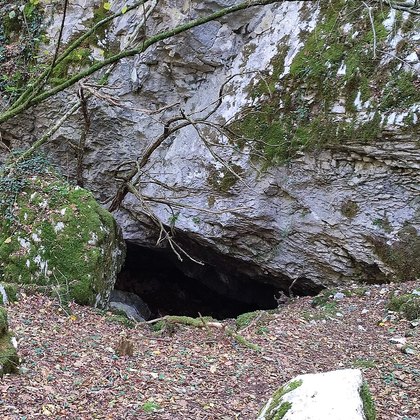



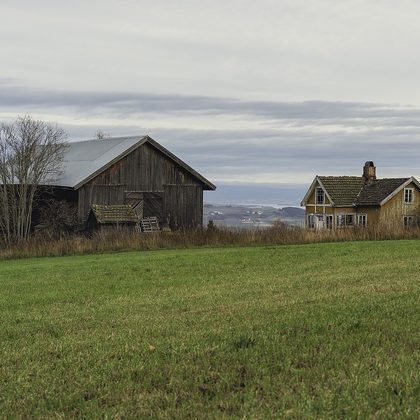

Distribution
Sub-Saharan Africa, Egypt, the Middle East and south-western Asia to Pakistan; six subspecies are recognised. Within the guide area the species lives in the Nile Valley and Nile Delta in northern Egypt, on Cyprus, on the Mediterranean coast of southern Turkey, and in Syria, Lebanon, Israel, the Palestinian territories and Jordan. Cyprus is the only country of the European Union where the species occurs. Most GBIF records within the guide area come from Israel, followed by Jordan, Turkey and Egypt.
- Native
- dark = core range, pale = thinly spread
Way of life
Nocturnal; the bats leave the roost every night to feed, after sunset, and return before sunrise. In winter activity starts a little later and ends a little earlier, but there is no hibernation. The diet consists mainly of soft fruits from at least twelve genera of native plants in nine families, including figs (Ficus), as well as cultivated fruits such as plum, loquat, apple and citrus. Flowers, occasionally leaves and even insects are also eaten. Adults eat 50 to 150% of their own body weight per day; they forage in groups and can travel long distances to food sources. In the Mediterranean region seasonal movements follow fruit availability. Colonies number 100 to several thousand bats, exceptionally 40,000 to 50,000, and often share the roost with other bat species. During the breeding season the sexes segregate and females form maternity colonies. Gestation lasts 105 to 107 days in captivity; usually one young is born, twins occur regularly. The young weighs 18 to 24 g at birth, opens its eyes after ten days, is suckled for 60 to 70 days and is fully grown after about nine months. The bats spend about half the night grooming fur and wings.
Where and when to look
In towns and villages in Israel, Cyprus and southern Turkey the species can be seen at dusk at ripe fig, loquat or date trees in gardens and parks, where the bats land, pick a fruit and fly off. Spat-out fibre pellets under such a tree indicate a feeding site that may be used again on later visits. At a cave with a colony the emergence after sunset can be watched and the screams and tongue clicks heard without a bat detector. Caves with colonies are not entered. Fruit bats are not touched with bare hands: Marburg virus has been detected in this species in sub-Saharan Africa.
Conservation status
Least Concern (LC, 2016), on the basis of its wide distribution, large overall population and adaptability to human-modified areas. In parts of Africa the species is hunted for food. In the Mediterranean region fruit growers regard it as a pest, which has led to the destruction and fumigation of caves; in some countries, such as Israel, this has stopped. In populations in sub-Saharan Africa the species has been shown to be a natural host of Marburg virus. On Cyprus the species is covered by the Habitats Directive.
Scientific name
Rousettus aegyptiacus | (É. Geoffroy Saint-Hilaire, 1810)
É. Geoffroy Saint-Hilaire described the species in 1810 as Pteropus Egyptiacus; because it was later moved to another genus, the author and year stand in brackets. Rousettus is a Latinization of French roussette, the usual name for fruit bats since Buffon, from roux, 'reddish brown'. aegyptiacus is Latin for 'Egyptian'; Geoffroy Saint-Hilaire described the animal from material he collected at the pyramids of Giza. The specimen the first description was based on came from Egypt, Giza.