All species › Rodents › Voles and hamsters › European Snow Vole
European Snow Vole | Chionomys nivalis
Sneeuwmuis | Topillo Nival
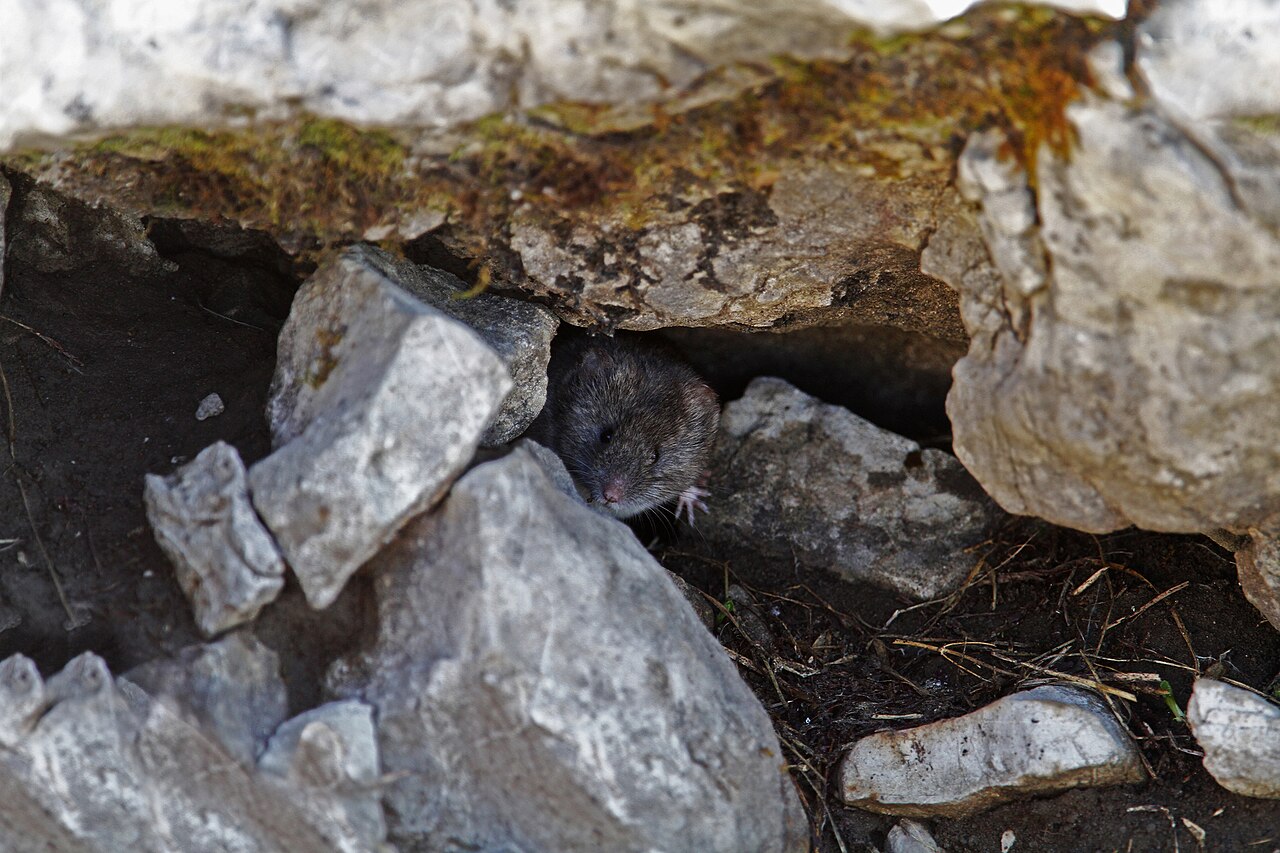
The European Snow Vole is a vole of rocks, boulder fields and screes, mainly above the treeline and up to about three thousand metres. It is pale grey, has a long tail for a vole and lives in rock crevices; in high mountains this makes it identifiable with certainty.

Tracks
The signs are found mainly among stones, not on open ground. Under an overhanging block, in a crevice or beneath a flat stone at the foot of a scree, look for droppings of four to six millimetres, cylindrical with blunt ends, green-brown when fresh and greyish later, in small fixed heaps close to the crevice entrance; the animals use set places, which can be found for years. Around the same entrance lie cut plant fragments: stems of alpine grasses, sedges and herbs in pieces a few centimetres long, bitten obliquely, and in late summer small piles of half-dried leaves dragged into the crevice as a hay store. On damp soil between the stones a print may show: four toes in front, five behind, smaller than a fingertip. In areas with many animals a short, high squeak from a boulder pile is often all a walker notices. There are also pellets of Alpine Chough, Kestrel and above all Tengmalm's Owl and Eagle Owl, containing the flat vole molars folded into zigzag prisms; those of the Snow Vole can be recognised by size and number of triangles. The species makes no run systems in the turf or burrow tunnels: it does not dig, but lives in crevices.
In its habitat
Head close-up
Identification
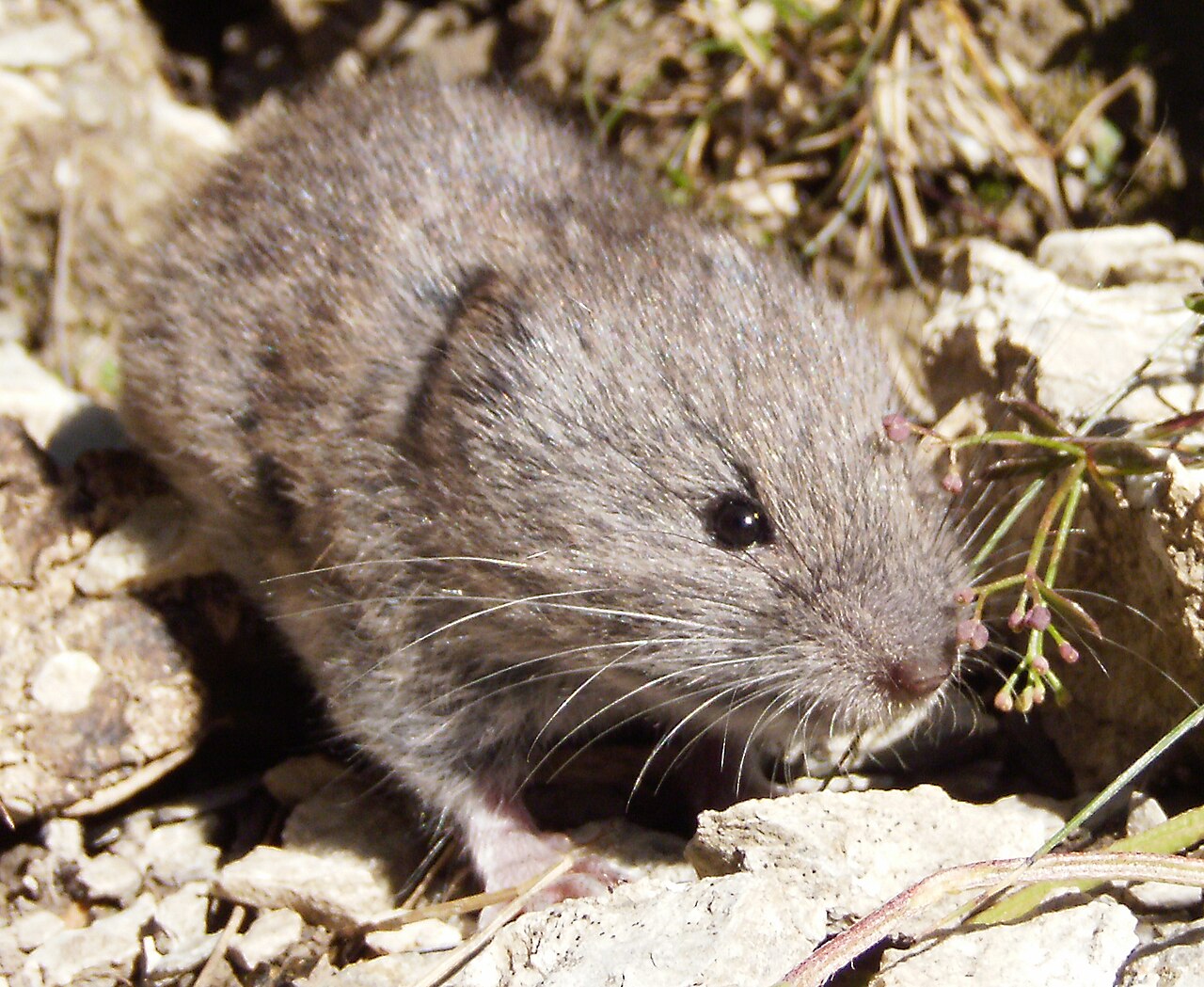
A medium-sized vole, head and body 10.7 to 14.3 cm, with a silvery to pale grey coat, paler on the flanks and dirty white on the belly, without the rufous or buff tone of other voles. Three characters of the head stand out: large dark eyes, clearly projecting rounded ears and very long white whiskers that reach past the shoulder and are used for feeling in dark crevices. The tail is long for a vole, roughly half the head-body length, and two-toned, dark above and white below, with a white tuft at the tip. The feet are pale to white. The animal is supple, climbs well and can squeeze through very narrow cracks.
Similar species
Above the treeline confusion is hardly possible in the Alps, the Pyrenees and most other ranges: no other vole there is so grey, so long-tailed and so large-eyed and large-eared, and no other lives there in rock crevices. Where the ranges meet at lower altitude, the Common Vole and the Common Pine Vole are possible confusion species; both are browner, shorter-tailed and smaller-eared. The Alpine Field Mouse (Apodemus alpicola) is a true mouse, with large ears, bulging eyes and a tail as long as the body. In the Dinaric mountains the Balkan Snow Vole (Dinaromys bogdanovi) lives in the same limestone rocks; it is clearly larger, heavier and greyer still, so that there size is decisive. Two relatives occur in the Caucasus, Chionomys gud and Chionomys roberti; both are darker and browner, and roberti lives in damp woodland rather than on rock. In southern Turkey and the Levant the species limits are uncertain: the name syriacus belongs to the same animal and is older than nivalis, but the name nivalis is retained until the nomenclature commission has ruled.
Habitat
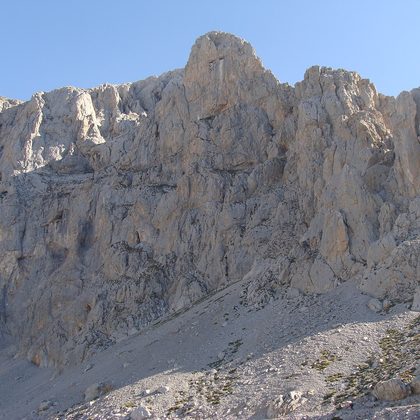
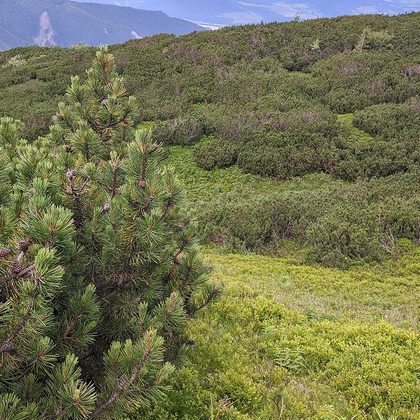
Almost exclusively rocky terrain: crevices and cavities in limestone and dolomite faces, boulder fields and screes, with alpine grassland, dwarf shrubs and open, sparse vegetation around them where the animals feed. It requires a crevice system with a stable temperature and humid air, which gives coolness in summer and shelter in winter. In the Alps and Pyrenees the species usually lives between 1000 and 3000 metres, with records well above that; in the French and Spanish karst and on some cool north-facing crags it occurs much lower, in northern Spain down to near sea level. Mountain pasture without stones is avoided, however rich the grass.
Where the animal is most at home, classified with EUNIS — the European standard for habitats.



Distribution
The high mountains of Europe and western Asia, in isolated sub-ranges that follow the mountain ranges. On the Iberian Peninsula the Cantabrian Mountains with the Picos de Europa, the Pyrenees, the Iberian System and the northern sierras, including karst areas and cool crags in the middle mountains; the Serra de Montesinho in northern Portugal marks the western limit of the range. Further the Massif Central and the French karst, the Alps, the Jura, the Apennines, the Tatras and Carpathians, the Dinaric Alps, the Pindus and the Greek mountains as far as Euboea, and eastward the Turkish ranges, the Caucasus, Lebanon, Syria, Iran and Turkmenistan. Of the thirteen described subspecies almost every one is tied to its own massif; the animals of the Sierra Nevada, the Apennines and the Tatras have been separated from one another for thousands of years. No snow vole of any kind occurs in the British Isles.
- Native
- dark = core range, pale = thinly spread
Way of life
Activity is polyphasic, with the main peak at night; across the year the species is also active at dusk, almost only at night in summer and also by day in winter. It is herbivorous: leaves, stems, flowers, seeds and roots of alpine herbs and grasses, supplemented with mosses and lichens, and it eats about 52 grams of fresh plant material a day, comparable to or more than its own body weight. It does not hibernate but spends the winter under the snow in the crevice system, on the store laid up in late summer. Females normally have two litters a season after twenty to twenty-two days' gestation, with two to six embryos and one to four young reared. Home ranges are small: males use on average about 330 square metres, females about 210; female ranges do not overlap, while that of a male includes several. Predators are Stoat, Red Fox, Kestrel, Alpine Chough, Eagle Owl and Tengmalm's Owl.
Where and when to look
A good place is a mountain hut at sunrise. Snow voles often live in the boulder fields and dry-stone walls around huts, are used to people there, and at first light, when the night's activity has not yet ended and the sun begins to warm the stones, they sit out on the warm rock. Sit quietly on the bench outside the hut and watch the crevices in the retaining wall and the edge of the scree; within half an hour a grey animal with a long tail usually runs from stone to stone. Beyond that every overhanging rock at the edge of a boulder field above the treeline is worth checking: look for dropping heaps and cut stems at the crevice entrance. The high squeak from a pile of stones is often the only sign of presence.
Conservation status
Least Concern (2016). The species is locally common in suitable terrain and the population appears stable; it also lives in areas with little farming or building. It is, however, a cold-adapted mountain species in isolated sub-populations: each massif holds its own population, isolated for thousands of years, which cannot move to another mountain. With climate warming the suitable crevice climate shifts upward, the area available on each massif shrinks, and the lowest sites and the lowest mountains are expected to be lost first. The outlook for the small isolated populations in the Spanish karst, the Apennines and the Greek mountains is therefore less favourable than the global category indicates. Locally the abandonment of grazing and the resulting scrub encroachment on alpine grassland also play a part.
Scientific name
Chionomys nivalis | (Martins, 1842)
Martins described the species in 1842 as Arvicola nivalis; because it was later moved to another genus, the author and year stand in brackets. Chionomys is Greek, from chiōn, 'snow', and mys, 'mouse': the vole of the snow line. nivalis is Latin for 'of the snow, snowy', from nix (nivis), 'snow', after its life high in the mountains. The specimen the first description was based on came from Switzerland, Bernese Oberland.