All species › Bats › Horseshoe bats › Geoffroy's horseshoe bat
Geoffroy's horseshoe bat | Rhinolophus clivosus
Rhinolophus clivosus | Rhinolophus clivosus
Geoffroy's Horseshoe Bat is a horseshoe bat of dry country, described in 1828 by Philipp Jakob Cretzschmar from the Red Sea coast of Arabia. Within the guide area the species reaches only the south-eastern margin: the Levant and northern Egypt. Taxonomically it is a complex: the Handbook of the Mammals of the World describes R. clivosus as paraphyletic with respect to the Greater Horseshoe Bat and probably composed of at least three species. The Mammal Diversity Database restricts the name to North Africa and the Arabian Peninsula.
No photograph of a living wild animal of this species with a suitable Creative Commons licence exists. Do you have one that meets the rules? Send it in.
Tracks
By day the species hangs singly or in groups of up to about 50 in caves, rock crevices, abandoned mine shafts, catacombs, stone huts and derelict buildings; in large colonies the bats hang in small clusters that do not touch one another. Prey is eaten after capture while hanging from a branch or other vegetation, so insect remains can collect beneath such spots. On a detector in the Levant the call is a long constant-frequency tone around 85 kHz with short frequency-modulated start and end sweeps.
Identification
Medium-sized to fairly large; for the whole complex the handbook gives a forearm of 42 to 59 mm and a weight of 10 to 25 g. The upperparts are highly variable: cream, grey, brownish grey, greyish fawn or reddish brown, usually with dark hair tips; the underparts are beige, pale brown or grey. Orange-rufous individuals occur. The ears are short (30 to 47 per cent of the forearm) and lack a tragus. The nose-leaf: a hastate lancet with a rounded tip; a rounded, raised connecting process, smoothly curved or slightly angular, reaching slightly to clearly higher than the tip of the sella; a narrow sella with concave sides and a broad, rounded top; a horseshoe of 6.6 to 9.6 mm with (sometimes rudimentary) lateral leaflets. Wings and tail membrane are light to dark grey. Echolocation is FM/CF/FM; in the guide area the constant frequency lies around 85 kHz: 85.2 kHz in Israel and 83.5 to 85 kHz in Jordan, with mean call durations of 54.5 and 48 milliseconds. In Algeria 92.7 kHz has been measured.
Similar species
The Greater Horseshoe Bat (Rhinolophus ferrumequinum) is the closest relative and also occurs in the Levant. It is larger (forearm 51–61 mm) and calls lower, around 82 kHz; the difference in call frequency is small, so a detector gives only a pointer. Its nose-leaf is of the same type, with a rounded connecting process. Blasius's Horseshoe Bat (R. blasii) is smaller (forearm 41–51 mm), calls around 94 kHz and has a connecting process shaped as a high, narrow, pointed horn. The Mediterranean and Mehely's Horseshoe Bats (R. euryale, R. mehelyi) call above 100 kHz, the Lesser Horseshoe Bat (R. hipposideros) around 110 kHz. The Trident Leaf-nosed Bat (Asellia tridens), which can roost in the same caves in Egypt and the Levant, belongs to another family: its nose-leaf lacks the lancet and sella of the horseshoe bats and carries three points at the top.
Habitat
Mostly dry and open country: wooded savanna, Mediterranean scrub, dry savanna, open grassland, semi-desert and desert, from sea level to about 2300 m. In the Levant the species lives mainly in arid Mediterranean scrub, in Arabia in dry scrub, steppe and savanna; in the Sahara it is largely confined to mountain massifs. Despite the aridity it is usually found near water, near dense vegetation to forage in and near caves to roost in. Wild animals drink regularly.
Where the animal is most at home, classified with EUNIS — the European standard for habitats.
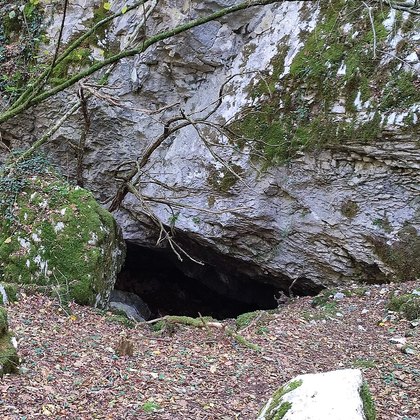
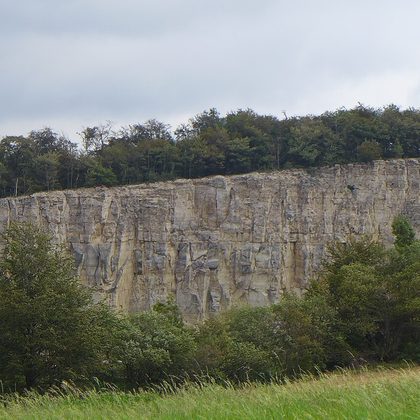
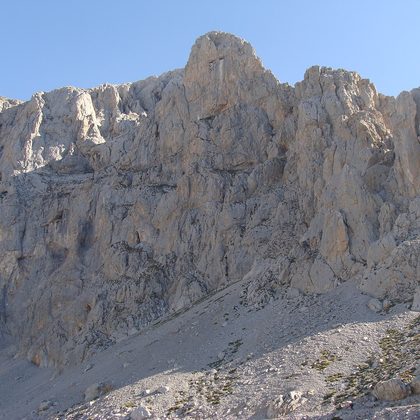
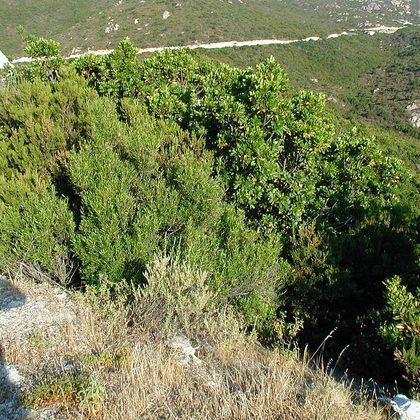


Distribution
In the current, restricted sense of the Mammal Diversity Database: Algeria, Libya, Egypt, Israel, Palestine, Jordan, Saudi Arabia, Yemen and Oman. The handbook also includes populations from the Horn of Africa to South Africa, in ten subspecies. Within the guide area live the form brachygnathus (Israel, Egypt and northern Sudan) and, in south-western Jordan, the nominate form. Egyptian animals cluster genetically with the Greater Horseshoe Bat; populations from Cyrenaica in Libya have recently been treated as a separate species, R. horaceki.
- Native
- dark = core range, pale = thinly spread
Way of life
Nocturnal; the bats forage throughout the night in slow flight, from a perch and probably also by gleaning prey from vegetation and the ground, often beneath trees. The diet consists mainly of moths and beetles: in Algeria on average 62.6 per cent moths and 29.4 per cent beetles by volume, in Jordan moths, beetles and midges. By day the bats can enter torpor. Little is known about breeding within the guide area; in southern Africa the species breeds once a year, with sperm storage, a gestation of 3.5 months, lactation of about 2 months and maturity at about 18 months. The handbook records no hibernation for the northern part of the range; how the bats pass the cool months there has not been documented.
Where and when to look
Within the guide area the best chance is in Israel and Jordan, in rocky wadis with caves and water. A detector that shows the constant frequency separates the species from the medium-sized and small horseshoe bats; against the Greater Horseshoe Bat the frequency difference is small and only size and nose-leaf shape help. Caves with colonies are sensitive to disturbance.
Conservation status
Least Concern globally (LC, 2016). The species is fairly common over much of its range but may be declining in the Palaearctic part. There are no overarching threats; locally, habitat destruction, roost disturbance and indirect poisoning by insecticides and other pesticides may play a part. In Jordan the species is protected by law. Because the taxonomy of the complex is unresolved, the assessment may change after a split.
Scientific name
Rhinolophus clivosus | Cretzschmar, 1828
Cretzschmar described the species in 1828 and placed it straight away in the genus where it still stands. Rhinolophus is Greek, from rhis, genitive rhinos, 'nose', and lophos, 'crest', after the nose-leaf. clivosus is Latin for 'hilly, steep', from clivus, 'slope'; Cretzschmar does not say what he meant by it, presumably the hill country of the type locality on the Red Sea. The specimen the first description was based on came from Saudi Arabia.