All species › Bats › Vesper bats › Geoffroy’s bat
Geoffroy’s bat | Myotis emarginatus
Ingekorven vleermuis | Murciélago Ratonero Pardo
Geoffroy's bat is a medium-sized Myotis with rusty brown, woolly fur and a notch in the outer margin of the ear, which gives the species its Dutch and Latin names. It lives in Europe, North Africa and south-western Asia in structurally rich, semi-open landscapes, feeds mainly on flies and spiders and often searches for them in and around cattle sheds. Maternity colonies hang in dense clusters in attics and caves, often together with horseshoe bats.

Tracks
Maternity colonies hang in dense, free-hanging clusters in the attics of churches and houses, in cattle sheds and other buildings, and in the south in caves, usually below 900 m; often together with horseshoe bats. Beneath such a cluster droppings lie on the floor. In cattle sheds the bats can be seen in the evening flying between the beams and along the walls. Hibernation takes place in caves, mines and other underground spaces, often free-hanging and, in males, usually alone; small groups sometimes hang among other species. Maternity roosts are often abandoned in August.
Identification
A medium-sized Myotis: forearm 36 to 45 mm, weight 5.5 to 15.5 g. The fur is long and woolly; the back is greyish brown to bright rusty brown, and the dorsal hairs are tricoloured: grey at the base, straw yellow in the middle and tipped with the back colour. The underside is slightly to much paler, yellowish grey to pale rufous. Juveniles are darker and greyer. The muzzle is haired and reddish to medium brown. The ears are greyish brown and fairly long, with a conspicuous notch in the outer margin at about two-thirds from the base; the tragus is lancet-shaped with a blunt tip and reaches just over half the ear height. The membranes are uniformly greyish brown, the wing attaches at the base of the outer toe, the hind feet are fairly short and the calcar reaches about halfway to the tail tip. Echolocation consists of very short (1 to 3 ms), strongly modulated calls starting at about 140 kHz and ending around 38 kHz, rarely below 30 kHz.
Similar species
Colour is the first character: no other Myotis species in the guide area has such rusty brown, woolly fur. Natterer's bat (M. nattereri) and the species split from it have a greyish brown back, a white underside, a pink face and a fringe of stiff hairs on the tail membrane; their ear has no deep notch. The whiskered and Brandt's bats (M. mystacinus, M. brandtii) are smaller and have a dark face and dark ears. In caves and attics Geoffroy's bat often hangs among horseshoe bats (Rhinolophus), which have a noseleaf, no tragus, and hang wrapped in their wings at rest. On a bat detector the species cannot be reliably separated from other Myotis species.
Habitat
Structurally rich, semi-open landscape: woodland with a preference for deciduous trees, scrub, riparian woodland and low vegetation, as well as orchards, parks and farmyards with cattle sheds, from sea level to 1800 m. The species favours sloping ground rather than open plains and always occurs near underground roosting sites. Hibernation sites are in caves and mines with a fairly constant temperature, often up to 13 °C.
Where the animal is most at home, classified with EUNIS — the European standard for habitats.


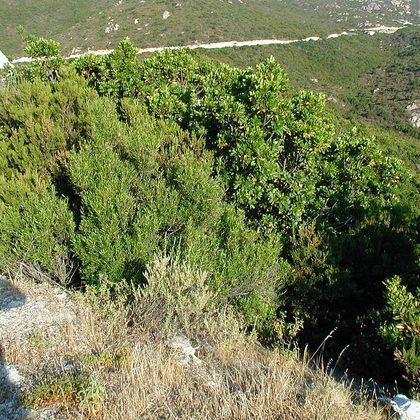
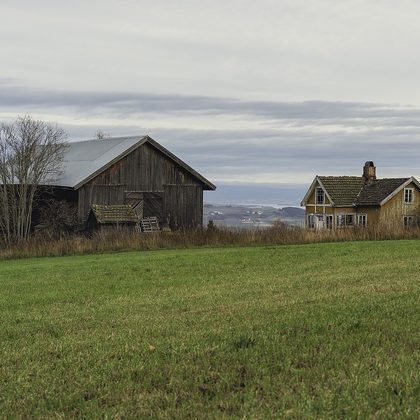

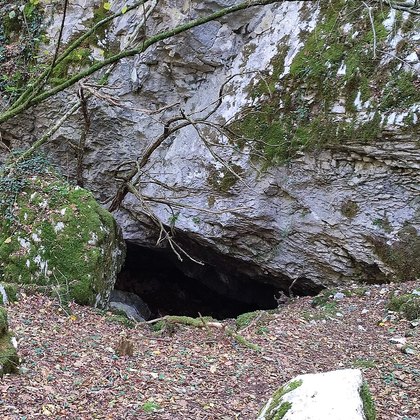
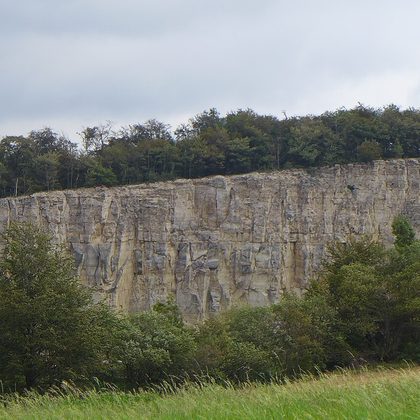
Distribution
Europe and North Africa, including most of the larger Mediterranean islands, east to the Caucasus and the Middle East (M. e. emarginatus); in the Asian part of the range east of the Caucasus the form M. e. desertorum. In Europe the range extends north into the Netherlands, Belgium and central Germany; according to available data the species is locally spreading into new areas.
- Native
- dark = core range, pale = thinly spread
Way of life
Geoffroy's bat takes most of its prey from surfaces (gleaning), flying low over the ground and along vegetation. The diet consists mainly of flies and spiders, supplemented by beetles and hymenopterans; the species forages in rich scrub and grassland and around cattle sheds and sheep pens, where many flies gather at livestock dung. The bats emerge 15 to 20 minutes after sunset and fly up to 12.5 km to foraging areas of 50 to 70 ha, at speeds of up to 55 km/h. Maternity colonies usually number 20 to 500 females and a few males. The young, one per female, rarely twins, are born between early June and mid-July; lactation lasts 25 to 35 days. Females usually do not mate in their first year. In late summer groups, mainly of males, swarm at caves and mines. Hibernation is long, lasting until mid-April or later. The longest known movement is 105 km, but few hibernation sites are known.
Where and when to look
Geoffroy's bat is best seen at emergence from a known maternity colony, or in the evening in a cattle shed where the bats hunt between the beams. The rusty colour of a hanging bat in a roost can be seen with a weak lamp; the bat is not touched and the lamp is not kept on the cluster for long. Maternity roosts are not entered from May to August, hibernation sites not in winter.
Conservation status
Least Concern (LC, 2016). Numbers declined in previous decades, but according to available data the species has recovered and is locally spreading. Because colonies hang in caves, the species is sensitive to disturbance, especially from recreation, and more recently from fires and vandalism; it is also hunted for traditional medicine. It is listed in Annexes II and IV of the Habitats Directive, which requires the designation of Special Areas of Conservation for it, and is covered by the Bern Convention and the EUROBATS Agreement.
Scientific name
Myotis emarginatus | (É. Geoffroy Saint-Hilaire, 1806)
É. Geoffroy Saint-Hilaire described the species in 1806 as Vespertilio emarginatus; because it was later moved to another genus, the author and year stand in brackets. Myotis is Greek, from mys, genitive myos, 'mouse', and ous, genitive ōtos, 'ear': 'mouse-ear'. emarginatus is Latin for 'notched at the edge', from e-, 'out', and margo, 'margin', after the marked notch in the outer edge of the ear. The specimen the first description was based on came from France, Ardennes.