All species › Rodents › Voles and hamsters › Gerbe's vole
Gerbe's vole | Microtus pyrenaicus
Pyrenese woelmuis | Microtus gerbei
Gerbe's Vole is the mountain species among the three Iberian burrowing voles: it inhabits the damp, cool zone between 800 and just over 2,000 m in the Pyrenees and the Cantabrian Mountains, while the two related species inhabit the lowlands and the dry south. Of the three it is the least subterranean — in Spain it lives largely above ground, in France it does not — and the only one found in groups of five to sixteen animals that show little aggression towards each other.
No photograph of a living wild animal of this species with a suitable Creative Commons licence exists. Do you have one that meets the rules? Send it in.
Tracks
It digs less deeply and less exclusively than the two related species, and this shows in the signs. There are small, low heaps of fine soil with plugged entrances, but fewer and less clearly in rows than with the Lusitanian and Mediterranean Pine Voles, and in addition — especially in the Spanish populations — surface runways 3 to 4 cm wide through the grass and herb layer of wood edges and subalpine meadows, along stream banks and beside stone walls. This combination of tunnels and surface runways distinguishes it from the other two Iberian burrowers. A molehill is much larger and taller, conical, built of clods and thrown up from a vertical shaft; a water vole heap is coarser and has the tunnel opening visible at the side. A characteristic feeding sign is the store: it collects bulbs of geophytes, especially autumn crocus and pignut, averaging about one gram each, in chambers along the tunnel. There are also bitten-off leaves and stems of dicotyledons, peeled roots at the foot of young trees and, in winter, gnawed bark. The droppings are 4 to 6 mm, cylindrical with blunt ends, and lie in latrines along the runway or in the tunnel. Pellets of Barn, Tawny and Short-eared Owl are the most reliable source.
Identification
A medium-sized vole of the burrowing type: rounded head, blunt muzzle, small eyes and short ears barely rising above the fur, with a tail of 2.2 to 3.6 cm, roughly a quarter to a third of head-body length. The coat is buff-brown to dark brown above and grey below. Females have four nipples in two inguinal pairs. Unlike in its closest relatives the supraorbital ridges on the skull are fairly strongly developed and remain separate; this character is usable with a skull or pellet find, not in the field. For an Iberian burrowing vole it is large: it weighs up to 32 g, whereas the Lusitanian Pine Vole stays below 20 g.
Similar species
In the field the species cannot be separated from the two related burrowers. The Lusitanian Pine Vole (Microtus lusitanicus) and the Mediterranean Pine Vole (M. duodecimcostatus) look the same; all three have the small eye, the ear sunk in the fur and the short tail of a burrower. Locality and altitude give indications: this species inhabits the mountain zone from 800 to just over 2,000 m with more than 1,000 mm of rainfall and a mean annual temperature below 15 to 16 degrees, and avoids steep slopes; the Lusitanian Pine Vole lives lower and further west on acid soils, the Mediterranean lower and further south on warm, dry limestone. In the hand there are two weak indications: at up to 32 g this is the heaviest of the three, and it is the least specialised burrower. Only the skull gives certainty. The distinction from the surface-living species can be made in the field: Common Vole, Field Vole, Microtus lavernedii and Microtus rozianus have clearly larger eyes, visible ears and a longer tail and use runways in the grass; Cabrera's Vole is larger and shaggier and tied to damp, unmown rank vegetation; the Bank Vole has a red back, large eyes and a half-length tail; and the European Snow Vole in the same mountains is pale grey, large-eared and long-tailed and lives among rocks.
Habitat
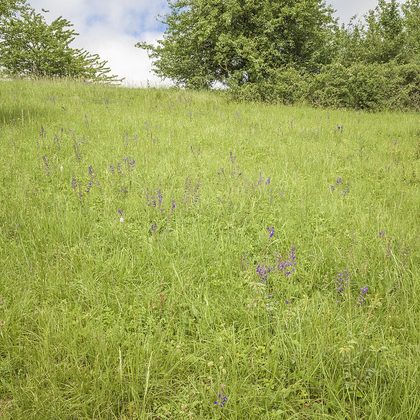
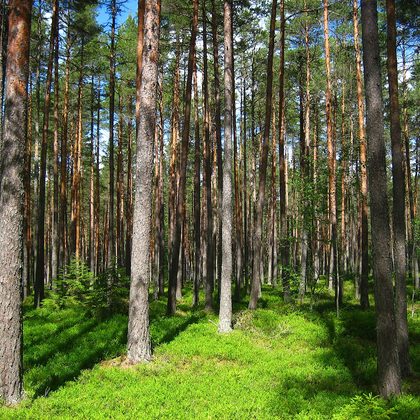
The humid mountain zone: wood edges and clearings in forest of mountain pine, birch and beech, margins along subalpine meadows, stream banks and grassland along old stone walls and terrace edges. It needs deep soil with a dense herb layer and high rainfall, and does not occur in the bare rock zone or in the dry, warm lowlands. The altitude limits are sharp for a vole: almost all sites lie between 800 and 2,035 m.
Where the animal is most at home, classified with EUNIS — the European standard for habitats.




Distribution
The Pyrenees, the Cantabrian Mountains and the adjoining part of France. In Spain a narrow band running west from the eastern Pyrenees into Cantabria; it is one of the smallest ranges of any Spanish mammal. In Andorra it occurs throughout. In France the range is much larger than the name suggests: it occupies the area west of the Massif Central and south of the Loire, and about half of the more than three thousand georeferenced records come from France. The total range covers a little over 200,000 square kilometres. It does not occur in Portugal or elsewhere in Europe.
- Native
- dark = core range, pale = thinly spread
Way of life
Active mainly at night and at dusk, in short bouts. It eats mainly leaves and stems of dicotyledonous herbs and also stores bulbs of geophytes, notably autumn crocus and pignut. It lives in groups of five to sixteen animals showing little aggression towards each other, in a shared tunnel system. Breeding continues throughout the year, with a clear peak from April to November; one to four embryos per litter, usually two or three. It does not enter winter torpor and remains active beneath the snow; in the Pyrenees, where snow lies for months, this period covers a large part of the year.
Where and when to look
In June or July visit a subalpine meadow or wood edge in the Aragonese or French Pyrenees, in Andorra or in the Picos de Europa, and search along old stone walls and stream banks for the combination that points to this species: swept runways in the grass and small soil heaps with plugged entrances. Carefully open a tunnel with a knife and check whether autumn crocus corms lie in a side chamber. Because it moves above ground a great deal in Spain, this is the Iberian burrower most often seen; sit ten metres away and watch for grass moving without wind. Pellets beneath a Barn Owl roost in a mountain hamlet provide the most reliable data.
Conservation status
Least Concern (LC, 2024), assessed under the name Microtus gerbii. The French part of the range is large and continuous; the Spanish part is narrow and fragmented and therefore more vulnerable than the category indicates. Threats come from the decline of traditional mountain farming: the loss of hay meadows and terraces, the abandonment of grazing after which meadows become overgrown, and the construction of ski areas and roads in the altitude zone it occupies. Locally it is controlled in orchards. Because of its sharp limits of rainfall and temperature, climate change is expected to shift its habitat to higher altitudes, where the available area is smaller.
Scientific name
Microtus pyrenaicus | (de Sélys-Longchamps, 1847) (GBIF: Microtus gerbei)
De Sélys-Longchamps described the species in 1847 as Arvicola pyrenaicus; because it was later moved to another genus, the author and year stand in brackets. Microtus is Greek, from mikros, 'small', and ous, genitive ōtos, 'ear', after the small ears hidden in the fur. pyrenaicus means 'of the Pyrenees', from where de Sélys-Longchamps described the animal. The specimen the first description was based on came from France, Pyrenees.