All species › Rodents › Blind mole-rats › Greater Blind Mole Rat
Greater Blind Mole Rat | Spalax microphthalmus
Oostelijke blinde muis | Spalax microphthalmus
The Greater Blind Mole Rat is one of the largest blind mole-rats in Europe and the type species of the genus Spalax; only the Giant Blind Mole-rat (S. giganteus) of the North Caucasus and Kalmykia grows larger, to thirty-five centimetres and a kilogram. It reaches well over thirty centimetres and can weigh eight hundred grams, and spends its whole life underground in the black loess soils of the Pontic steppe between the Dnieper and the Volga. Güldenstädt described the species in 1770 from animals in the steppe near Novokhopyorsk in the Russian government of Voronezh; every other species of the genus has at some time been treated as a subspecies or synonym of it. It is a common species that is locally controlled as an agricultural pest within its range.
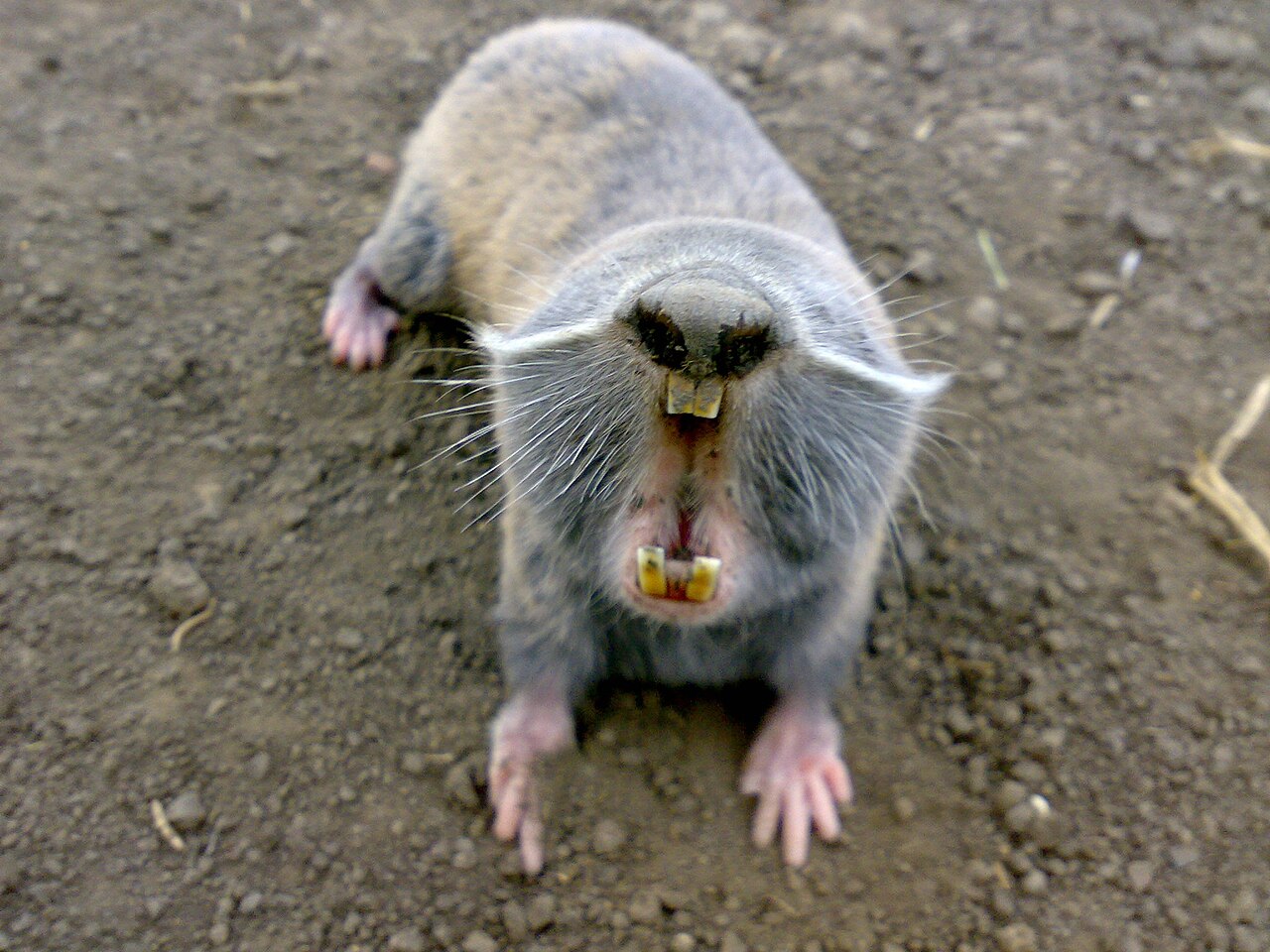
Tracks
The burrow systems of this species are the most extensive of the European blind mole-rats. A system measures a hundred to four hundred and fifty metres or more across and is almost linear, has one or two hubs with radiating feeding tunnels, or is irregular. Feeding tunnels lie at 10 to 25 cm, the deep chambers at 120 to 320 cm, and the two levels are joined by two to four vertical shafts. There are one or two nest chambers lined with grass and leaves, usually four to nine store chambers and several latrines, which are sealed once full. The mounds vary in shape and size: 20 to 240 cm across, averaging half a metre, set one to two metres apart; this dense pattern is characteristic of the genus. No open tunnel entrance is visible: the tunnel is plugged from within. One animal moves 200 to 300 litres of soil a day. Store chambers have been found holding 10 to 14 kg of collected root material. Other signs are gnawed roots of dandelion, cow parsnip and chicory, browsed tree seedlings, and patches at the surface where a plant has been pulled down from below. The digging is audible: beside a fresh mound the soil can be heard being pushed up from within.
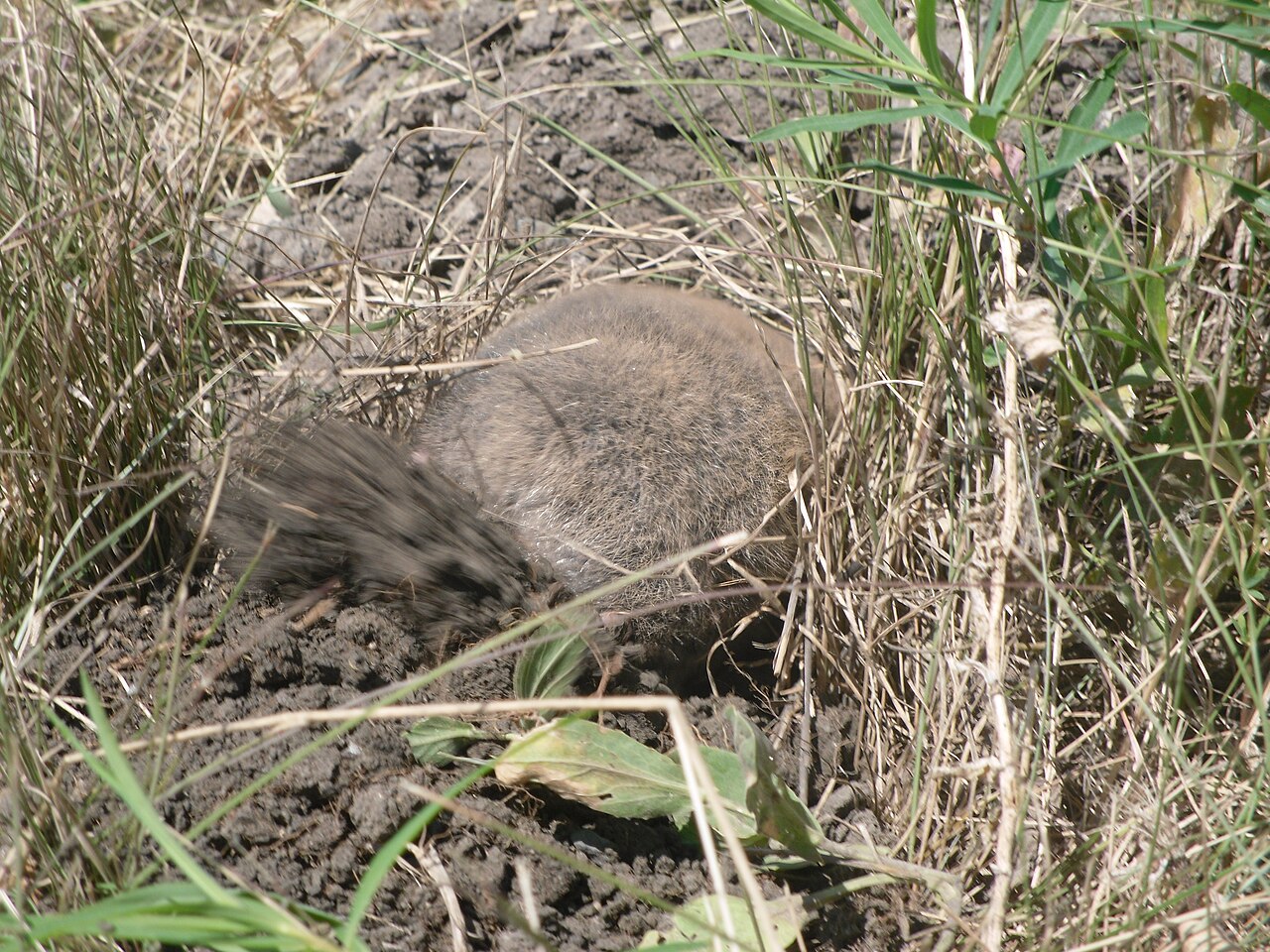
Head close-up
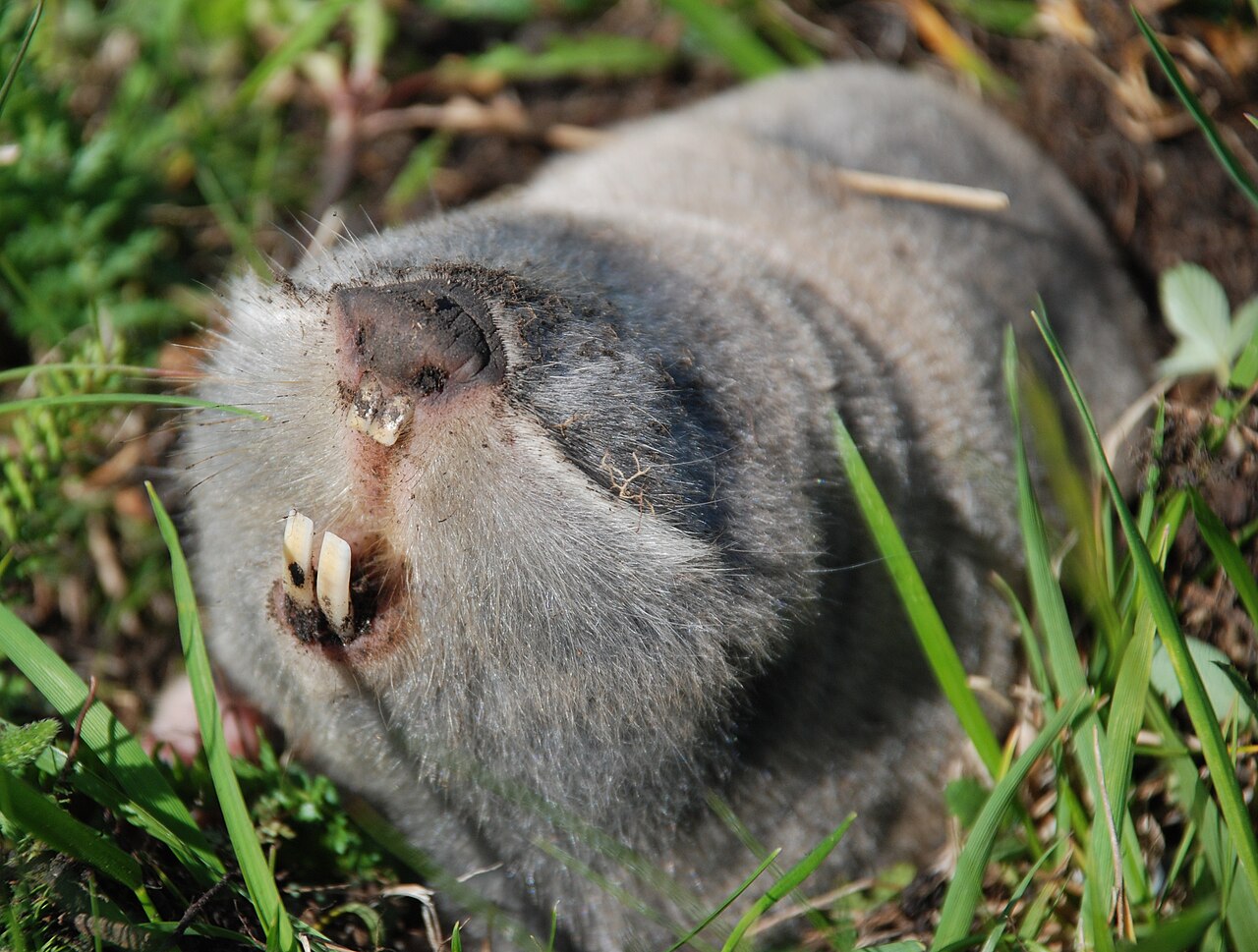
Identification
A large, neckless, cylindrical digger of 19 to 31.5 cm and 120 to 818 g; males are larger than females. The fur is straw grey-brown with a lighter, greyer head and a straw-coloured belly; the hair bases are mouse grey, so that an animal with worn hair tips appears entirely grey. A small yellowish-white patch often marks the forehead, and some animals have a white longitudinal stripe over the head. From the nose pad a fringe of yellowish hair runs outward and back towards the ears. The head is broad, flat and wedge-shaped, the forequarters heavy, and otherwise the build is as in all blind mole-rats: no ear pinnae, no visible eyes, no external tail. None of the sources consulted gives a tail measurement. The yellow to orange incisors protrude in front of the lips. Young animals are much greyer than adults; the dense winter coat is worn from September to May or June. Females have three pairs of nipples. The chromosome number is 2n = 60 or 62.
Similar species
Within the genus the species cannot be separated on external characters. All Spalax species have 2n = 60 or 62, so a chromosome preparation, which usually settles identification among the lesser blind mole-rats, does not help here; the species are separated on skull characters and mitochondrial DNA. In the field the locality is decisive. In the steppe between the Dnieper and the Volga this is the common species; on the right bank of the Dnieper the range of S. zemni begins, on the left bank near the mouth that of S. arenarius, and to the east and south-east those of S. uralensis and S. giganteus. The genus can be determined in the field: a Spalax is a bulky animal of twenty to well over thirty centimetres weighing four to eight hundred grams, whereas a Nannospalax weighs about as much as a large rat and seldom reaches half a kilo. The difference is reflected in the names of the two genera — the greater and the lesser blind mole-rats — and was confirmed by DNA in 2013 by Németh and colleagues. The mounds show the difference as well: this species sets its mounds one to two metres apart, so that an occupied system forms a densely churned field, whereas a Nannospalax sets its mounds twenty to thirty metres apart in a thin, meandering line. The pattern can be seen across a meadow from a distance. Other species to consider are the mole, half the size, with shovel-shaped forefeet and a short tail, and the water vole, with ears, eyes and a long tail.
Habitat
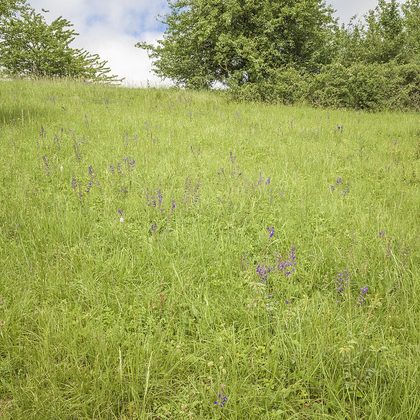
Level steppe and forest steppe, preferably on black earth: the species avoids loam and sand and seeks deep, nutrient-rich, free-draining soil. It is also common in farmland: in arable fields, melon fields, gardens, orchards, plantations and even forest. This broad habitat use is regarded as the main reason for its favourable status. It avoids high groundwater and heavy, wet clay. In the north of the range, where forest steppe gives way to forest, the populations are fragmented.
Where the animal is most at home, classified with EUNIS — the European standard for habitats.




Distribution
The steppe and forest steppe between the Dnieper and the Volga, from roughly Mordovia in the north south into Ciscaucasia. Within the guide area this means eastern Ukraine — Kharkiv, Luhansk, Poltava, Sumy — and south-western Russia, with the core areas in the Kursk, Belgorod, Voronezh and Rostov oblasts. The type locality is the steppe near Novokhopyorsk in Voronezh oblast. To the east the range crosses the Volga, beyond the guide area. Two subspecies are recognised: the nominate form in eastern Ukraine and south-western Russia, and typhlus in Ciscaucasia immediately east of the Sea of Azov; some authors assign the latter rather to S. giganteus.
- Native
- dark = core range, pale = thinly spread
Way of life
Active all year, less so in winter, when activity is concentrated in the deeper levels; digging peaks in spring, when the store chambers are empty. It neither hibernates nor enters winter torpor. It eats dandelion, cow parsnip and chicory and seedlings of oak, mulberry and acacia, with more leaves and shoots in spring and mainly roots and bulbs later in the year; the winter store weighs 10 to 14 kg. It is solitary, and fights between conspecifics are serious: the animals bite each other in the face and fight until one retreats or dies. Young animals leave the mother's system and dig their own alongside, or travel above ground for up to several hundred metres; adults, males especially in the breeding season, also sometimes move overland. An animal found above ground starts digging immediately. Density is three to ten animals per hectare, twenty under favourable conditions; large fluctuations do not occur. There is one litter a year of two to five young, born from late February to early May; females first breed in their second year. Predators are Eurasian Eagle-Owl, Eastern Imperial Eagle, Long-legged Buzzard, Common Buzzard, Caspian Gull and mustelids.
Where and when to look
Visit a steppe reserve in eastern Ukraine or south-western Russia in April or May, while the grass is still short — for example Striltsivskyi Step, the Khomutovskyi steppe or the Streletskaya steppe near Kursk — and scan the ground: an occupied system is recognisable by mounds one to two metres apart. Find the outermost mound of the group, usually the newest, sit a few metres away and wait: the soil being pushed up is audible, and the head sometimes appears briefly. This species is also regularly seen above ground: dispersing young cross open ground and roads, and most photographs of the species have been taken this way.
Conservation status
Least Concern (LC, 2016). The species has a large range, is common within it, occurs in a number of protected steppe areas and persists in farmland. In the north of the range, where populations are fragmented, it is under pressure from agriculture. Because it can cause damage in arable fields and orchards, it is locally poisoned. Blind mole-rats are regarded as ecosystem engineers: they turn over the soil, change its composition and with it the plant community, and their abandoned tunnels are used by other small mammals and invertebrates. The assessment dates from 2016; the effects of the war in eastern Ukraine since 2022 on the western populations have not yet been studied.
Scientific name
Spalax microphthalmus | von Güldenstädt, 1770
Von Güldenstädt described the species in 1770 and placed it straight away in the genus where it still stands. Spalax is Greek spalax, also aspalax, 'mole'. microphthalmus is Greek for 'small-eyed', from mikros, 'small', and ophthalmos, 'eye'; in these blind mole-rats the eyes lie buried beneath the skin. The specimen the first description was based on came from Russia, Voronezhskaya.