All species › Carnivores › True seals › Grey seal
Grey seal | Halichoerus grypus
Grijze zeehond | Foca gris
The Grey Seal lives on both sides of the North Atlantic and in the Baltic, and is the largest wild carnivore on the North Sea coasts; bulls weigh up to about 310 kg. After centuries of persecution the species had disappeared from the southern North Sea by around 1900. Since the 1980s it has become re-established there and gives birth in midwinter on sandbanks and beaches.

Tracks
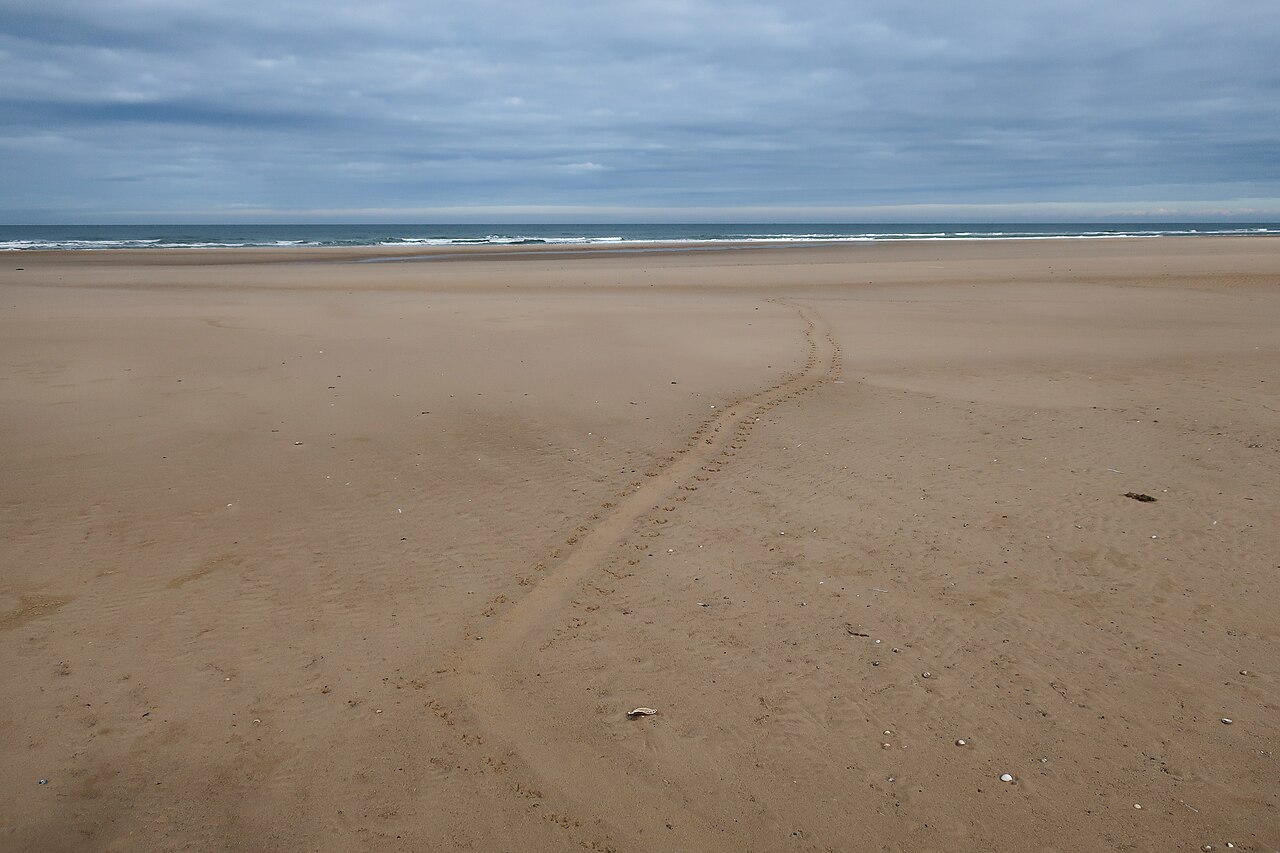
A seal leaves no footprints but a drag trail: the animal pulls itself forward on the fore flippers and drags the body behind. The result is a broad, smooth groove 30 to 50 cm wide, straight or in gentle curves from the tide line up the beach, with short slanting scrape marks of the fore flippers at regular intervals on either side. In soft sand the groove is deep, on hard flats only a polished band. The direction of travel is shown by the ridge of sand at the end. The species cannot be determined from the trail alone, because Grey and Harbour Seals make the same trail; a groove wider than half a metre is almost certainly from a Grey Seal bull. There is also the haul-out: a scoured patch on the highest part of a sandbank or on a rock platform, far from access points, often surrounded by tufts of shed hair. In March and April moulted hair lies there: tufts of grey hair and sometimes whole pieces of coat among the shells in the strandline. During the pupping season a colony is recognised mainly by sound: the wailing calls of the white pups can be heard further away than the animals can be seen. Droppings are rarely found and can be recognised by the fish bones and otoliths in them.
Head close-up

The young

Identification
Heavily built and high-shouldered when hauled out. The head is long and straight, without a step between muzzle and forehead (the 'Roman nose'). The nostrils are nearly parallel and do not meet below; a clear gap remains between them. The coat is grey with irregular dark blotches, which in the male merge into an almost black back with pale patches; the female is pale with dark blotches. An adult bull is a third longer than a cow and has a heavy, wrinkled neck, a scarred chest and a broad, arched muzzle. The fore flipper has five heavy dark claws. A wet animal is almost black, a dry one pale grey to buff. On a beach the Grey Seal lies flat, head and hind flippers low; the arched posture of the Harbour Seal occurs rarely and less markedly.
Similar species
The distinction rests on the head, which can be judged at two hundred metres with a telescope. The Harbour Seal has a short, dished muzzle with a clear step in front of the eyes, and its nostrils form a V: they almost meet below and diverge upwards. The Grey Seal has a long, straight, conical muzzle and parallel nostrils. The Harbour Seal is also smaller and more finely marked, with round spots rather than irregular blotches, and lies on the bank with head and hind flippers raised. In the water the Grey Seal surfaces high and upright, showing the whole forehead. In the north its range overlaps with that of the Bearded Seal, more coarsely built, with a small head and a dense mass of white curled whiskers, and with that of the Hooded Seal, blotched black on silver-grey, the bull with a nasal sac. A dead stranded animal can be identified by the teeth: in the Grey Seal the cheek teeth stand in a straight row, in the Harbour Seal obliquely.
Habitat
Open sea over the shallow sandy bottoms of the continental shelf; ashore, places that stay dry at high water and are little disturbed: high sandbanks, saltmarsh edges, shingle beaches, and in the north and west mainly rocky islands, boulder shores and the foot of cliffs. The species dives to a few tens of metres, hunts sandeels, flatfish and gadoids and sometimes seals of other species, and forages up to a hundred kilometres offshore. Unlike the Harbour Seal it prefers to pup where high tides do not reach: at the dune foot, above the strandline or on rock platforms.
Where the animal is most at home, classified with EUNIS — the European standard for habitats.


Distribution
Around the North Atlantic, with a western population off Canada and New England and an eastern one from the Barents Sea to Brittany, plus a separate population in the Baltic. Britain and Ireland hold about two in five of the world's Grey Seals; large colonies are on the Farne Islands, the Isle of May, North Rona, Orkney and the Monach Isles, and in winter large numbers gather at Donna Nook, Blakeney Point and Horsey on the Lincolnshire and Norfolk coast. The species is common along the coasts of Iceland, Norway, the Faroes and the Baltic, and becomes scarcer southwards through Brittany. In the Netherlands it was exterminated around 1900 and became re-established from the 1980s; the 2024 count found about 7,800 in the Dutch Wadden Sea, with a growing group in the Delta near the Brouwersdam and on the Vlakte van de Raan. Along the Belgian coast it is a regular visitor, with a fixed haul-out at the Bay of Heist. The species does not breed in the Iberian Peninsula; there are isolated records on the Cantabrian coast, in Galicia and exceptionally in Portugal, mostly of young animals from Brittany or the British Isles.
- Native
- dark = core range, pale = thinly spread
Way of life
By day at the haul-out, mostly asleep; hunting takes place on long trips at sea, by day and night, with dives of five to ten minutes. Outside the pupping season the species is not very social and the animals lie in loose groups without rank. Pups are born in the winter half of the year: September to December on the Atlantic coasts, November to January in the southern North Sea (including the Wadden Sea and the Delta), and only in March in the Baltic. The pup is born in a thick, creamy-white lanugo coat, weighs fifteen kilos and triples that weight in three weeks on milk that is about half fat; it then moults, is abandoned by its mother and must learn to fish on its own. During those weeks the bulls defend a part of the beach with the cows lying on it, roaring and biting, and lose up to a quarter of their weight. After the pupping season comes the moult in March and April, for which the animals stay ashore for days. Cows live to thirty-five or more, bulls seldom beyond twenty.
Where and when to look
During the pupping season the white pups lie high on banks and beaches. In the Wadden Sea and at the Brouwersdam they can be followed with a telescope in November and December from the sea wall or on a tidal-flat walk or boat trip. On the English east coast, at Donna Nook, Horsey and Blakeney Point, hundreds of pups lie within twenty metres of a roped path in November and December; on the Farne Islands and in Orkney boat trips in late summer approach resting animals on the rocks. Stay on the path or on shore: a disturbed colony goes to sea, and pups driven into the water can drown or lose their mothers. At low water you can scan the banks from the ferry to Ameland, Schiermonnikoog or Vlieland; Grey Seals usually lie on the outermost, highest banks, Harbour Seals closer to the channel. On an empty beach after a storm, a drag trail followed back to the tide line shows where the animal re-entered the sea.
Conservation status
Least Concern (LC, 2016). European populations are increasing. The Atlantic population is estimated at a few hundred thousand animals and is still growing; the Baltic population has recovered from a low of a few thousand animals in the 1970s, when PCBs made the cows infertile. The species has been protected in Britain since 1914 and in the Netherlands since 1954. Current threats are entanglement in fishing nets and lost gear, disturbance of haul-outs by pleasure craft and drones, and conflicts with fisheries, which accuse the species of taking fish from nets. In the Baltic, Sweden and Finland again allow limited hunting.
Scientific name
Halichoerus grypus | (O. Fabricius, 1791)
O. Fabricius described the species in 1791 as Phoca Grypus; because it was later moved to another genus, the author and year stand in brackets. Halichoerus is Greek, from hals, 'sea, salt', and choiros, 'pig': the sea hog. grypus is Greek grypos, 'hook-nosed, curved', after the high arched profile of the muzzle. The specimen the first description was based on came from Denmark, Amager.