All species › Rodents › Mice and rats › Herb Field Mouse
Herb Field Mouse | Apodemus uralensis
Kleine bosmuis | Ratón De Campo Enano
The Herb Field Mouse (Apodemus uralensis) is the smallest field mouse in Europe: an adult stays at the size of a half-grown Wood Mouse. In central Europe the species is still often listed under the old name Apodemus microps (pygmy field mouse). It lives in open country and along edges, not in closed woodland, and ranges from central Europe into western China. In the field it can be separated from the Wood Mouse only on size and body measurements.

Tracks
There are no signs specific to the species; this is one reason it is poorly known. Droppings, bounding trails and opened seeds and stones are those of any Apodemus: dark spindle-shaped droppings three to five millimetres long, four prints in a group with the five-toed hind feet leading, and a round hole with a smooth rim and incisor grooves beside it. The landscape gives an indication: if such signs lie not in woodland but in an arable margin, a dry verge, a steppe-like grassland or a rank wood edge in central or eastern Europe, the Herb Field Mouse is a candidate alongside the Wood Mouse. A second source is owl pellets: in Barn and Short-eared Owl pellets the two species can be separated on skull measurements, and most of what is known about this species was gathered this way. Density is low, between one and ten animals per hectare, so signs are scarce as well.
Head close-up

Identification
The smallest Apodemus in Europe: head-body 7 to 10.5 cm, tail 6.5 to 11 cm, about as long as head and body together, and a weight of 13 to 28 g. The upperparts are dark brown, greyer and duller than in the Wood Mouse; the underparts are whitish grey and sharply demarcated. The eyes are relatively small, the ears short, under 15 mm, and the muzzle blunt; the Wood Mouse has large, bulging eyes, long thin ears and a pointed muzzle. The hind foot measures 17 to 21 mm and in an adult stays under 20.5 mm; in the hand that is the decisive character. About one animal in five has a small yellowish throat patch. The tail is bicoloured.
Similar species
From the Wood Mouse the species can only be separated by measurement: adult Herb Field Mice are the size of a half-grown Wood Mouse, their hind foot stays under 20.5 mm, above it in the Wood Mouse, their ears are shorter than 15 mm, their eyes smaller and their muzzle blunter, and the coat is greyer and darker. In the hand, with a rule, the identification is feasible; in the field, in torchlight, it is not, and the identification is then 'Apodemus'. The Yellow-necked Mouse is twice the weight, redder and has a yellow chest band. The Striped Field Mouse, which occurs alongside it in much of the range, has a black dorsal stripe and a tail shorter than the body. The House Mouse is duller, lacks the sharp line between back and belly and has a tail dark all round. The Harvest Mouse has a prehensile tail and an orange-brown coat.
Habitat
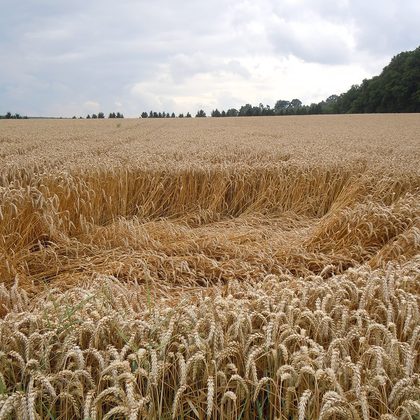
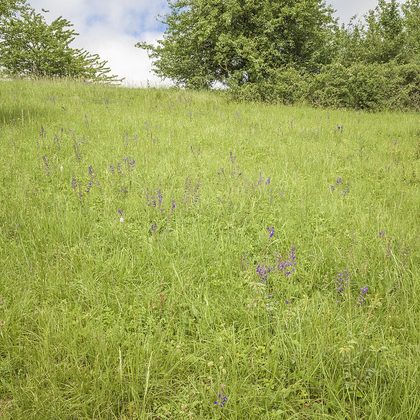
Open, dry country and its edges, not closed woodland: dry grassland and steppe-like vegetation, arable fields and field margins, hedges, shelterbelts and rank wood edges, and also damp tall-herb stands. In Lithuania the species has been described as a pronounced ecotone species of the boundary between woodland and open ground; in Turkey it also occurs in deciduous woodland of beech, alder, willow, walnut, maple and oak and in spruce and fir forest. In Austria it is confined to the Pannonian lowland and hill country, usually below four hundred metres; across the whole range it has been found up to 2250 m.
Where the animal is most at home, classified with EUNIS — the European standard for habitats.




Distribution
From central and eastern Europe east through Russia, northern Anatolia and the Caucasus into western China. The western limit in Europe is irregular and runs through Austria, the Czech Republic, Slovakia, Hungary and Croatia; further east, in Poland, the Baltic states, Ukraine, Romania and Bulgaria, the species is commoner. It is absent from the British Isles, the Low Countries, France, the Iberian Peninsula and Scandinavia. The exact course of the range is less well known than for most other European mice, because the species is only identified with certainty after measurement; in older distribution data part of the Herb Field Mice are recorded as Wood Mouse.
- Native
- dark = core range, pale = thinly spread
Way of life
Nocturnal, climbs and jumps well, and forages both on the ground and in shrubs. It does not hibernate. The diet consists mainly of grass and herb seeds, supplemented with fruit and insects; acorns and beech mast play a smaller part than in the field mice of closed woodland. The nest lies in an underground tunnel or in a tree. A litter has three to seven young, on average a little under five. In central Europe densities of one to just over nine animals per hectare have been measured, a fraction of what the Wood Mouse reaches in a mast year. No comprehensive European study exists on lifespan, social organisation or home range.
Where and when to look
A field sighting can rarely be identified to species; record such an animal as 'Apodemus'. Confirmation requires measurement in the hand: hind foot under 20.5 mm, ears under 15 mm and the small size together, which in practice means licensed trapping. For an amateur, pellet analysis is the feasible route: Barn Owl pellets from, for example, the Pannonian plain, southern Slovakia or Hungary, with the skulls identified by a specialist.
Conservation status
Least Concern (LC, 2016). The species ranges from central Europe to western China, and no demonstrated decline has been reported from any part of that area. Density is low everywhere, however, the habitat (herb-rich arable margins, dry grassland and rank edges) is declining in central and eastern Europe through field enlargement and pesticide use, and the species is not counted separately in monitoring. Because many records are filed as 'Wood Mouse', the assessment rests on limited data.
Scientific name
Apodemus uralensis | (Pallas, 1811)
Pallas described the species in 1811 as Mus sylvaticus Uralensis varietas; because it was later moved to another genus, the author and year stand in brackets. Apodemus is Greek, from apodēmos, 'away from home'. uralensis means 'of the Urals'; Pallas described the animal as a variety from that range. The specimen the first description was based on came from Russia.