All species › Carnivores › True seals › Hooded seal
Hooded seal | Cystophora cristata
Klapmuts | Foca capuchina
The Hooded Seal (Cystophora cristata) is a seal of deep water and drift ice in the northern Atlantic. It has the shortest known lactation of any mammal: the pup suckles for three to five days, doubles its weight in that time and is then left on the floe by its mother. The adult bull has two inflatable structures on the head: a black, expandable nasal cavity above the muzzle, the 'hood' that gives the species its name, and a red nasal septum that he blows out through one nostril when excited.
Tracks
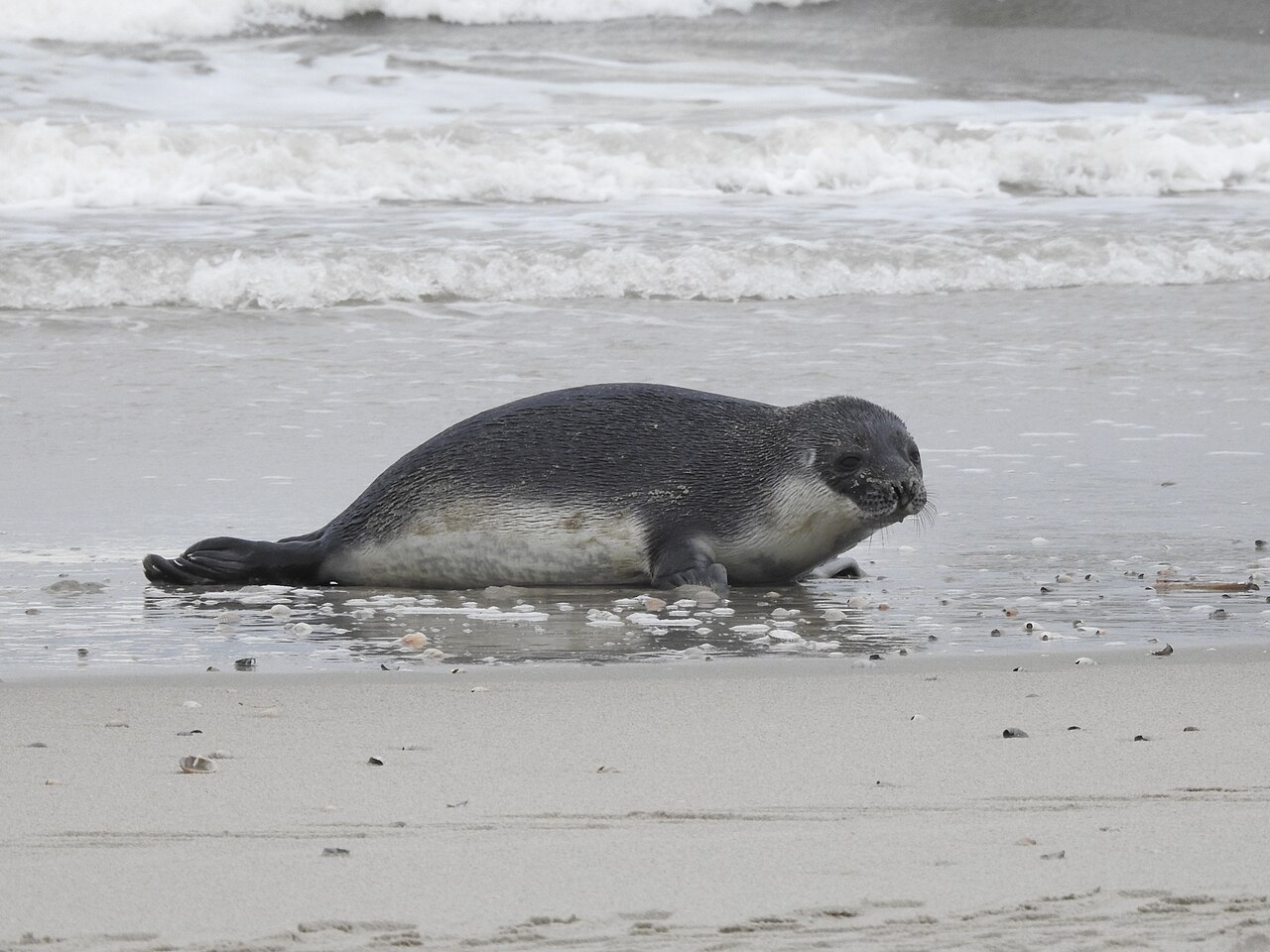
On European coasts the find is usually the animal itself: an exhausted young Hooded Seal on a beach, in late winter or spring, hundreds of kilometres outside the normal range. A broad drag groove, thirty to fifty centimetres wide, then runs from the surf to the dune foot, with the animal usually at its end, motionless and with the head low. A stranded Hooded Seal is almost always in distress, in contrast to a Harbour Seal resting on a beach. Young animals are also irritable: they snort, gape and move towards people and dogs instead of shuffling away. On the pack ice the signs are those of other ice-breeding seals: a short groove from the edge of the lead to the resting place and, in the breeding season, bloodstains and trampled snow where bulls have fought over a female.
The young
Identification
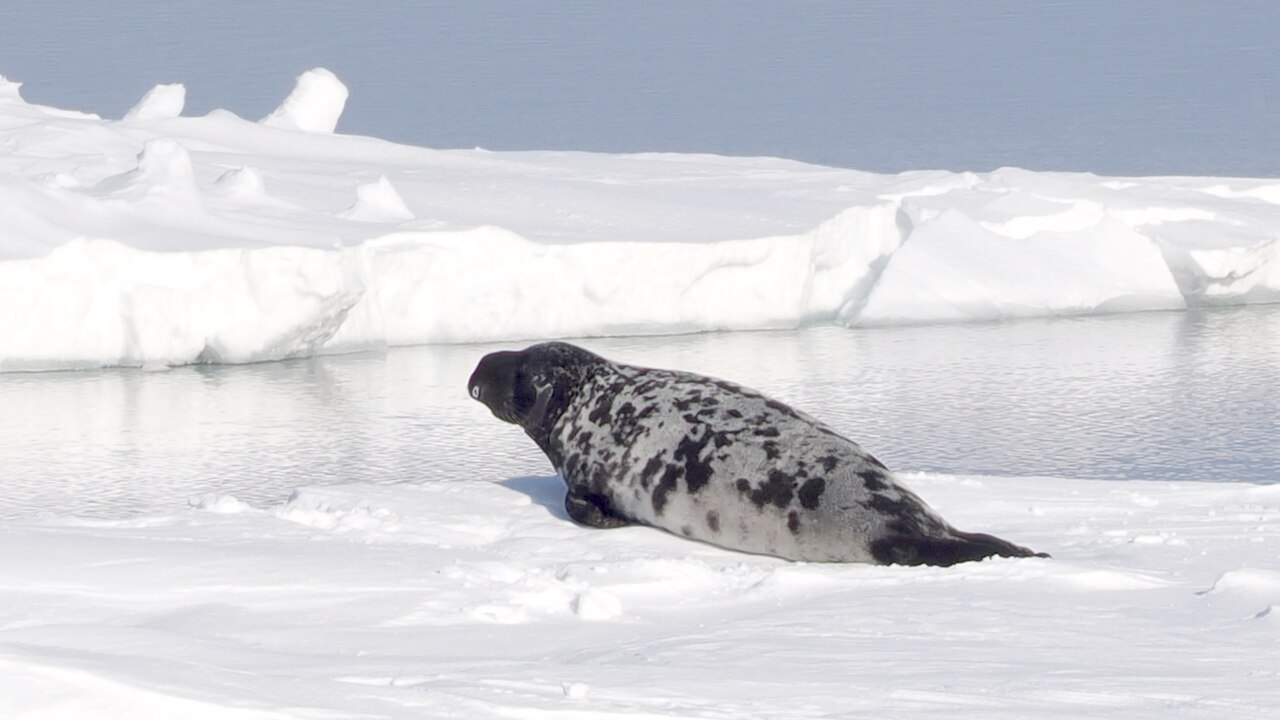
Large and heavy, with a broad, domed head and a short muzzle. The coat is silver-grey to blue-grey and marked over back and flanks with irregular, sharply edged dark blotches; head, muzzle and hindquarters are usually plain dark to black. The adult male has two inflatable structures: the black hood, an expandable nasal cavity that bulges over head and muzzle when inflated, and the red septum, which he can blow out through one nostril into a glossy scarlet bladder. Females are smaller and have neither. The pup is called a blueback: slate-blue above, sharply divided from a cream belly; the white lanugo is shed before birth.
Similar species
On European coasts a Hooded Seal is almost always a vagrant on a beach, usually a young animal. A blueback is recognised by the sharp division between slate-blue back and cream belly; a Harp Seal pup at that stage is silver-grey with sharp black spots and not two-toned, and a Harbour Seal pup is finely speckled and much smaller. An adult Hooded Seal differs from the Grey Seal in the broad, domed head with a short muzzle (a long, straight muzzle in the Grey Seal) and in the sharply edged dark blotches (a blurred, mottled pattern in the Grey Seal). It differs from the Bearded Seal in the large, heavy head (small relative to the body in the Bearded Seal) and in the blotches, which the Bearded Seal lacks. On a dead animal the loose, wrinkled skin above the muzzle can be felt in females and pups as well.
Habitat
Deep water and heavy drift ice, far from the coast. Unlike the Bearded Seal it is not tied to a shallow bottom: it dives to hundreds of metres, exceptionally more than a kilometre, and hunts squid, redfish, halibut, polar cod and shrimp in the deep northern seas. Pupping and moulting take place on thick drift ice over deep water. Vagrants end up on sandy beaches, in harbours and on coastal rocks, where they rarely survive for long.
Where the animal is most at home, classified with EUNIS — the European standard for habitats.


Distribution
The northern Atlantic and the adjoining polar seas, with four whelping areas: the Gulf of St Lawrence, the 'Front' east of Newfoundland, the Davis Strait and the West Ice off Jan Mayen, the only European whelping area. Outside the breeding season the species ranges far into the Greenland Sea and the Arctic Ocean. Further south it is a vagrant: Iceland and Norway provide most records, and young animals strand at intervals on the coasts of the southern North Sea, including the Wadden Islands and Zeeland. In Britain and Ireland there are a few records, mostly from Shetland, Orkney and the Scottish east coast, and in the Iberian Peninsula a few strandings in Galicia and Portugal. Since the 1990s the number of European strandings has increased, with cases as far as France, Portugal and Spain; no explanation for this is known.
- Native
- dark = core range, pale = thinly spread
Way of life
Solitary and wandering, except for the three weeks of whelping, when the animals concentrate on the ice. The pup is born in late March, one per litter, weighs twenty kilos at birth and drinks for three to five days a milk that is more than half fat; in those days it doubles its weight, after which the mother leaves it. During this period bulls gather round the female, threaten one another with hood and red bladder and fight; mating takes place in the water as soon as the pup is weaned. The moult is in July on the ice east of Greenland, where animals from all four whelping areas come together. Lifespan is twenty-five to thirty-five years.
Where and when to look
In Europe the chance of a sighting is highest on the beach: in late winter and spring, after a north-westerly gale, along the tide line of the North Sea and Atlantic coasts. Keep your distance and notify the local seal rescue or animal rescue service; a Hooded Seal bites, even as a pup, and should not be touched. At sea a sighting is practically only possible on an expedition cruise in March in the Greenland Sea or off Jan Mayen.
Conservation status
Endangered (EN, 2025). The IUCN placed the species in this category in 2025 because the north-east Atlantic population of the West Ice, off Jan Mayen, has declined by roughly seventy per cent since the 1940s and is not recovering, although commercial hunting there stopped in 2007. The cause of the lack of recovery is unknown; the loss of drift ice over deep water, changes in the food supply and the after-effects of the hunt for bluebacks are all put forward. In Canada the population is larger and more stable. The strandings of young animals in Europe concern individuals that have strayed and are exhausted.
Scientific name
Cystophora cristata | (Erxleben, 1777)
Erxleben described the species in 1777 as Phoca cristata; because it was later moved to another genus, the author and year stand in brackets. Cystophora is Greek, from kystis, 'bladder', and pherein, 'to carry': the bladder-bearer, after the inflatable nasal sac of the male. cristata is Latin for 'crested', from crista, 'crest', after the inflatable hood on the male's head. The specimen the first description was based on came from Southern Greenland and Newfoundland.