All species › Rodents › Blind mole-rats › Hungarian Blind Mole-rat
Hungarian Blind Mole-rat | Nannospalax hungaricus
Nannospalax hungaricus | Nannospalax hungaricus
Nannospalax hungaricus, the Hungarian Blind Mole-rat, is the blind mole-rat of the Hungarian lowland; in Hungarian it is called magyar földikutya. In Hungary the species has reserves, a statutory conservation value and a small number of known colonies, and it is threatened there. Nehring described the taxon in 1898 from animals from Mezőhegyes on the Hungarian-Romanian border; for a long time it was regarded as a subspecies or chromosomal form of the Lesser Blind Mole-rat. The Mammal Diversity Database has treated it as a species since 2024, also including transsylvanicus from north-western Romania and north-eastern Hungary and hercegovinensis from the Dinaric mountains.
Tracks
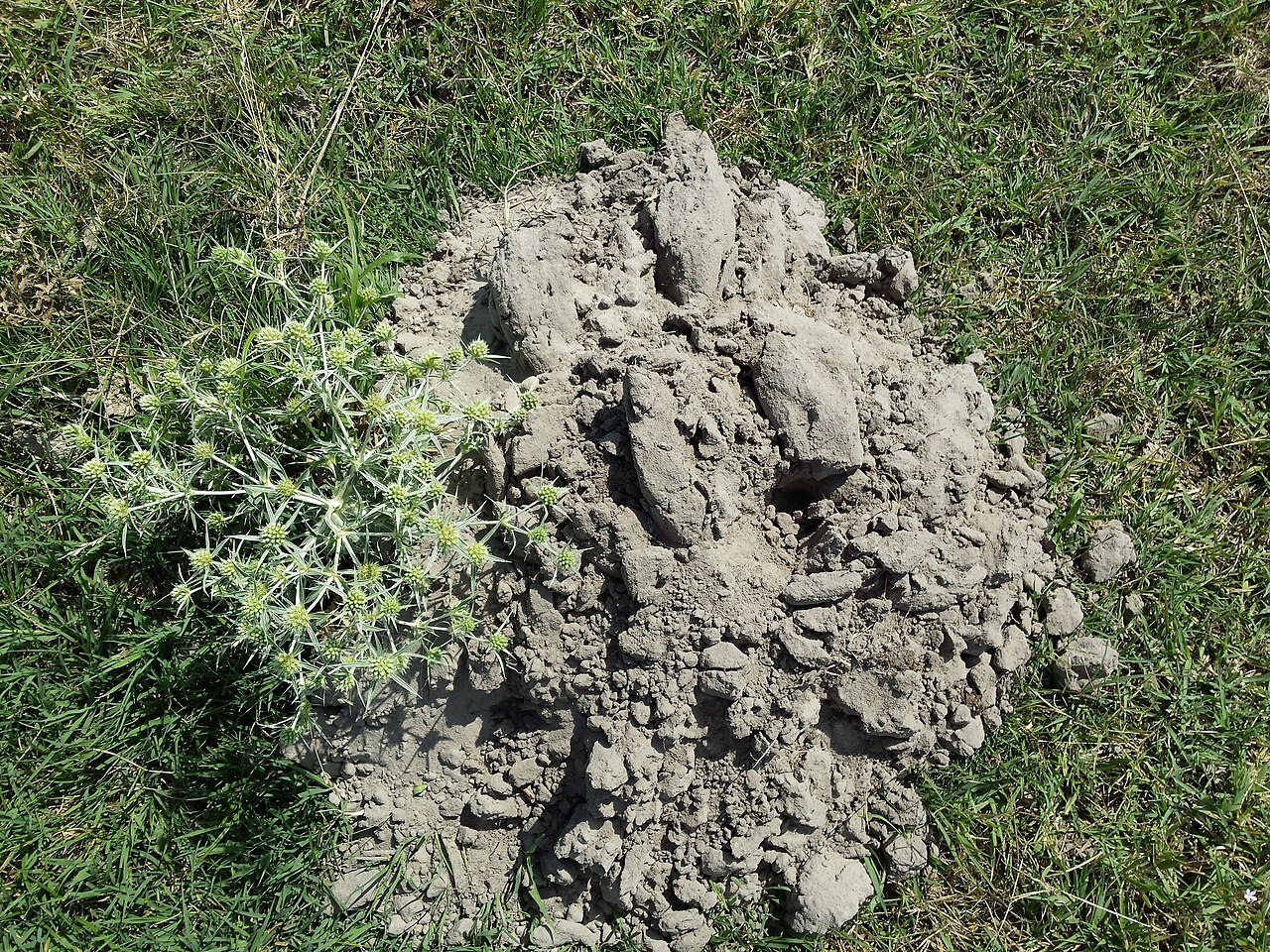
The earth mounds are the main sign and in Hungary form the basis of a survey method. A mole-rat mound is broad and low rather than conical, consists of coarse clods rather than fine crumbs and never has a visible opening, because the tunnel is sealed from inside. In Hungarian fieldwork a mound is only counted when its base measures more than sixty centimetres. The tunnels are five to seven centimetres wide; in hard ground the shallow feeding tunnels lie at ten to fifteen centimetres, in loose ground the deep tunnels and chambers reach a metre and a half and deeper. One animal moves about ten kilograms of soil per day. The mounds lie twenty to thirty metres apart in a meandering line along the main tunnel. Underground there are separate store chambers, a grass-lined nest and a latrine. A molehill is smaller, higher, finer-grained and comes from a vertical shaft; on sandy soil the two can look very similar, and then size and arrangement in a line are decisive. There are also gnawed roots and bulbs in the tunnel, and skull remains in pellets of Barn Owl and Little Owl, which have provided a large part of the older Hungarian distribution data.
Identification
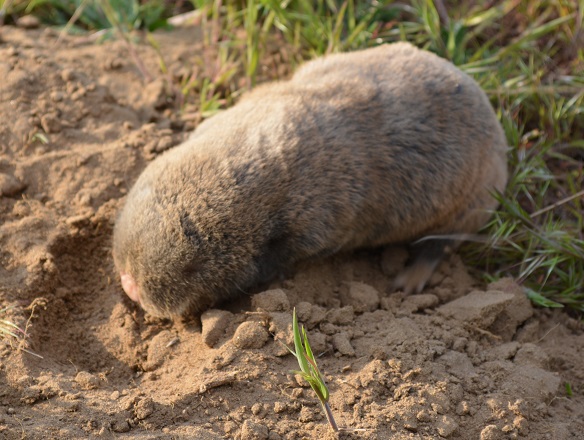
Externally a typical blind mole-rat: a neckless, cylindrical burrower of 19 to 27 centimetres and 140 to 220 grams, with a broad, flat head, a large bare nose pad and a bristly pale fringe running back from it. Ear pinnae, visible eyes and an external tail are absent; the eyes are reduced to millimetre-sized lenses beneath a closed fold of skin. The fur is velvety, brownish grey with a yellow or rusty tinge, the belly dark grey; the head often has small white or yellow spots. The yellow to orange incisors protrude in front of the lips. None of these characters separates the species from the related species; they describe the animal but do not identify it. The distinguishing character is the chromosome number 2n = 48 (fundamental number NF = 84), against 54 in N. montanosyrmiensis, 56 in N. leucodon and 58 in N. hellenicus.
Similar species
Apart from range and chromosome preparation there is no decisive character. Colour, size, head shape, the bristle fringe on the muzzle and tooth colour are the same in all species of the leucodon complex, and the differences between forms are smaller than the variation within each form. Chromosome number alone is not always sufficient either: N. monticola, N. montanosyrmiensis and N. serbicus all have 2n = 54 and differ only in fundamental number. In the field locality determines the assignment. In the Hungarian lowland and in the Banat and Bačka this is the only species, except in the border area around Kelebia and Ásotthalom and the adjoining Subotica sands (Subotička peščara) in northern Bačka, where N. montanosyrmiensis occurs; there the distinction cannot be made externally. What can be excluded are the mole, with spade-shaped forefeet, a short tail and a much smaller size, and the Water Vole, with normal ears, eyes and tail. A field record is entered as 'blind mole-rat'; the locality determines the species name.
Habitat
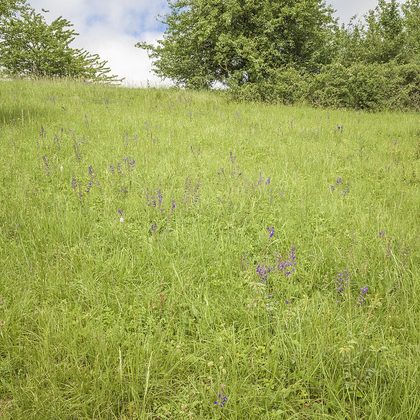
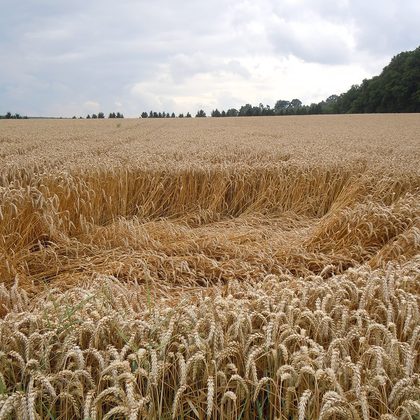
Dry and moderately moist grassland on deep, loose, well-drained soil: loess steppe, sand steppe, the alkaline grasslands (szik) of the Hungarian puszta, hay meadow, sheep pasture and grassed burial mounds in arable land. Also woodland edges, odd corners, old dykes and unploughed field margins. Wet ground, rock, closed woodland and intensively worked arable are unsuitable. Ploughing ends a colony; as a result the species now survives only on remnants in a landscape largely converted to arable.
Where the animal is most at home, classified with EUNIS — the European standard for habitats.



Distribution
The Carpathian Basin and the northern Balkans: eastern and south-eastern Hungary, with known sites near Debrecen, Battonya, Mezőtúr and Kunmadaras, and further north-western and western Romania, northern Serbia (Banat and Bačka) and Bosnia and Herzegovina. The type locality is Mezőhegyes in Békés county, Hungary. The boundary with the related species is not precisely known, because it can only be established karyologically: at every new colony animals must be trapped and karyotyped to determine the species. Blind mole-rats are absent from western and northern Europe and from the Iberian Peninsula.
Way of life
Strictly subterranean and active around the clock, with most digging at the beginning and end of the day; almost only young animals come above ground, during dispersal. There is no hibernation; the winter is bridged with store chambers. The diet consists of bulbs, tubers, rhizomes and thick roots, supplemented in late spring with green plant material; daily intake is a substantial part of body weight. The species is solitary and tolerates no conspecifics in its burrow system; animals come together only in the mating season, at the end of winter. After a gestation of about thirty days two to four young are born in March or April, blind, naked and weighing less than seven grams; they are independent by summer, and females first breed in their second year. Because of this slow reproduction a lost colony does not recover by itself. Predators are Red Fox, Stoat, Weasel, Steppe Polecat, feral dogs and cats, and Little Owl, Barn Owl, Long-eared Owl, Eagle Owl and Eastern Imperial Eagle.
Where and when to look
Visit one of the Hungarian reserves or an unploughed steppe parcel in Békés or Hajdú-Bihar in March or April, preferably early in the morning and when the grass is short, and look for a line of broad, low mounds twenty to thirty metres apart. Fresh, dark, coarsely clodded soil indicates an occupied system. Waiting a few metres from the last mound, the movement of soil from inside can sometimes be heard and seen. Digging is pointless and prohibited for this strictly protected species. Report finds: knowledge of the distribution in Hungary rests largely on reports of new mounds, and only known colonies can be protected.
Conservation status
Not evaluated by the IUCN. The Red List recognises only the collective species Nannospalax leucodon, assessed as Least Concern; that assessment does not apply to this species. The only separate assessment is that of Csorba and colleagues in 2015, who assessed the forms of the Carpathian Basin separately and classed hungaricus as Endangered: extent of occurrence and area of occupancy of at most three hundred square kilometres, fewer than five known localities, more than ninety-five per cent of the population at a single site, and a habitat continuing to decline in extent and quality. The form transsylvanicus, which the Mammal Diversity Database assigns to this species, was assessed as Vulnerable. In Hungary the species is strictly protected and has one of the highest conservation values in the country. The causes of decline are grassland conversion, deep ploughing, building, road construction and the burning of vegetation. Because the animals are rarely observed, colonies often disappear unnoticed.
Scientific name
Nannospalax hungaricus | (Nehring, 1898)
Nehring described the species in 1898 as Spalax typhlus var. hungaricus; because it was later moved to another genus, the author and year stand in brackets. Nannospalax joins Greek nannos, 'dwarf', to Spalax: the small blind mole-rat. hungaricus means 'Hungarian', from medieval Latin Hungaria; Nehring described the animal from Mezőhegyes in south-eastern Hungary. The specimen the first description was based on came from Hungary, Mezőhegyes.