All species › Bats › Sheath-tailed bats › Naked-rumped tomb bat
Naked-rumped tomb bat | Taphozous nudiventris
Kaalbuikgrafvleermuis | Taphozous nudiventris
The naked-rumped tomb bat is a large insectivorous bat of the sheath-tailed bat family (Emballonuridae), with a range from West Africa to Myanmar. It was described from Giza in Egypt. Within the guide area it is known from the Nile Valley in northern Egypt, from the Jordan Valley and the Dead Sea area, and, since an acoustic record in 2021, from southern Tunisia. The rump and lower belly are hairless, which gives the species its name.
No photograph of a living wild animal of this species with a suitable Creative Commons licence exists. Do you have one that meets the rules? Send it in.
Tracks
Roosts are in rock crevices, caves, tombs, temples, barns, houses, tree hollows and tunnels; in the Nile Valley old buildings and tombs are known sites. Tomb bats do not hang freely from the ceiling but rest against a vertical wall, belly to the wall, and can withdraw sideways into a crevice. Below such a spot lie droppings, coarser than those of smaller bats, with remains of beetles, grasshoppers, crickets and cockroaches. Most roosts hold a few individuals; colonies of hundreds, up to 2,000 in Pakistan, have been reported. On a bat detector the species sounds like long, even tones around 23 kHz.
Identification
A large bat with a flat head, a long, conical, blunt-ended muzzle and large eyes. The ears are triangular, set apart and point backwards; the inner margin carries papillae and the outer margin extends almost to the corner of the mouth. The tragus is hatchet-shaped. The dorsal fur is grey-brown, dark brown or sepia, the underside paler; the rump and lower belly are naked. Males have a gular gland pouch and a chest gland; both sexes have a radio-metacarpal pouch near the wrist. As in all sheath-tailed bats, the tail pierces the tail membrane and its last part lies free on the upper surface. The wings are long and narrow. Head-body 83 to 105 mm, tail 22 to 46 mm, ear 20 to 23 mm, forearm 70 to 80 mm, weight 30 to 35 g; in autumn fat is deposited under the naked skin of the rump. Echolocation consists of long, nearly constant-frequency calls with several harmonics; in Tunisia the frequency of maximum energy was around 23 kHz, in the second harmonic, similar to recordings from Jordan and the Near East.
Similar species
Within the guide area the European free-tailed bat (Tadarida teniotis) is the species of similar size with similarly low-frequency calls (around 12 kHz). It has a furred rump, large forward-pointing ears that nearly meet above the muzzle, a wrinkled upper lip and a tail projecting well beyond the edge of the tail membrane. The mouse-tailed bats (Rhinopoma) are smaller and have a long, thin, largely free tail and a small nose fold. The Egyptian fruit bat (Rousettus aegyptiacus) is larger, with a dog-like head, large eyes, simple ears without a tragus and almost no tail. South of the guide area, in Egypt, Taphozous perforatus occurs; it is smaller and has a furred rump.
Habitat
Arid and semi-arid areas, tropical forest and wet evergreen forest, wherever open ground for hunting is combined with roosts in rocks or underground. In Africa the species lives in Sudanian and Sahelian savanna, where inselbergs and rock crevices provide roosts. It is often found near large bodies of water such as rivers and lakes. In the guide area this means the Nile Valley with its farmland and settlements, and the Jordan Valley and the shores of the Dead Sea.
Where the animal is most at home, classified with EUNIS — the European standard for habitats.
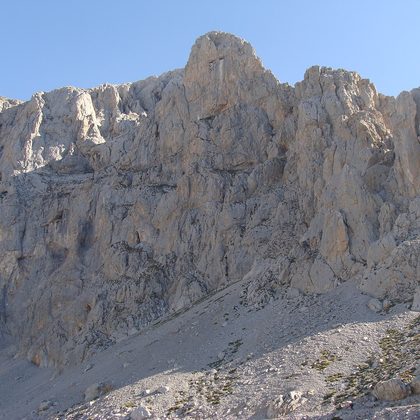
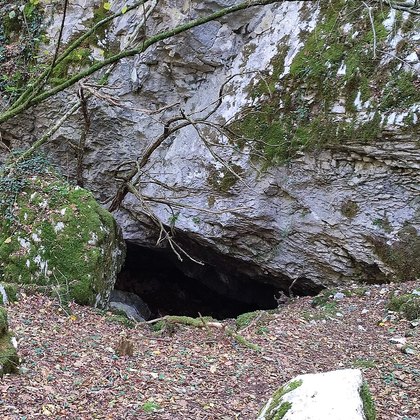



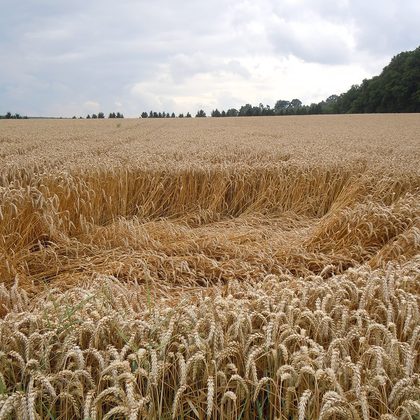
Distribution
From Mauritania, Senegal and Guinea-Bissau through the Sahel and East Africa to Tanzania, and via Egypt, the Arabian Peninsula, the Near East, Turkey, Iraq and Iran to Afghanistan, Pakistan, India, Nepal, Bangladesh and north-western Myanmar. Five subspecies are recognised; the nominate form lives in Africa and the Levant, T. n. magnus in Turkey, Iraq and Bahrain. Within the guide area records come from the Nile Valley in northern Egypt, from Israel, the Palestinian territories and Jordan along the Jordan Valley, and from southern Tunisia, where the species was recorded acoustically in 2021 in the Oued Dkouk Nature Reserve, the first record for the country.
- Native
- dark = core range, pale = thinly spread
Way of life
Nocturnal; the bats become active about half an hour before sunset and emerge well after sunset. They hunt high and fast in open air for large flying insects: beetles, crickets, grasshoppers, cockroaches, moths and winged termites. Some populations migrate or hibernate in the cool season. At the end of the rainy season, when insects are most abundant, the bats lay down fat under the naked skin of the rump as a reserve for the dry winter. The species is monoestrous and has one young a year; in hibernating populations sperm is reported to be stored until spring, when fertilisation follows. The species shares roosts with other bat species.
Where and when to look
In the Nile Valley and the Jordan Valley the species is best seen at emergence from a known roost in an old building or a rock face. On a bat detector it stands out by its low frequency around 23 kHz; the European free-tailed bat calls even lower, around 12 kHz, and is audible to many people with the naked ear. A tomb bat resting against a wall or in a crevice can be recognised by the naked rump and the long, pointed muzzle, but such roosts are not disturbed.
Conservation status
Least Concern (LC, 2017), on the basis of its large range, a presumed stable population and tolerance of habitat modification. Numbers differ between regions: in parts of the range the species is common, in the west scarce. Colonies in Africa and the Mediterranean are usually small; in South Asia the species is common, but a decline has been recorded there in recent years. In countries that are parties to the EUROBATS Agreement the species is covered by it; across much of the range there are no specific measures outside protected areas. The effect of pesticides on the species has not been studied.
Scientific name
Taphozous nudiventris | Cretzschmar, 1830
Cretzschmar described the species in 1830 and placed it straight away in the genus where it still stands. Taphozous is Greek, from taphos, 'tomb', and zōos, 'living': the tomb-dweller, after the bats Geoffroy found in the burial chambers of Egypt. nudiventris is Latin for 'naked-bellied', from nudus, 'naked', and venter, genitive ventris, 'belly': in this bat the underside is bare. The specimen the first description was based on came from Egypt, Giza.