All species › Bats › Vesper bats › Noctule bat
Noctule bat | Nyctalus noctula
Rosse vleermuis | Murciélago Nóctulo Común
The Noctule is a large bat with uniformly reddish-brown fur, long narrow wings and a forearm of 47 to 60 mm; it weighs 17 to 44 grams. Von Schreber described it in 1774 as Vespertilio noctula from France. It roosts mainly in tree holes, often old woodpecker holes, and hunts fast and high over woodland, water and open ground. Over much of its range it migrates between summer and winter quarters; the longest known movement within Europe is 1546 km.
Tracks
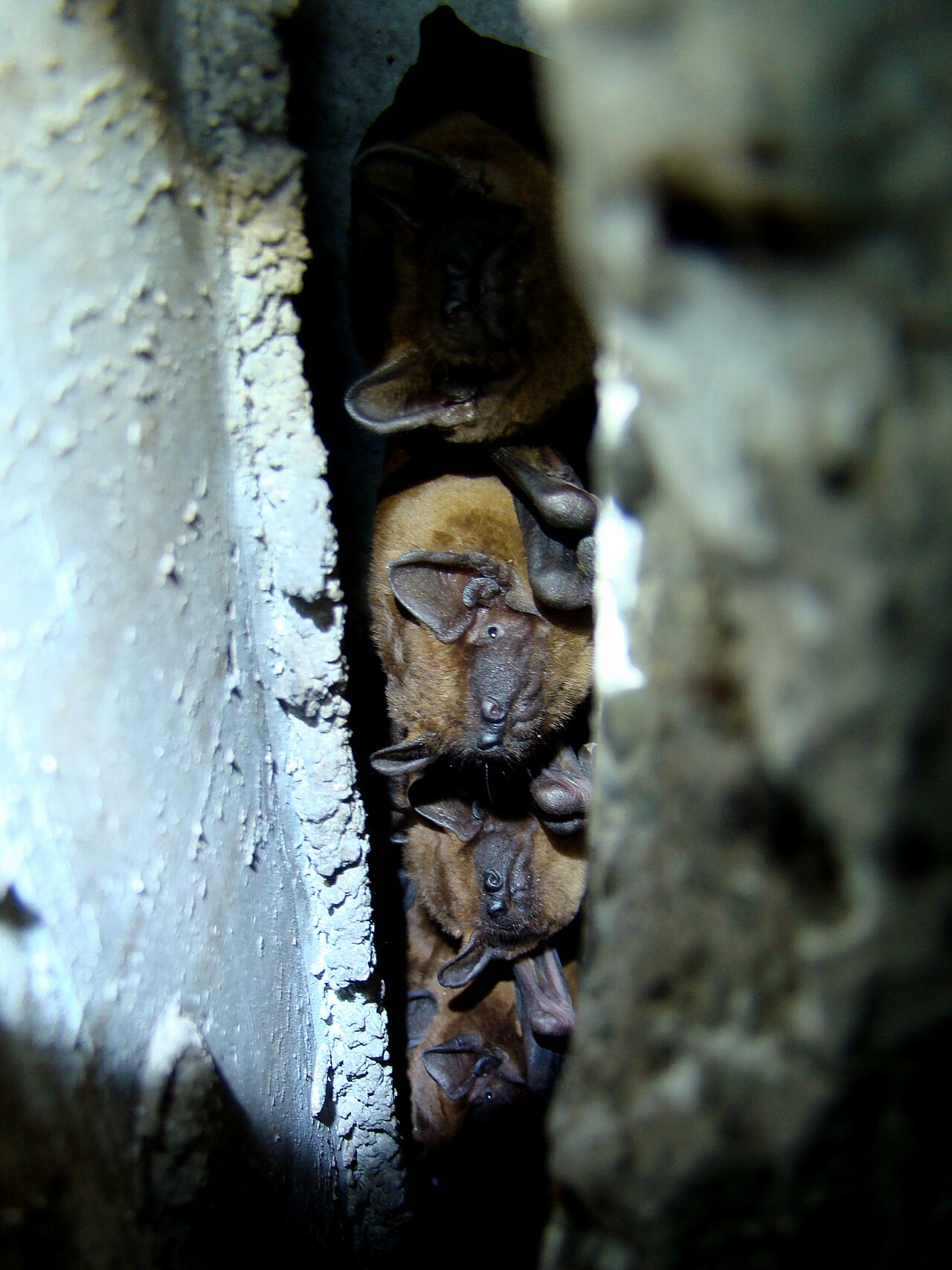
Roosts are mostly in holes in old trees, often woodpecker holes, and also in crevices in buildings and rocks. Noctule calls are loud and audible without a detector to some people. In late summer males hold a mating roost and give shrill calls at the entrance or in flight; such a roost can be recognised by that sound and by the strong smell. A male's group of females numbers up to 20, usually 4 or 5. At emergence in the dusk the animals can be seen leaving the hole one by one and counted. Winter roosts in tree holes, rock crevices and buildings may hold up to about 1000 animals.
Identification
A large, slender bat with uniformly reddish-brown upperparts: individual hairs are the same colour along their whole length. The underparts are slightly paler; juveniles and freshly moulted adults are duller brown. Face, ears and membranes are dark brown. The muzzle is short and broad, with large glands between nostrils and eyes. The ears are short and triangular, with four or five folds on the outer edge, and the tragus is very short and mushroom-shaped, as in all Nyctalus species. The wings are long and narrow and attach at the ankle; belly fur extends onto the wing and tail membranes. The animal has a musky smell, strongest in males in the mating season. Flight is fast and straight, with dives, usually high above the canopy or over open ground. Search calls are FM/QCF, with maximum energy around 25 kHz; two call types alternate, one with maximum energy at 22 to 27 kHz, the other at 17.5 to 23.6 kHz.
Similar species
Leisler's Bat (Nyctalus leisleri) has the same tragus and a similar flight, but is smaller (forearm 35 to 46 mm) and has bicoloured hairs, dark at the base and golden brown at the tip. A forearm under 47 mm points to Leisler's. The Greater Noctule (N. lasiopterus) is larger (forearm 59 to 70 mm, weight 33 to 74 g) and calls lower, with a peak frequency around 19 kHz; the forearm ranges of the two meet at about 59 to 60 mm. The Serotine (Cnephaeus serotinus) has broader wings, a longer, blunt-tipped tragus and a slower flight. On a bat detector the calls overlap partly with those of Serotine, Leisler's and Particoloured Bat (Vespertilio murinus, maximum energy 22 to 27 kHz); alternation of two call types indicates the Noctule, but without analysis of the recording part of the records remain at 'Nyctalus/Cnephaeus/Vespertilio'.
Habitat
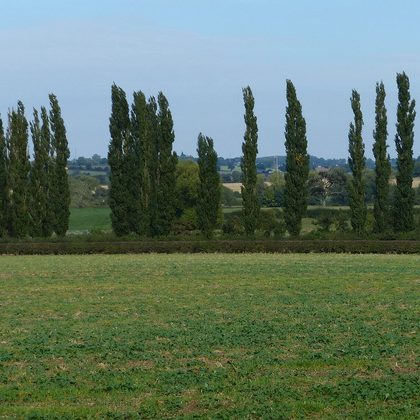
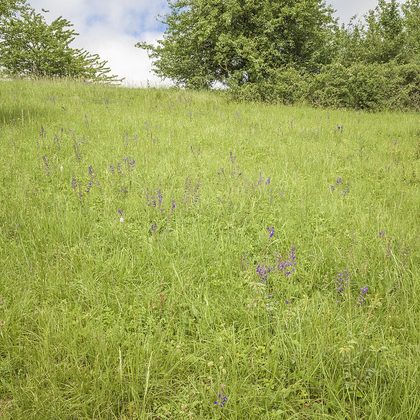
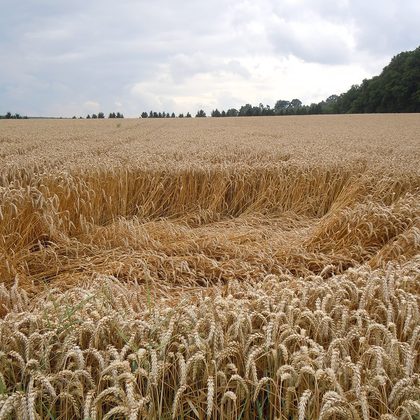
Mainly temperate deciduous woodland, wetlands and well-watered country, and farmland with pasture; from sea level to about 1900 m, with a preference for lowlands (the highest records are from Switzerland). It hunts high above the canopy and over open ground and water. It also occurs in cities and suburbs, hunting there and roosting in old trees in parks and avenues. Summer roosts are mainly in hollow parts of old trees.
Where the animal is most at home, classified with EUNIS — the European standard for habitats.



Distribution
From Great Britain, France and Spain east to western Russia, western Kazakhstan and south-western Turkmenistan, including southern Scandinavia, Gotland, Öland and Cyprus (subspecies N. n. noctula). On the Iberian Peninsula it is absent from much of the area, and it is locally extinct in Portugal. N. n. lebanoticus lives in Syria, Lebanon and north-eastern Israel, N. n. mecklenburzevi from Kazakhstan to north-western China. From North Africa there are only two records from Algeria dating from 1858, which may refer to the Greater Noctule. Breeding takes place mainly in the north of the range, wintering mainly in the south.
- Native
- dark = core range, pale = thinly spread
Way of life
Nocturnal. The Noctule hunts for about one hour a night in total, split into two bouts, after sunset and before sunrise. It is a fast aerial hawker that takes large flying insects high over woodland and open country, such as moths, cockchafers and crickets, as well as swarming midges, crane flies and caddisflies. In Switzerland hard beetles (Melolontha, Geotrupes) were preferred over swarming insects in spring and autumn, and the reverse in summer. The species is migratory: females travel further and more often than males, which in the north often stay all year. Most individuals cover less than 1000 km; the record within Europe is 1546 km. In the south and west of the range animals are largely sedentary. Mating takes place in late summer and early autumn, with a male and his harem in a mating roost; fertilisation is delayed. Maternity colonies average 20 to 50 females, sometimes about 100. In late June or July, after just over two months' gestation, one or two young are born, usually two; they are weaned at three to four weeks and fly independently at six weeks. Hibernation lasts roughly from October to March or April but is interrupted for foraging flights; animals fly at temperatures down to about −7 °C and stay in below −10 °C. Predators include hawks, harriers, falcons, Herring Gulls, crows and Great Grey Shrikes.
Where and when to look
The Noctule emerges early, often as the first bat of the evening, and at dusk shows against the sky as a large bat with narrow, pointed wings flying high and straight and diving suddenly. A bat detector tuned to 20 to 25 kHz picks up the loud calls at long range; alternation between two call types of different pitch is characteristic of this species. Old avenues, parks with hollow trees, and woodland edges along lakes and rivers are suitable places. The species is active from March to October; on mild winter evenings animals may also fly outside.
Conservation status
Least Concern (2016). The species is widespread and common over much of its range. The handbook lists no major threats; loss of roosts in old trees may affect it. It has disappeared from much of the Iberian Peninsula, and entirely from Portugal. Like all bats in the European Union, the Noctule is listed in Annex IV of the Habitats Directive and is covered by the EUROBATS Agreement.
Scientific name
Nyctalus noctula | (von Schreber, 1774)
Von Schreber described the species in 1774 as Vespertilio noctula; because it was later moved to another genus, the author and year stand in brackets. Nyctalus belongs with Greek nyx, genitive nyktos, 'night'; Bowdich gave no explanation, and just which Greek word he was reaching for is not settled. noctula is the Italian nottola, 'bat', from Latin noctua, 'night owl', and nox, 'night'; von Schreber took it over as a noun by way of the French name la noctule. The specimen the first description was based on came from France.