All species › Carnivores › Mustelids › Pine marten
Pine marten | Martes martes
Boommarter | Marta
The pine marten is a marten of old woodland that spends much of its time in trees, searching cavities and also sleeping and giving birth in them. It ranges from Ireland and the Iberian Peninsula to western Siberia and occurs on the large Mediterranean islands. Across most of Europe it lives alongside the stone marten, and separating the two is the standing question with every marten record.
Tracks
The print shows five toes, usually with claw marks. The forefoot measures 35 to 45 mm wide and 35 to 40 mm long, the hind foot about 40 mm wide and 48 mm long. Because the soles are furred, the pads register less sharply in snow and soft mud than those of the stone marten; the difference is reliable only in good prints. Trail width is about 10 cm, the stride about 35 cm when walking and 60 to 90 cm when bounding; in a bound the prints lie in pairs or small groups. The scat is 5 to 12 cm long and 10 to 15 mm thick, often twisted, with constrictions and a pointed end; colour varies from black to grey, and in summer and autumn it contains stones and seeds of berries and fruit. Scats lie near resting and nest sites or scattered through the territory, often on a raised spot. Other signs: plucked feathers on thick branches near scats, emptied eggs, partly eaten skins of small mammals, bitten-off heads of for example rabbit or hedgehog, and larger eggs buried in sand or moss. Scats cannot be assigned to pine or stone marten by appearance; DNA analysis of scats is used in monitoring to separate the two.
Identification
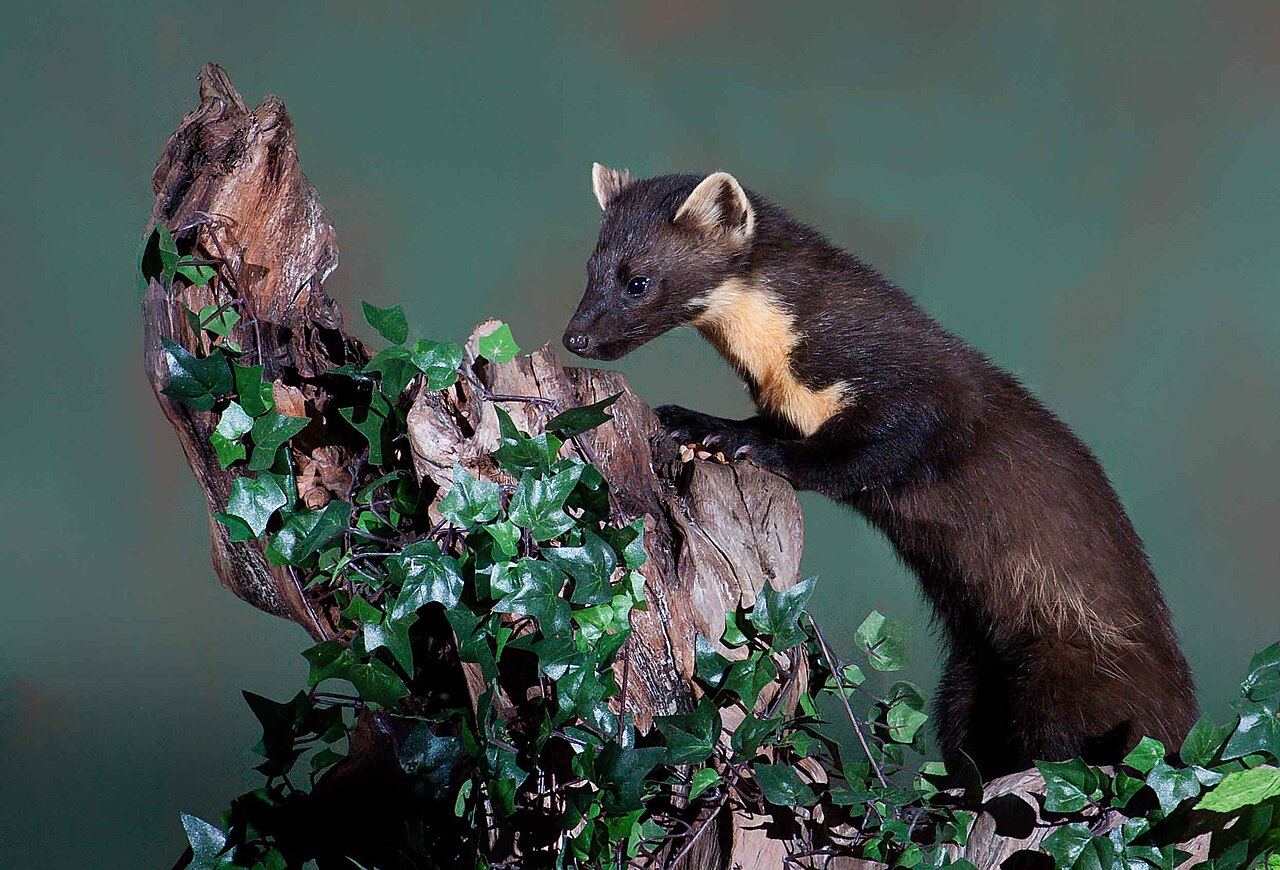
A slender mustelid with a long body, short legs and a bushy tail about half the head-body length. The fur is yellowish brown to dark chestnut, with a yellow to orange-yellow throat and chest patch that usually ends rounded at the bottom. The underfur on the flanks is dark greyish brown. The nose pad is black to dark brown; the ears are fairly large, rounded and pale-edged. The soles of the feet are furred. Males are larger than females; weight ranges from about 0.9 to 2 kg.
Similar species
The stone marten is the one species with which confusion is constant. The most useful features: the throat patch is yellow to orange in the pine marten, white and often forked in the stone marten, with two extensions onto the forelegs; the underfur is dark in the pine marten and pale in the stone marten, visible where the fur is parted or wet; the nose is black or dark brown in the pine marten, flesh-coloured in the stone marten. On a camera-trap image or in headlights the colour of the throat patch is unreliable because of lighting and angle; an image that shows the nose and the shape of the patch is more useful. The American mink and the polecat are smaller, shorter-tailed, lack a coloured throat patch and live more near water and on the ground; the polecat also has a facial mask.
Habitat
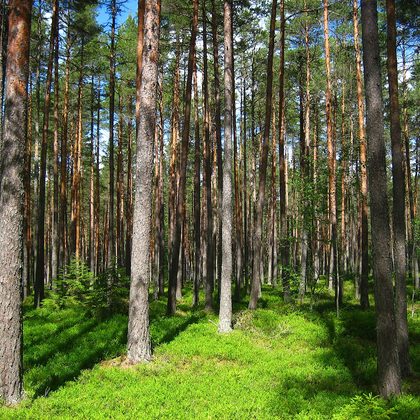
Mature broadleaved and coniferous woodland with old trees and cavities. In Norway the species prefers spruce forest with large trees and avoids clearcuts and open ground; in Belarus densities are higher in woodland on clay soils than on sandy soils, where the animals concentrate in stream valleys. Resting sites are in hollow trees and logs, under brush piles, under snow, in rock crevices and in buildings. In Great Britain 44 per cent of the resting sites studied were in trees, 28 per cent among rocks and 14 per cent in buildings, and 70 per cent were above ground. In the Balearics the species lives in Mediterranean woodland.
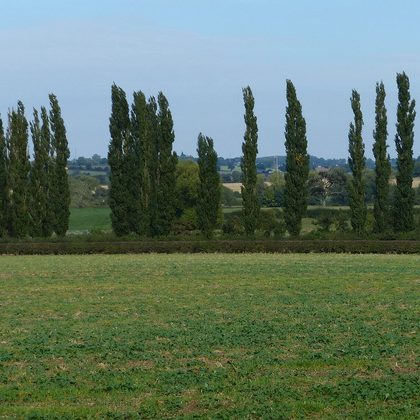
Where the animal is most at home, classified with EUNIS — the European standard for habitats.




Distribution
Most of Europe to western Siberia, including the large Mediterranean islands (Mallorca, Menorca, Corsica, Sardinia, Sicily), and Turkey, the Caucasus, Iraq and Iran. Within the guide area the Mammal Diversity Database lists, among others, Ireland and the United Kingdom, Scandinavia, Finland, the Iberian Peninsula, Italy, the Balkans and eastern Europe. Fur trapping reduced the species strongly in many areas during the twentieth century, with a low point in the 1970s; since then it has recovered in many regions.
- Native
- dark = core range, pale = thinly spread
Way of life
Mainly nocturnal, with more daytime activity in summer, especially in females with young. In Poland 69 per cent of active time fell at night. On average a pine marten is active for about nine hours a day, up to 13 hours on warm days and two to five hours on cold days; there is no winter dormancy. It is solitary; ranges of animals of the same sex barely overlap, while a male's range overlaps one or more females. In Białowieża, Poland, annual ranges averaged 2.6 km² for males and 1.4 km² for females, and an animal covered on average 5.1 km a day. Food consists of small mammals (in Finland and Scotland mainly voles), birds, eggs, squirrels, amphibians, insects, carrion, honey, berries (including rowan) and fungi; surplus is cached. Mating takes place in midsummer; delayed implantation means the young are born only in March or April, after a total gestation of 230 to 275 days. A litter has two to eight, usually three to five young of about 30 g; the eyes open at 32 to 38 days, weaning is at six to seven weeks and the young become independent in autumn. Sexual maturity follows in the second year.
Where and when to look
The pine marten is most accessible through its signs and a camera trap. Look for scats on stumps, fallen trunks, forest tracks and near nest boxes and hollow trees; in snow the bounding trail with paired prints of a marten can be followed to a tree or cavity. A camera trap at a hollow tree or on a fallen trunk often produces images; set it so that the throat patch and nose can appear in the frame. The chance of seeing an animal itself is greatest at dusk in summer, when there is also daytime activity.
Conservation status
Least Concern (LC, 2016). The species was long trapped intensively for its fur, which caused a strong decline by the 1970s; since then populations have recovered in many areas. The pine marten is listed in Annex V of the Habitats Directive. It is protected in some countries and hunted in others. Old woodland with hollow trees matters for resting and breeding sites; where such trees are lacking, the species more often uses nest boxes, rocks and buildings.
Scientific name
Martes martes | (Linnaeus, 1758)
Linnaeus described the species in 1758 as Mustela Martes; because it was later moved to another genus, the author and year stand in brackets. Martes is the Late Latin word for 'marten', taken over from a Germanic language (compare German Marder); its further origin is unknown. The specific name repeats the genus name. The specimen the first description was based on came from Sweden.