All species › Rodents › Blind mole-rats › South Serbian Blind Mole-rat
South Serbian Blind Mole-rat | Nannospalax serbicus
Nannospalax serbicus | Nannospalax serbicus
Nannospalax serbicus, the South Serbian Blind Mole-rat, is the blind mole-rat of the southern Balkan interior: the valleys of eastern Serbia, Kosovo, North Macedonia and south-western Bulgaria, and south into Greek Macedonia and Thrace. Méhelÿ described the taxon in 1909 from animals from Pirot in eastern Serbia, as a subspecies of Spalax monticola. For a century it was regarded as one of the chromosomal forms of the Lesser Blind Mole-rat; since the revision by Németh and colleagues in 2024 the Mammal Diversity Database has treated it as a species. Several described forms are included under this name, among them thermaicus of the Thermaic Gulf, makedonicus, ovchepolensis, strumiciensis, thracius, rhodopiensis and tranensis, each with its own chromosome number and indistinguishable in the field.

Tracks
The animal itself is rarely seen; its earthworks are. A mole-rat mound is broad and low rather than conical, consists of coarse clods rather than fine crumbs and never has an open tunnel mouth, because the tunnel is sealed from inside. The mounds lie twenty to thirty metres apart in a meandering line following the main tunnel. A molehill is smaller, higher, finer-grained and comes from a vertical shaft; the rule of thumb from Hungarian fieldwork, which only counts a mound at a base diameter of more than sixty centimetres, also applies in the Balkans. Underground there is a main tunnel with side branches, with shallow feeding tunnels five to seven centimetres wide at fifteen to twenty-five centimetres depth, deep connecting tunnels to over a metre, a grass-lined nest, separate store chambers and latrines. There are also gnawed roots, bulbs and tubers in the tunnel, and patches at the surface where a plant has been pulled down from below. Skull remains in pellets of Barn Owl, Little Owl, Long-eared Owl and Eagle Owl provide the only firm distribution data in large parts of the Balkans.
In its habitat

Head close-up

Identification
Externally like the other blind mole-rats: a neckless, elongated burrower with a broad, flat head, a heavily built front and velvety brownish-grey fur with a yellow or rusty tinge. Ear pinnae are absent, the eyes are reduced to lenses about a millimetre across beneath a closed fold of skin, and there is no external tail. From the large, bare, triangular nose pad a stiff fringe of pale bristles runs backwards, with which soil is pushed aside. The yellow to orange incisors protrude in front of the lips, so that the animals can bite into the soil with the mouth closed. No measurements of its own have been published for this species; measurements of related species are not adopted. The species character is karyological: 2n = 54 with a fundamental number NF = 98 in animals from the type area, against NF 94 in the form of the Ovče Polje and NF 96 in that of Tran.
Similar species
A living blind mole-rat cannot be assigned to a species by its appearance. The forms of the leucodon complex are alike in fur, size, head profile, bristle fringe and tooth colour, and the differences cited in the literature fall within the variation of each population; crossing experiments between forms produced no embryos, and their species status rests on this. Chromosome number alone is not decisive either: N. monticola, N. montanosyrmiensis and this species all have 2n = 54. In the field locality determines the assignment: in North Macedonia, Kosovo, eastern Serbia south of the Danube and Greek Macedonia and Thrace this is the only species; in western Bulgaria it occurs alongside N. bulgaricus and in the mountains of central Serbia alongside N. montanoserbicus. The genus, however, can be determined in the field. A Nannospalax weighs about as much as a large rat, up to a little over half a kilogram in the heaviest animals, whereas a Spalax of the eastern steppes can weigh six to eight hundred grams and is nearly a third longer; this difference is expressed in the generic names and was confirmed with DNA by Németh and colleagues in 2013. The signs differ as well: the mounds of a Nannospalax lie twenty to thirty metres apart in a thin, meandering line, whereas a Spalax makes a dense field of mounds one to two metres apart. Within the range of this species the distinction does not arise, since the nearest Spalax range lies hundreds of kilometres to the north-east. Confusion is possible here with the mole (smaller, spade-shaped forefeet, short tail) and the Water Vole (normal ears, eyes and a long tail). A record is entered as 'blind mole-rat', with the locality; the species requires a karyogram.
Habitat
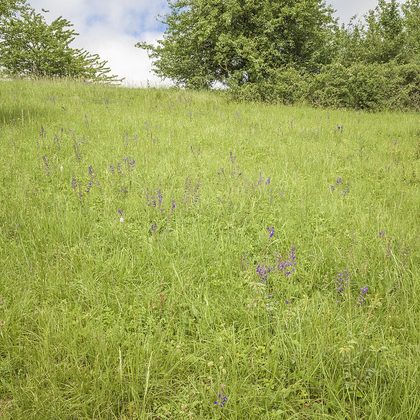
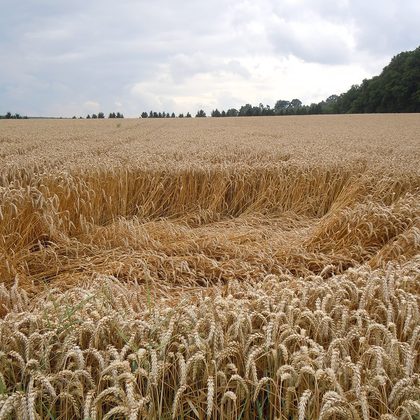
Dry and moderately moist grassland on deep, loose, well-drained soil. Within the range this means mainly the valley landscape: the plains of the Morava, the Vardar, the Struma and the Ovče Polje, the lower meadows and hay meadows of Kosovo and western Bulgaria, and in Greek Macedonia and Thrace the coastal plains and lower slopes. The species requires an underground food supply of bulbs, tubers and thick roots and avoids wet ground, rock and closed woodland. Where the landscape allows, it also occurs in woodland edges, odd corners, orchards, sheep pastures and unploughed field margins. Intensively worked arable land is unsuitable; deep ploughing ends the colony at that site.
Where the animal is most at home, classified with EUNIS — the European standard for habitats.



Distribution
The southern Balkan interior. In the delimitation followed here: south-eastern Serbia with the type area around Pirot, Kosovo, the whole of North Macedonia, western and south-western Bulgaria, and in Greece Macedonia and Thrace up to the Turkish border. The Mammal Diversity Database lists Albania and European Turkey with a question mark, because too little material has been karyotyped there. The boundary with the related species is nowhere precisely known, because it can only be established karyologically: at every new colony animals must be trapped and karyotyped. Blind mole-rats are absent from western and northern Europe and from the Iberian Peninsula.
Way of life
Strictly subterranean, active around the clock, with most digging at the beginning and end of the day. Almost only young animals come above ground, during dispersal, and most records concern such animals, for example while crossing a road. There is no hibernation or winter dormancy; the winter is bridged with store chambers. The diet consists of bulbs, tubers, rhizomes and thick roots, supplemented in late spring with green plant material and occasionally an insect; daily intake is a substantial part of body weight. The species is solitary and tolerates no conspecifics in its burrow system; outside the mating season in late winter a burrow system is the territory of one animal. After a gestation of about thirty days two to four young are born in March or April, blind, naked and weighing less than seven grams; they are independent by summer, and females first breed in their second year. Predators are Red Fox, Stoat, Weasel, Steppe Polecat, feral dogs and cats, and Little Owl, Barn Owl, Long-eared Owl, Eagle Owl and Eastern Imperial Eagle.
Where and when to look
Search for the line of mounds, not for the animal. In March or April visit a valley such as the Ovče Polje, the Pelagonian plain near Prilep or the meadows around Pirot, early in the morning and while the grass is short: an occupied system can be recognised by a series of broad, low mounds twenty to thirty metres apart. Fresh, dark, coarsely clodded soil indicates an occupied system; overgrown mounds an abandoned one. Waiting a few metres from the last mound, it is sometimes possible to see new soil being pushed out from inside. Digging is pointless. In the Macedonian and Serbian valleys most photographs of this species have been taken of animals crossing a road.
Conservation status
Not evaluated by the IUCN. The Red List recognises only the collective species Nannospalax leucodon, assessed as Least Concern; that assessment refers to a different species concept and says nothing about this species. A separate assessment is lacking. The Handbook of the Mammals of the World states that several species of this complex are threatened, lack protection and need separate assessment. For a European blind mole-rat this species has a large range, spread over five countries, and in the higher valleys of Serbia, North Macedonia and Bulgaria extensive pasture has not everywhere been ploughed. The species is, however, bound to unploughed, deep, dry soil, the land type that is converted to arable first. With every conversion the animals of that plot disappear, and because the species is rarely observed, colonies usually disappear unnoticed.
Scientific name
Nannospalax serbicus | (Méhelÿ, 1909)
Méhelÿ described the species in 1909 as Spalax monticola serbicus; because it was later moved to another genus, the author and year stand in brackets. Nannospalax joins Greek nannos, 'dwarf', to Spalax: the small blind mole-rat. serbicus means 'Serbian'; Méhelÿ described the animal from Pirot in south-eastern Serbia. The specimen the first description was based on came from Serbia, Pirot.