All species › Rodents › Voles and hamsters › Southern water vole
Southern water vole | Arvicola sapidus
West-Europese woelrat | Rata De Agua
The Southwestern Water Vole is the largest rodent of Iberian streamsides and the only one of the three European Arvicola species that can be reliably identified in the field under favourable conditions. It is larger and darker than the Eurasian Water Vole, strictly tied to water, and swims and dives well. Because of that dependence on streams and canals it is sensitive to any deterioration of southern European watercourses.

Tracks
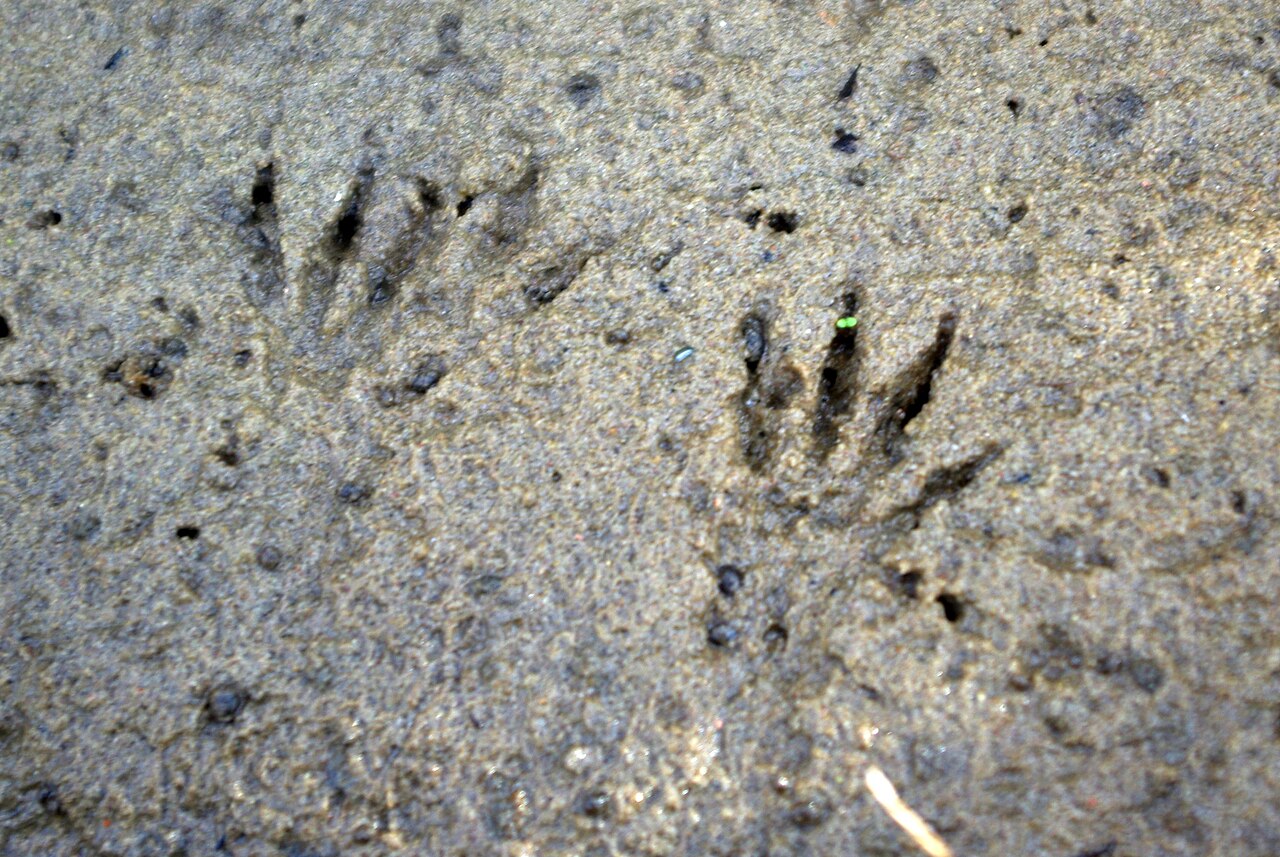
Most signs of this species lie on the bank. The burrow entrances in the side are oval and wider than tall and lie in series along the water, some below the waterline, each with a close-grazed patch in front. On muddy bank margins the prints are readily found: the fore foot registers four toes in a star shape, the hind foot five, with long, widely splayed toes and fine claw points, in a trail running from the water into the reeds. Along the runs lie feeding stations: small piles of grass, sedge and reedmace stems in lengths of five to ten centimetres, cut obliquely, and in spring the grazed leaves of iris and water-plantain. The droppings — 8 to 12 mm long, 4 to 5 mm thick, cylindrical with blunt ends, green-brown and odourless — lie in latrines on a stone, a tussock or a ledge at the water's edge. In Spain and France these latrines are the standard method for establishing whether a stream is still occupied, because the animals themselves are hard to count. Unlike the Eurasian Water Vole, this species rarely makes earth heaps in meadows; earth heaps in south-western France belong to the fossorial form of the Eurasian Water Vole.
Head close-up

Identification
The Southwestern Water Vole is the largest Arvicola in Europe: 16.5 to 22 cm head and body and up to 275 grams, males averaging larger than females. The animal is heavy and barrel-shaped, with a blunt muzzle, small ears sunk in the fur and small dark eyes. The coat is long, shaggy and dark reddish brown to almost black, the belly grey; wet, the animal looks glossy black. The tail is furred, dark, and a good half to two-thirds the head-body length — longer than in the Eurasian Water Vole. The hind foot is large (31 to 39 mm) and the toes are fringed with stiff hairs that enlarge the swimming surface. Swimming, it rides high with its back clear of the water and the tail trailing, and it dives with a slap of the tail. On the bank the size is the most obvious feature.
Similar species
The main identification problem arises in France, where this species and the Eurasian Water Vole (Arvicola amphibius) meet along hundreds of kilometres, from Brittany and the Loire to the Rhône valley. There the rule is: A. sapidus is larger, darker, shaggier and longer-tailed, and always at water; the Eurasian Water Vole is smaller, browner and greyer, and in France very often in the fossorial form that avoids water altogether and throws up earth heaps in pasture. A big dark animal swimming along a stream is almost certainly sapidus; a smaller, paler one heaping soil in a meadow is almost certainly amphibius. But a young sapidus and an adult amphibius overlap in size, and then the field gives no answer; the skull or the locality decides. In the Iberian Peninsula identification is simpler, since outside the Pyrenees and the Cantabrian Mountains it is the only large waterside vole; the confusion species there is the Brown Rat, with its pointed muzzle, large naked ears and scaly hairless tail, and in the north the much smaller Cabrera's Vole and Mediterranean Pine Vole. The Pyrenean Desman shares the stream but has a mobile, elongated snout and a flattened tail.
Habitat
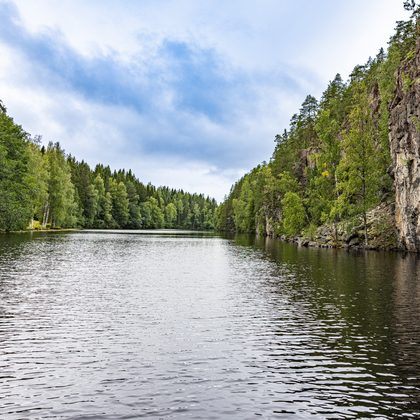
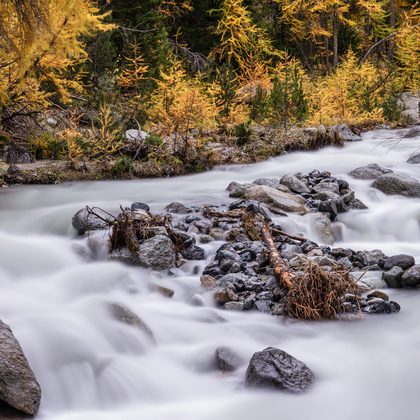
The species is strictly tied to fresh water and has specific requirements: still or slow-flowing water with a densely vegetated bank — reed, reedmace, sedge, rushes, willow scrub — and a soft, diggable side. Ditches, irrigation canals, brooks, river banks, ponds, pools, marshes and brackish lagoons, from sea level to 2300 metres in the Pyrenees and the Sierra Nevada. Suitable places are narrow and scattered: in studied areas of southern Spain the usable habitat covers less than two per cent of the ground. Where livestock graze the bank bare or the stream dries out in summer, the species disappears.
Where the animal is most at home, classified with EUNIS — the European standard for habitats.


Distribution
The Southwestern Water Vole occurs only in France, Spain and Portugal. In France it lives from Brittany and the Loire southwards, with the northern limit running roughly from Normandy to Burgundy, where it borders the range of the Eurasian Water Vole. In the Iberian Peninsula it occurs almost everywhere there is water, from Galicia and the Cantabrian coast to the Guadalquivir; it is absent only from the driest parts of the south-east, much of Almería and Murcia, and the Balearic and Canary Islands. In Iberia the Eurasian Water Vole reaches only the Pyrenees and the Cantabrian Mountains, so that a large vole by water in almost all of Spain and Portugal is this species. The species is absent from north-west Europe and from Britain and Ireland, where only the Eurasian Water Vole occurs; the nearest populations are in central France.
- Native
- dark = core range, pale = thinly spread
Way of life
The Southwestern Water Vole is active by day and by night, with two summer peaks in late morning and afternoon; as a result it is exceptionally visible for a vole. It swims and dives well and digs burrows in the bank. The diet is almost entirely plant material with a strong bias to monocotyledons: grasses more than half, reedmace about a sixth and sedges about a sixth, plus herbs, roots and aquatic plants; animal food is rarely taken. Breeding runs from February to October and in mild weather can continue through the winter, with one to eight embryos per female and several litters a year. Young disperse along the watercourse and cross dry ground in doing so, which is their greatest risk. It does not hibernate.
Where and when to look
A stream or irrigation canal with a dense fringe of reed in Spain, Portugal or southern France is most suitable in the late morning: the species is active by day and therefore easier to observe than other European voles. From a footbridge or a steep bank the waterline under the reed stems can be watched; the animal swims a short way, climbs onto a tussock and feeds there sitting upright with a stem in its forepaws. If the animal does not appear, a latrine is equally good evidence: a small pile of green-brown droppings on a stone at the water's edge; this is how the species is mapped in Spain and France. In the mud at the water's edge the prints with four toes in front and five behind can be found.
Conservation status
Near Threatened (NT, 2024), and of the three European Arvicola species the one faring worst. The decline has been put at around thirty per cent over ten years and is continuing. The causes are the same everywhere: the straightening, concreting and annual clearing of streams and irrigation canals, watercourses drying out through abstraction and drought, overgrazing of the bank, and fragmentation: the habitat is naturally linear, and a severed reach means the loss of a population. On top of that, in France and Iberia it is prey to the naturalised American Mink, which, as with the water vole in Britain, is small enough to enter the burrows. Recovery of the species depends on recovery of the banks: where a stream keeps or regains its reed fringe, the species can return.
Scientific name
Arvicola sapidus | G. S. Miller, 1908
G. S. Miller described the species in 1908 and placed it straight away in the genus where it still stands. Arvicola is Latin, from arvum, 'ploughed land', and colere, 'to inhabit': the dweller in the fields. sapidus is Latin for 'savoury, well-flavoured', from sapere, 'to taste'. Miller leaves it open what he meant by it. The specimen the first description was based on came from Spain.