The habitats of Amazonia and the Guianas
Every species in this guide is linked to the habitats where it most occurs in Amazonia and the Guianas. Each bird has at most seven formations: not everything it has ever been seen in, but where it truly belongs.
Select a habitat to read its description.
Open sea and oceanic islands A
All salt water beyond the low-tide line, from the Caribbean coast of Venezuela past the Guianas and the Amazon mouth to Rio Grande do Sul, with the islands far out in the ocean. Beaches, mangroves and mudflats belong to Coast and mangroves. The subdivision follows depth: open ocean beyond the continental shelf, inshore waters above it, and oceanic islands. Albatrosses, petrels, shearwaters, boobies, frigatebirds, tropicbirds and terns live here, many seen only from a boat or on the islands.
-
 Open Atlantic Ocean A1
67 species
The deep water beyond the edge of the continental shelf, where the seabed drops to thousands of metres. The shelf edge is the boundary with Inshore waters and continental shelf; the islands in this ocean belong to Oceanic islands and rocks. Off the mouth of the Amazon the shelf edge lies far from the coast, off south-eastern Brazil much closer. Birds here can only be seen from a ship. Off southern Brazil Atlantic Yellow-Nosed Albatross, Black-Browed Albatross and White-Chinned Petrel forage, often behind fishing boats. After breeding on islands in the South Atlantic, Great Shearwater moves north through these waters, and Wilson's Storm-Petrel occurs along the whole length of the guide area.
-
 Inshore waters and continental shelf A2
78 species
The shallow sea above the continental shelf, from the low-tide line to the shelf edge, where Open Atlantic Ocean begins. On the landward side it borders Sandy beaches and dunes, Mudflats, lagoons and salt flats, Mangroves and Rocky shores and cliffs. Off the Guianas and the mouth of the Amazon the water is murky and brown with silt carried by the river; off south-eastern and southern Brazil it is clearer and colder. Brown Booby and Magnificent Frigatebird fish along almost the entire coast, and Royal Tern is found throughout. In the south South American Tern occurs and, outside the breeding season, Magellanic Penguin. Parasitic Jaeger chases terns to steal their fish.
-
 Oceanic islands and rocks A3
29 species
The islands and rocks far offshore, separated from the mainland by Open Atlantic Ocean: Fernando de Noronha, Atol das Rocas, the rocks of Sao Pedro e Sao Paulo and, much further to the south-east, Trindade and Martim Vaz. Islands close to the coast belong to Rocky shores and cliffs. Seabirds breed in colonies on these islands, far from predators on the mainland. Sooty Tern and Brown Noddy breed in large numbers on Atol das Rocas, and Masked Booby nests on bare ground. Within the guide area Trindade Petrel breeds only on Trindade. Fernando de Noronha holds two land birds found nowhere else: Noronha Vireo and Noronha Elaenia.
Coast and mangroves B
The narrow strip where land and sea meet, between the low-tide line and the point the tide no longer reaches. Open sea belongs to Open sea and oceanic islands, freshwater marshes and forest inland to the groups of the interior. Along the Guianas and the mouth of the Amazon mudflats and mangroves dominate, in north-eastern Brazil sandy beaches and dunes, in the south-east restinga and rocky shores. Shorebirds from North America spend the northern winter here, alongside herons, ibises, terns and a handful of coastal specialists.
-
 Sandy beaches and dunes B1
80 species
Sandy coast from the low-tide line to the crest of the dunes. Seawards it borders Inshore waters and continental shelf; inland it passes into Restinga, and where silt rather than sand is deposited into Mudflats, lagoons and salt flats. Long sandy beaches lie mainly in north-eastern and southern Brazil, with the large dune fields of the Lencois Maranhenses and the beach of Rio Grande do Sul. Along the Guianas sandy beach is scarce, because mud dominates there. Sanderling runs with the waves, while Semipalmated Plover, Collared Plover and Wilson's Plover forage on the drier sand. American Oystercatcher and resting Royal Tern are also regular.
-
 Restinga B2
43 species
The vegetation on the sandy coastal plains of Brazil, behind beach and dunes. Restinga runs from open grassland and low shrubs just behind Sandy beaches and dunes to low forest further inland, where it passes into Coastal lowland forest. At river mouths it borders Mangroves. The soil is poor, dry sand, with wet hollows here and there between old beach ridges. Restinga occurs along large parts of the Brazilian coast, but much of it has been lost to building. Restinga Tyrannulet is tied to this habitat and lives only in the restinga of south-eastern and southern Brazil. Southern White-fringed Antwren keeps to the scrub, and Chalk-browed Mockingbird and Tropical Mockingbird sing from the tops of the bushes.
-
 Mangroves B3
137 species
Forest of salt-tolerant trees in the tidal zone of sheltered coasts and estuaries. On the seaward side it borders Mudflats, lagoons and salt flats; inland it passes into Restinga or, where the water turns fresh, into Várzea (whitewater flooded forest). Along the coasts of Amapa, Para and Maranhao lies a broad, almost unbroken belt of mangroves, and the coast of the Guianas and the Orinoco delta are also rich in mangrove. Further south the forests become smaller. Scarlet Ibis breeds and feeds here in flocks, and Rufous Crab Hawk hunts crabs among the roots. Yellow-Crowned Night-Heron, Mangrove Rail, Mangrove Cuckoo and Bicolored Conebill are resident.
-
 Mudflats, lagoons and salt flats B4
147 species
Open, bare coast of silt and mud exposed at low tide, with the lagoons and salt pans behind it. Seawards it borders Inshore waters and continental shelf, landwards Mangroves and Sandy beaches and dunes. The freshwater marshes of the south belong to Southern marshes and lagoons. Silt from the Amazon forms extensive mudflats along the Guianas and in the Reentrancias Maranhenses, and there are salt pans in north-eastern Brazil and along the Venezuelan coast. Mainly in the months of the northern winter, large numbers of Semipalmated Sandpiper, Short-billed Dowitcher and Hudsonian Whimbrel spend the season here; Red Knot rests at sites such as the Lagoa do Peixe. American Flamingo and Roseate Spoonbill feed in shallow lagoons.
-
 Rocky shores and cliffs B5
25 species
Coast of rock, cliff and steep bank, including rocky islets close to shore. Where the rock ends Sandy beaches and dunes begins, and islands far out at sea belong to Oceanic islands and rocks. Rocky coast lies mainly in south-eastern and southern Brazil, where the mountains of the Serra do Mar reach the sea, and along parts of the Venezuelan coast. In north-eastern Brazil cliffs of sandstone and clay rise above the beach. Along the Guianas rocky coast is rare. Ruddy Turnstone forages among the rocks at low tide. Brown Booby and Magnificent Frigatebird breed on islets off south-eastern Brazil, and Kelp Gull and Neotropic Cormorant rest on the rocks.
Inland waters C
The open fresh water of the interior: rivers, streams, rapids, lakes and reservoirs, with their bare banks and sandbars. Flooding forest belongs to Flooded forest and swamps of Amazonia; the marshes of the Pantanal, the Llanos and the south to their own groups. The guide area covers the Amazon and Orinoco basins and much of the Parana and Sao Francisco basins. Water levels change greatly between rainy and dry seasons. Kingfishers, terns, skimmers, cormorants, herons and swallows are typical.
-
 Large rivers and sandbars C1
94 species
The broad main channels of the lowlands and the sandbars and bare banks that emerge in the dry season. Along the banks Várzea (whitewater flooded forest) or Igapó (blackwater flooded forest) begins; vegetated islands and floating grasslands belong to Floating meadows and river islands, rocky stretches to Rapids and waterfalls. This means rivers such as the Amazon, the Madeira, the Araguaia and the Orinoco. At low water sandbars appear, sometimes kilometres long, and Large-billed Tern, Yellow-billed Tern and Black Skimmer breed there in colonies. Pied Plover and Sand-colored Nighthawk rest on the sand by day, and Orinoco Goose grazes on the banks.
-
 Blackwater rivers and small streams C2
57 species
Rivers with dark, tea-coloured water and the small streams under the forest canopy, the igarapes. The water is clear but stained dark by dissolved plant compounds, and poor in nutrients. Along the banks stands Igapó (blackwater flooded forest) or, beside streams on higher ground, Tall terra firme forest. The Rio Negro is the largest blackwater river; many smaller ones drain the Guiana Shield and the white-sand areas. Sungrebe swims beneath overhanging branches, and Green-and-rufous Kingfisher and American Pygmy Kingfisher fish from low perches over shaded water. Zigzag Heron and Agami Heron live hidden along streams and banks in the forest, and White-banded Swallow hunts low over the water of the larger blackwater rivers.
-
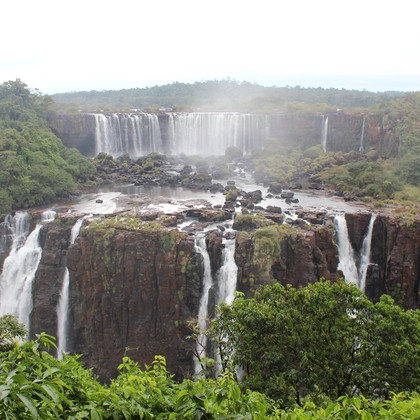 Rapids and waterfalls C3
25 species
Stretches of river where water runs over rocks and ledges or plunges over a fall, with the wet rock faces around them. Up- and downstream they pass into Large rivers and sandbars or Blackwater rivers and small streams; slope forests belong to Highland forest of the Guiana Shield or Atlantic Forest. Guiana Shield rivers are full of rapids, with falls such as Kaieteur in Guyana and Salto Angel in Venezuela; in the south lie the Iguacu falls. Black-collared Swallow perches on rocks in mid-stream. White-collared Swift and Great Dusky Swift nest on rock faces behind falling water, the latter at Iguacu. Fasciated Tiger Heron hunts in fast water, and Brazilian Merganser lives on clear, rocky Cerrado rivers.
-
 Lakes and reservoirs C4
143 species
Still open water: natural lakes on the floodplains of the large rivers and the reservoirs behind dams. Where the shore becomes overgrown with floating plants Floating meadows and river islands begins, and the surrounding forest belongs to Várzea (whitewater flooded forest) or Igapó (blackwater flooded forest). The lakes of the Pantanal belong to Lakes, baías and aquatic vegetation. Countless floodplain lakes lie along the Amazon, merging with the river in the rainy season. Large reservoirs include Tucurui and Balbina in Brazil, Guri in Venezuela and Brokopondo in Suriname. Neotropic Cormorant and Anhinga fish in open water, Least Grebe in quiet bays. Black-bellied Whistling Duck, Great Egret and Ringed Kingfisher are regularly seen.
Flooded forest and swamps of Amazonia D
The forest and swamp of the Amazonian lowlands that floods every year or stays permanently wet. Higher forest that never floods belongs to Terra firme forest of Amazonia, open water to Inland waters. In the rainy season and the months after, rivers rise by several metres and large areas of forest flood. The subdivision follows the water: whitewater forest, blackwater forest, palm swamps, and floating meadows and river islands. Hoatzin, Horned Screamer, parrots, macaws and many flooded-forest antbirds and ovenbirds live here.
-
 Várzea (whitewater flooded forest) D1
532 species
Forest along the whitewater rivers, which are muddy and rich in silt from the Andes, that stands under water for part of every year. Higher up the bank, where the water never reaches, Tall terra firme forest begins; along blackwater rivers the flooded forest is called Igapó (blackwater flooded forest), and young growth on sandbars and islands belongs to Floating meadows and river islands. Várzea lines the Solimoes, the Amazon, the Madeira and the Purus, with large areas in the Mamiraua reserve. The silt makes the soil fertile and the forest rich in food. Hoatzin eats leaves in low trees along the water. Long-billed Woodcreeper, Black-chinned Antbird, Silvered Antbird, Band-tailed Antbird and Varzea Piculet are tied to this forest.
-
 Igapó (blackwater flooded forest) D2
141 species
Forest along blackwater rivers and lakes that floods for part of every year. The water is dark and nutrient-poor, and the forest is lower and poorer in species than Várzea (whitewater flooded forest). Higher up it passes into Tall terra firme forest or, on poor white sand, White-sand forest and campina. Igapó dominates along the Rio Negro, with the Anavilhanas islands, and along many rivers draining the Guiana Shield. In the dry season the trees stand on bare sandy banks; in the rainy season only their crowns show above water. Cherrie's Antwren and Black-chinned Antbird glean insects from low foliage over the water, Zigzag Heron hides in the shade, and Hoatzin sits in small groups in riverside trees.
-
 Palm swamps D3
52 species
Swamps dominated by palms, above all the buriti or moriche palm, on permanently wet ground in the Amazonian lowlands and the coastal plains of the Guianas. The veredas of the Cerrado belong to Veredas and gallery forest. Where palms give way to mixed flooded forest, Várzea (whitewater flooded forest) or Igapó (blackwater flooded forest) begins, and on dry ground Tall terra firme forest. Palm swamps often fill hollows between higher ground and seepage zones behind the coast. Red-bellied Macaw and Blue-and-yellow Macaw eat the fruit and nest in dead trunks. Point-tailed Palmcreeper forages among the fronds, Sulphury Flycatcher hunts from the crowns, and Fork-tailed Palm Swift nests in hanging dead leaves.
-
 Floating meadows and river islands D4
166 species
Floating mats of grasses and water plants along the banks and in the floodplain lakes, and the young islands in the large rivers with cane, willows and <em>Cecropia</em>. Once an island grows older and carries tall forest it belongs to Várzea (whitewater flooded forest); bare sandbars and open water belong to Large rivers and sandbars and Lakes and reservoirs. This vegetation changes every year: the water builds new sandbars and washes old ones away. Wattled Jacana and Azure Gallinule walk over the floating plants. On the river islands of the Amazon live specialists such as Red-and-white Spinetail, Parker's Spinetail, River Tyrannulet and Lesser Wagtail-Tyrant, which are found almost nowhere else.
Terra firme forest of Amazonia E
Forest on ground that is never flooded by the rivers: most of the Amazon basin in Brazil, southern Venezuela and the interior of the Guianas. Along the rivers it gives way to Flooded forest and swamps of Amazonia, to the south and east to the Cerrado, and in the north to the uplands of the Guiana Shield and tepuis. For birds this is the richest habitat of the guide area, with tinamous, toucans, parrots, woodcreepers, antbirds and manakins, often together in mixed flocks.
-
 Tall terra firme forest E1
566 species
Tall, closed rainforest on well-drained ground, with a dense canopy and scattered giants rising above it. Where the river overflows its banks in the rainy season, Várzea (whitewater flooded forest) or Igapó (blackwater flooded forest) begins; on poor white sand it becomes White-sand forest and campina, and where bamboo dominates, Bamboo and liana forest. It covers much of the basin, from Acre and Rondônia to Pará, Amapá and the interior of Suriname and French Guiana. In the shady understorey Great Tinamou and Black-faced Antthrush walk the forest floor, the Screaming Piha calls from the mid-storey, and in the canopy live White-throated Toucan and noisy groups of Red-throated Caracara. The Harpy Eagle hunts monkeys and sloths here.
-
 Bamboo and liana forest E2
100 species
Forest in south-western Amazonia where bamboo of the genus <em>Guadua</em> and lianas fill much of the understorey and mid-storey, above all in Acre and the adjoining south-west of Amazonas. It passes without a sharp boundary into Tall terra firme forest, where the bamboo disappears and the canopy closes again; along rivers it can also grow on higher banks next to Várzea (whitewater flooded forest). After many years the bamboo flowers all at once and then dies back, so the forest keeps changing in character. For birds it is a world of its own, with species you seldom see outside it: Rufous-headed Woodpecker, Bamboo Antshrike, Manu Antbird, Peruvian Recurvebill, White-cheeked Tody-Flycatcher and Large-headed Flatbill all forage among the bamboo stems.
-
 White-sand forest and campina E3
141 species
Low, open forest and scrub on nutrient-poor white sand, mainly in the Rio Negro basin and around Manaus, and scattered across southern Venezuela and the Guianas. Where the trees stand denser and taller it is called campinarana; open patches with shrubs, lichens and bare sand are called campina. It lies as islands within Tall terra firme forest and along black rivers often borders Igapó (blackwater flooded forest), which grows on the same poor soil. Water from these areas is stained dark by dissolved humus. Many birds of ordinary rainforest are missing here, but a few species are tied to this forest or are more frequent in it, such as Bronzy Jacamar, Black Manakin, Saffron-crested Tyrant-Manakin and Rufous-crowned Elaenia.
-
 Secondary forest and forest edge E4
718 species
Young forest growing back on abandoned fields and pastures, clearings left by logging and the edges of roads, rivers and open land. It lies between Tall terra firme forest on one side and Pasture and arable land or Towns, cities and gardens on the other, and over the years becomes taller forest again. Fast-growing trees such as <em>Cecropia</em>, shrubs, heliconias and lianas form a dense, untidy growth. You find it around cities such as Manaus, Belém and Paramaribo and along roads into the forest. Edge species are at home here: Silver-beaked Tanager, Yellow-rumped Cacique with its colonies of hanging nests, Common Squirrel Cuckoo, Barred Antshrike and Rufous-breasted Hermit at the heliconias.
Guiana Shield and tepuis F
The ancient rock of the Guiana Shield above the lowland forest: from the Gran Sabana and the tepuis of south-eastern Venezuela via Mount Roraima and the Pakaraima Mountains in Guyana to the inselbergs of Suriname and French Guiana. The surrounding lowland forest belongs to Terra firme forest of Amazonia. The group covers highland forest, tepui summits, rock outcrops and the savannas of the Guianas. For birds it is an area with many species found nowhere else, from Tepui Swift around the cliff faces to the Guianan Cock-of-the-Rock in the ravines.
-
 Highland forest of the Guiana Shield F1
202 species
Humid montane forest on the slopes of the tepuis and the uplands of the Guiana Shield. Downhill it passes into Tall terra firme forest, uphill into Tepui summits and sandstone scrub,. The forest is lower than in the lowlands, often wrapped in cloud and rich in mosses, bromeliads and tree ferns. You find it in the Sierra de Lema along the road to the Gran Sabana, in the Pakaraima Mountains of Guyana and around Pico da Neblina in Brazil. Many species found only in these uplands live here, such as Red-banded Fruiteater, Rose-collared Piha, Roraiman Antwren, Tepui Toucanet, Peacock Coquette and Rufous-brown Solitaire.
-
 Tepui summits and sandstone scrub F2
36 species
The flat sandstone summits of the tepuis, cut off from the land below by sheer walls, such as Roraima, Kukenán, Auyán-tepui, Duida and Pico da Neblina. Highland forest of the Guiana Shield clothes the slopes; the summits themselves are bare rock with low scrub, boggy hollows, bromeliads and carnivorous plants such as <em>Heliamphora</em>. It is wet, cool and often misty, and each summit is an island with its own flora. Few birds live this high, and some of them are tied to the tepuis: Tepui Goldenthroat, Tepui Wren, Great Elaenia, Tepui Brushfinch and Greater Flowerpiercer forage in the scrub, while Tepui Swift hunts along the cliff faces.
-
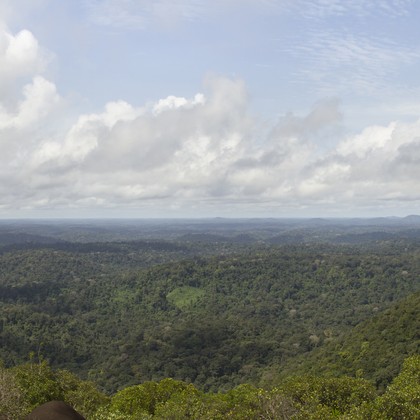 Inselbergs and rock outcrops F3
12 species
Bare granite domes and walls that rise abruptly from the lowland forest, and other rock outcrops on the Guiana Shield, such as the Voltzberg in Suriname and the Nouragues inselberg in French Guiana. Tall terra firme forest surrounds them; the high sandstone summits belong to Tepui summits and sandstone scrub. On the rock only grasses, bromeliads, cacti and low shrubs grow in thin layers of soil, and in the dry season the rock grows hot. For birds it offers crevices, caves and ledges to breed or rest. The Guianan Cock-of-the-Rock fixes its nest to rock faces in shady ravines, the Cliff Flycatcher hunts from the rock, White-collared Swift nests by damp walls and Orange-breasted Falcon uses high ledges.
-
 Savannas of the Guianas F4
152 species
Open grassland with scattered shrubs, termite mounds and low trees on the Guiana Shield: the Rupununi in Guyana, the lavrado of Roraima, the Sipaliwini savanna in southern Suriname and the Gran Sabana in Venezuela. Tall terra firme forest or Highland forest of the Guiana Shield surrounds them,. To the north-west lies the Llanos savanna and further south the Cerrado savanna. In the rainy season the hollows flood; in the dry season the grass withers and fire often sweeps through. Typical birds are Sharp-tailed Ibis in wet hollows, Hoary-throated Spinetail in riverside scrub, Bearded Tachuri, Grassland Sparrow and Wedge-tailed Grass Finch in the grass, and Double-striped Thick-knee on bare ground.
Cerrado G
The great savanna belt of central Brazil, from Mato Grosso and Goiás to Minas Gerais, Tocantins and southern Maranhão and Piauí, with Brasília at its heart. In the north and west it borders Terra firme forest of Amazonia, in the east Caatinga and dry forest, in the south-east the Atlantic Forest and in the south-west the Pantanal. Its formations range from open grassland through wooded savanna to dry woodland, with palms and gallery forest along the water. Characteristic birds are Greater Rhea, Red-legged Seriema, Toco Toucan and Curl-crested Jay.
-
 Cerrado savanna G1
167 species
Open savanna of grass with scattered, twisted trees and thick-barked shrubs, from almost treeless grassland to fairly dense wooded savanna. Where the trees close up it becomes Cerradão and dry woodland, wet valley floors hold Veredas and gallery forest, and on rocky heights Campo rupestre and mountain grassland begins. The rainy season runs roughly from October to April; in the dry season the grass withers and fires sweep through regularly, after which many plants sprout again quickly. Large areas lie in Emas National Park and the Chapada dos Veadeiros in Goiás. Greater Rhea and Red-legged Seriema walk through the grass, Burrowing Owl sits by its burrow, and Curl-crested Jay, Coal-crested Finch and Collared Crescentchest live in the shrubs.
-
 Cerradão and dry woodland G2
170 species
Closed dry woodland within the Cerrado: cerradão, a taller, denser woodland on deeper soil with species of both savanna and forest, and seasonal forest on richer and limestone soils that sheds much of its foliage in the dry season. It borders open Cerrado savanna and Veredas and gallery forest along the water, and to the east it passes into Dry forest of the north-east. In the Paranã valley in Goiás dry forest grows on limestone, the home of Pfrimer's Parakeet. You also find Great Rufous Woodcreeper, flocks of Peach-fronted Parakeet and Toco Toucan.
-
 Veredas and gallery forest G3
286 species
The wet network running through the Cerrado: veredas, wet valley floors with grassland and rows of buriti palms (<em>Mauritia flexuosa</em>), and gallery forest, narrow evergreen forest along streams and rivers. Around them lies Cerrado savanna or Cerradão and dry woodland; the palm stands resemble Palm swamps in Amazonia but here lie as narrow ribbons in open country. Water stays here even in the dry season and the trees stay green, so birds from the surroundings gather here. Grande Sertão Veredas National Park in Minas Gerais is named after them. Red-bellied Macaw, Point-tailed Palmcreeper and Sulphury Flycatcher breed in the buriti palms; Helmeted Manakin, White-striped Warbler and Brasilia Tapaculo, live in the gallery forest.
-
 Campo rupestre and mountain grassland G4
55 species
Grassland and low scrub among quartzite and sandstone rocks on the heights of central and eastern Brazil, mainly in the Serra do Espinhaço from Minas Gerais to the Chapada Diamantina in Bahia, and the high grasslands of the Serra da Canastra. Lower on the slopes lies Cerrado savanna; damp ravines and valleys hold Veredas and gallery forest or woodland linked to the Atlantic Forest. The flora is very rich in species found only on these mountains. For birds it means a small group of specialists of rock and grass: Cipo Canastero in the Serra do Cipó, Hyacinth Visorbearer at flowering shrubs, Grey-backed Tachuri in the tall grass and Horned Sungem in the open scrub.
Caatinga and dry forest H
The semi-arid interior of north-eastern Brazil, from Piauí and Ceará to northern Minas Gerais, with a long dry season and irregular rains. To the west and south it borders the Cerrado, to the east the Atlantic Forest and the Northeastern coastal forest. The group covers thorny scrub, taller dry forest and humid forest islands on the heights. Typical birds are Caatinga Cacholote and Caatinga Parakeet; Lear's Macaw nests in sandstone cliffs in northern Bahia.
-
 Caatinga scrub H1
101 species
Low, thorny scrub with cacti, bromeliads and scattered trees that shed their leaves in the dry season, on the shallow, stony soils of the north-east. On deeper soil it becomes Dry forest of the north-east, on moister heights Brejos and highland forest begins, and to the west it passes into Cerrado savanna. For most of the year the scrub looks grey and bare; after the first rains it turns green within a few days. Large areas lie in the Raso da Catarina in Bahia and the Serra da Capivara in Piauí. Caatinga Cacholote builds large stick nests, and Red-cowled Cardinal, Campo Troupial, Caatinga Parakeet, White-naped Jay and Stripe-backed Antbird are also typical.
-
 Dry forest of the north-east H2
87 species
Taller, closed dry forest in the north-east and the São Francisco valley, on deeper or lime-rich soils, where trees stand mostly bare in the dry season and form a dense canopy in the rainy season. On shallow, stony ground it passes into Caatinga scrub; to the west it joins Cerradão and dry woodland, and on humid heights Brejos and highland forest. Much of it has been cleared for farming, and what remains often lies in separate patches, as in northern Minas Gerais. For birds the forest offers more cover and taller trees than the scrub. Great Xenops, White-browed Guan, Silvery-cheeked Antshrike and Caatinga Antwren live here.
-
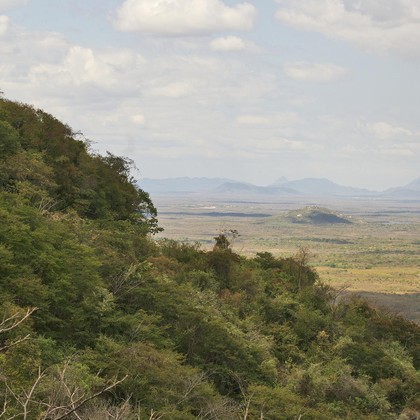 Brejos and highland forest H3
28 species
Islands of humid, evergreen forest on the plateaus and ridges in the middle of the caatinga, where rising air brings more rain and mist than in the surrounding lowland. Known examples are the Serra de Baturité in Ceará and the slopes of the Chapada do Araripe between Ceará and Pernambuco. Caatinga scrub or Dry forest of the north-east surrounds them; in plants and animals this forest resembles the Atlantic Forest more than the caatinga. For birds they are isolated refuges with their own species: Araripe Manakin at the springs at the foot of the Chapada do Araripe, Grey-breasted Parakeet in the Serra de Baturité, and Ochraceous Piculet and Ceara Gnateater.
Atlantic Forest I
The forest along the Atlantic coast of Brazil and in the adjoining interior, from Rio Grande do Norte to Rio Grande do Sul. Inland it gives way to Cerrado, in the north-east to Caatinga and dry forest and in the south to Pampa and southern grasslands; towards the sea it meets Coast and mangroves. Much of it has been cleared; the largest remnants lie on the slopes of the Serra do Mar. Many of its birds live nowhere else: tapaculos, berryeaters, manakins, tanagers and antbirds.
-
 Coastal lowland forest I1
345 species
Evergreen rainforest on the coastal plain and at the foot of the coastal mountains, from Bahia to Santa Catarina. Higher up it gives way to Montane forest of the Serra do Mar; on the sand just behind the beach stands Restinga, and north of Bahia begins Northeastern coastal forest. It is tall, humid forest with many epiphytes and palms. Most of the lowland forest has been lost to farming and cities; remnants are found mainly in reserves in southern Bahia, in Espírito Santo and at the foot of the Serra do Mar in São Paulo and Paraná. Typical are Saw-billed Hermit, Spot-billed Toucanet, Unicolored Antwren, Black-headed Berryeater, White-winged Cotinga and Green-headed Tanager.
-
 Montane forest of the Serra do Mar I2
236 species
Humid, often misty montane forest on the slopes and ridges of the Serra do Mar and the Serra da Mantiqueira, in Rio de Janeiro, São Paulo, Minas Gerais and further south. Lower on the slope it gives way to Coastal lowland forest, on the highest summits to Campo rupestre and mountain grassland, inland to Interior semi-deciduous forest and in the south to Araucaria forest. The trees are lower than below, with many mosses, bromeliads and bamboo. Large areas are protected, among them Itatiaia and the Serra dos Órgãos. Here live Bare-throated Bellbird, Hooded Berryeater, Swallow-tailed Cotinga, Slaty Bristlefront and Brassy-breasted Tanager; the call of the bellbird carries far across the slopes.
-
 Interior semi-deciduous forest I3
316 species
Semi-deciduous forest in the interior behind the coastal mountains, in western São Paulo, in Minas Gerais and in inland Paraná as far as the Iguaçu. Some of the trees shed their leaves in the dry season. Towards the coast it gives way to Montane forest of the Serra do Mar, on the higher plateaus in the south to Araucaria forest and in the north and west to Cerrado. Most of it has been converted to fields and pasture; the largest continuous block lies in Iguaçu National Park. Characteristic are Scaly-headed Parrot, Surucua Trogon, Rufous-capped Motmot, Saffron Toucanet and Helmeted Woodpecker. Species of the drier interior also occur here alongside those of the coastal forest.
-
 Araucaria forest I4
147 species
Mixed forest with the Paraná pine, a conifer with a flat, umbrella-shaped crown, on the high plateaus of Paraná, Santa Catarina and Rio Grande do Sul, with smaller patches high in the Serra da Mantiqueira. On the slopes towards the coast it gives way to Montane forest of the Serra do Mar, lower in the interior to Interior semi-deciduous forest; on the plateau it alternates with open grassland, which in the south joins Pampa grassland. Logging has left far less of it than there once was. The seeds of the araucaria feed Vinaceous-breasted Amazon, Red-spectacled Amazon and Azure Jay. The Araucaria Tit-Spinetail searches the crowns for insects, and Red-breasted Toucan also occurs here.
-
 Northeastern coastal forest I5
75 species
The Atlantic Forest north of the Rio São Francisco, in Alagoas, Pernambuco, Paraíba and Rio Grande do Norte. To the south it joins Coastal lowland forest; inland it gives way to Dry forest of the north-east and the Caatinga, with scattered Brejos and highland forest on the hills. Little of it remains: small, separate forest fragments among sugarcane fields, such as near Murici in Alagoas. As a result several of its own species have become very rare or have disappeared. Searching here you can still find White-winged Cotinga and Seven-colored Tanager, and with much luck Orange-bellied Antwren, Alagoas Antwren or Pinto's Spinetail, which live only in this part of the Atlantic Forest.
Pantanal J
A large, low basin in the catchment of the upper Rio Paraguay, in Mato Grosso and Mato Grosso do Sul, surrounded on all sides by the higher-lying Cerrado. In the rainy season much of the plain floods; in the dry season the water withdraws into lagoons and rivers. Along the Transpantaneira near Poconé this is clearly visible. For birds this means storks, herons, ibises, ducks and raptors on the water, and parrots, guans and toucans in the woodland patches.
-
 Seasonally flooded plain J1
100 species
The open plain of the Pantanal, with grassland, marshy hollows and scattered trees, which floods for shorter or longer periods in the rainy season and dries out to grassland in the dry season. Permanent water with aquatic plants belongs to Lakes, baías and aquatic vegetation; the wooded ridges and woodland patches belong to Gallery forest and woodland islands of the Pantanal. Much of it has long been grazed by cattle. As the water drops, fish are left behind in shallow pools, where Jabiru, Wood Stork and herons gather. Greater Rhea and Plumbeous Ibis walk the dry grassland, and Southern Screamer and flocks of Nanday Parakeet are common sights.
-
 Lakes, baías and aquatic vegetation J2
62 species
The water that remains in the Pantanal even in the dry season: rivers such as the Paraguay and the Cuiabá, old river channels and the round lakes known as baías, with floating water hyacinths and other aquatic plants. In the south there are also brackish lakes, the salinas. The surrounding plain belongs to Seasonally flooded plain, the forest along the banks to Gallery forest and woodland islands of the Pantanal. In the dry season this water becomes the refuge for everything that lives on fish and aquatic animals. Wattled Jacana walks over the floating plants, Limpkin searches the shore for snails, and Black-collared Hawk, Ringed Kingfisher, Anhinga and Brazilian Teal are typical.
-
 Gallery forest and woodland islands of the Pantanal J3
128 species
The forest of the Pantanal: gallery forest along the rivers and the capões, round woodland patches on slightly higher ground that stand like islands in the plain at high water, with palm stands and elongated wooded ridges in between. The open land around belongs to Seasonally flooded plain, the water to Lakes, baías and aquatic vegetation; at the edges of the basin it gives way to the forest of the Cerrado. Hyacinth Macaw searches the palms for nuts. In the forest live Bare-faced Curassow, Chaco Chachalaca, Toco Toucan, Pale-crested Woodpecker and Thrush-like Wren. Many herons and storks breed here in colonies in tall trees.
Pampa and southern grasslands K
The open grassland of southern Rio Grande do Sul, the Brazilian part of the pampas, with the marshes and lagoons of the coastal plain and the low hills with woodland and scrub. To the north it borders the Atlantic Forest, with Araucaria forest on the plateau; towards the sea, Coast and mangroves. The landscape is rolling and largely used as cattle pasture. For birds this means ground birds of the grassland, swans, rails and reed birds in the marshes, and scrub species from further south.
-
 Pampa grassland K1
116 species
Low, rolling grassland on the gentle hills, the coxilhas, of southern and western Rio Grande do Sul. Wet hollows with reeds and rushes belong to Southern marshes and lagoons, the hills with woodland and scrub to Woodland and scrub of the southern hills; to the north the grassland gives way to Araucaria forest. Most of it is grazed by cattle, and more and more has been converted to cropland. Where the grass stays tall enough, Greater Rhea and Spotted Nothura occur. Southern Lapwing is everywhere, Firewood-Gatherer builds its large stick nest in isolated trees, and wet grasslands hold Black-and-white Monjita and Saffron-cowled Blackbird, both of which have become rare.
-
 Southern marshes and lagoons K2
128 species
Fresh and brackish marshes, reedbeds and shallow lakes in the coastal plain of Rio Grande do Sul, around the Lagoa dos Patos and the Lagoa Mirim and in areas such as Taim and the Lagoa do Peixe. The dry grassland around them belongs to Pampa grassland; the mudflats and salt flats of the ocean shore belong to Mudflats, lagoons and salt flats. It is a flat landscape of rushes, reeds and floating plants, partly converted to rice fields. Black-necked Swan and Coscoroba Swan swim on the open water, Southern Screamer stands at the edge. In the reeds and rushes live Wren-like Rushbird, Many-colored Rush Tyrant and Straight-billed Reedhaunter, species you hardly meet elsewhere in the guide area.
-
 Woodland and scrub of the southern hills K3
63 species
Low woodland, scrub and gallery forest on the hills of the Serra do Sudeste and along the rivers of the pampas, and in the far west of Rio Grande do Sul the espinilho: an open savanna of low thorn trees, protected near Barra do Quaraí. The open land around belongs to Pampa grassland; to the north it gives way to Araucaria forest and Interior semi-deciduous forest. Birds of the dry woodland of Argentina and Uruguay that are absent from the rest of the guide area live here. In the espinilho you find Brown Cacholote and Tufted Tit-Spinetail; scrub and woodland edges hold Mottled Piculet, Red-crested Cardinal and Rufous Hornero.
Llanos and northern Venezuela L
Venezuela north of the Orinoco: the great grass plains of the Llanos, the dry lowland along the north coast and the forested coastal range, the Cordillera de la Costa. South of the Orinoco begins Guiana Shield and tepuis; towards the sea it meets Coast and mangroves. The year divides into a rainy season, roughly in the middle of the year, and a long dry season. For birds this means waders and ducks on the flooded plains, and dry-country specialists and montane forest species found only here.
-
 Llanos savanna L1
158 species
The higher parts of the Llanos, which flood briefly or not at all: open grassland with scattered trees, palms and woodland patches, mainly in the north and west of the Llanos, in states such as Guárico, Cojedes and Barinas. The lower, wet plains belong to Flooded Llanos and esteros; to the north the savanna gives way to Dry forest and thorn scrub of northern Venezuela, and south of the Orinoco lie the Savannas of the Guianas. Much of it is cattle pasture. Crested Bobwhite, Double-striped Thick-knee and Southern Lapwing live on the grassland, Crested Caracara sits along the roads, and Red-breasted Meadowlark and Saffron Finch are typical of the open country.
-
 Flooded Llanos and esteros L2
109 species
The low Llanos, mainly in Apure, which flood over large areas in the rainy season, with esteros: shallow marshes that hold water even in the dry season. The higher, drier savanna belongs to Llanos savanna; the large rivers themselves belong to Large rivers and sandbars. On the cattle ranches, the hatos, the land lies under water for months, and in the dry season birds gather at the last pools and esteros. Then you see large flocks of Scarlet Ibis, Bare-faced Ibis and Black-bellied Whistling Duck, Jabiru stands in the shallows and Hoatzin sits in the scrub along the bank. Yellow-hooded Blackbird sings in the reeds.
-
 Dry forest and thorn scrub of northern Venezuela L3
198 species
Dry forest, thorn scrub and cactus stands in the lowland and low hills of northern Venezuela, from around Lake Maracaibo through Falcón and Lara to the coast of Sucre and Margarita Island. Higher up it gives way to Montane forest of the Venezuelan coastal range, to the south to Llanos savanna; towards the sea it meets Coast and mangroves. The landscape is grey and leafless in the dry season and turns green briefly in the rainy season. Here live species otherwise found mainly in dry northern Colombia: Vermilion Cardinal, Bare-eyed Pigeon and Buffy Hummingbird, alongside Venezuelan Troupial, Brown-throated Parakeet and Rufous-vented Chachalaca.
-
 Montane forest of the Venezuelan coastal range L4
281 species
Humid montane and cloud forest in the Cordillera de la Costa, the mountain range along the Venezuelan coast, including Henri Pittier and El Ávila above Caracas, and further east the mountains of the Paria Peninsula. Lower on the slopes it gives way to Dry forest and thorn scrub of northern Venezuela, on the south side to Llanos savanna. The forest is rich in mosses and epiphytes and often lies in the clouds. The range is separate from the Andes and has its own species and forms. Here live Band-tailed Guan, Helmeted Curassow, Blood-eared Parakeet, Groove-billed Toucanet and Venezuelan Bristle Tyrant.
-
 Montane forest of the Venezuelan Andes and Perijá L5
Sierra Nevada National Park, Mérida, Venezuela
443 species
Humid montane and cloud forest on the eastern flank of the Andes in Venezuela, in the states of Táchira, Mérida and Trujillo, and in the Serranía de Perijá on the border with Colombia. The forest runs from the lower mountain slopes to the treeline, where it gives way to páramo. At lower elevations it borders Llanos savanna and Dry forest and thorn scrub of northern Venezuela; to the east lies the separate Cordillera de la Costa with Montane forest of the Venezuelan coastal range. The forest is rich in mosses and epiphytes and often lies in the clouds. Many species here are Andean species that also occur further south in Colombia, Ecuador and Peru.
Farmland and built-up areas M
Everything people have made of the original landscape: pasture, fields, plantations, villages and cities, in every part of the guide area. It borders every other habitat and pushes ever further into them, especially along the edges of Amazonia, in the Cerrado and in the Atlantic Forest. For forest birds it is mostly a loss, but species of open country and forest edge spread with it. Towns also hold introduced species such as House Sparrow, Rock Pigeon and Common Waxbill, alongside native species such as Black Vulture.
-
 Pasture and arable land M1
308 species
Open land made by people: cattle pastures, fields of soya, maize, rice or sugarcane, and fallow ground, from the cleared edges of Amazonia to the Cerrado and the south. Natural grasslands belong to their own group, such as Cerrado savanna, Pampa grassland or Llanos savanna; tree rows and orchards belong to Plantations and agroforestry. Large fields are poor in birds, but pastures with scattered trees and ponds attract many open-country species. Cattle Egret follows the livestock, Southern Lapwing and Crested Caracara are everywhere, Fork-tailed Flycatcher perches on posts and wires, and groups of Smooth-billed Ani and, in the south, Guira Cuckoo search hedges and edges for insects.
-
 Plantations and agroforestry M2
209 species
Planted forest and farming with trees: plantations of eucalyptus and pine, oil palm, coffee, and cacao in the shade of old trees, such as the cabruca of southern Bahia, as well as fruit orchards and yards with mixed trees. Open pasture and fields belong to Pasture and arable land; forest that returns by itself belongs to Secondary forest and forest edge. Dense eucalyptus plantations are poor in birds, but shade cacao and mixed orchards retain more of the forest. Here you see species of forest edges and semi-open country, such as Palm Tanager, Blue-grey Tanager, Bananaquit, Pale-breasted Thrush and flocks of White-eyed Parakeet.
-
 Towns, cities and gardens M3
266 species
Villages, towns and gardens, from small settlements along the rivers to large cities such as São Paulo, Rio de Janeiro, Caracas, Manaus and Belém, with parks, avenues and vacant lots. The surrounding land belongs to Pasture and arable land or Plantations and agroforestry. Cities with plenty of greenery and parks hold more species than you might expect, including parrots and tanagers. The introduced House Sparrow and Rock Pigeon are everywhere; in Brazil Common Waxbill also lives in rough ground. Great Kiskadee and Black Vulture can be seen in almost every city, and in the south Rufous Hornero builds its mud nest on posts and roofs.
Classification: still to be settled for this guide (phase 8).