All species › Passerines › Antbirds › Amazonian Streaked Antwren
Amazonian Streaked Antwren | Myrmotherula multostriata
Amazonemiersluiper | Hormiguerito rayado amazónico | Choquinha-estriada-da-amazônia
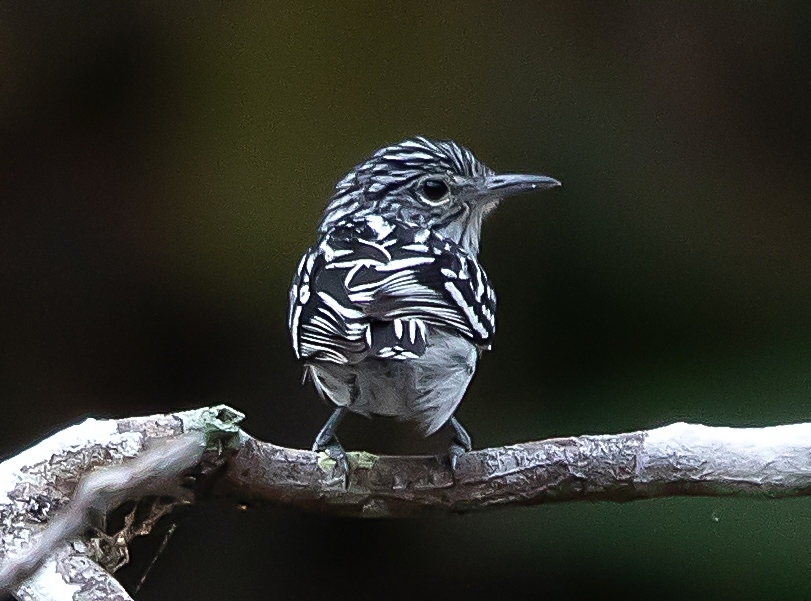
The Amazonian Streaked Antwren is a small, black-and-white streaked antwren of scrub and flooded forest along rivers and lakes in southern and western Amazonia. It is the sister species of Guianan Streaked Antwren north of the Amazon. Pairs stay low over the water and are often heard giving their short trill.
Voice
The song is a short, musical rattle that starts slightly rising. It also gives a flat, dry trill, a two-part contact note and a flat, complaining note.
Recording: JAYRSON ARAUJO DE OLIVEIRA — CC BY-NC-SA 4.0 · shortened to the first 60 s, mono · xeno-canto
Identification
9–10 cm, with a thin bill and a short tail. The male is black above with white streaks on the head, back and rump and has a large white patch between the shoulders. The wings are black with white tips to the coverts and white edges to the flight feathers; the tail is black with white edges and tips. The underparts are white, greyer on the flanks, with black streaks from throat to belly. The female has a cinnamon-rufous crown and nape streaked black, a buff face, a buff breast and otherwise whitish underparts with fine black streaks over the whole underside.
Confusion species
Guianan Streaked Antwren Myrmotherula surinamensis is very similar, but the female is almost unstreaked below; it lives north of the Amazon and east of the Rio Negro. Cherrie's Antwren Myrmotherula cherriei and Klages's Antwren Myrmotherula klagesi are also streaked black and white, but their females have a buff rather than rufous head. Pygmy Antwren Myrmotherula brachyura has a yellow belly and lives higher in the forest.
Habitat
Understorey and middle levels of flooded lowland forest, mainly várzea and igapó, and of dense secondary forest and scrub; almost always near water, in shrubs and vines along rivers, streams and oxbow lakes, from sea level to about 550 m. It gleans insects and spiders from leaves and twigs in pairs, often with other small antbirds. The nest is a small hanging cup in the fork of a twig.
Where the bird is most at home, classified by the vegetation units of Amazonia and the Guianas.




Range and movements
Brazil: almost entirely south of the Amazon, from the western border east into Maranhão and Tocantins and south into Mato Grosso, with an isolated group in Mato Grosso do Sul; north of the Amazon only in the lower Rio Negro basin. Venezuela: only locally in the far south. Absent from the Guianas. Outside the guide area in eastern Colombia, Ecuador and Peru and northern Bolivia.
- Resident
- dark = core range, pale = thinly spread
How and when to look
Search the banks of rivers and lakes in várzea, for example from a boat along shrubs and vines at the forest edge; the species responds well to played or imitated calls and then sits in the open in the low scrub.
Conservation status
Least Concern. Common and widespread in vegetation along water, including secondary scrub, and therefore little affected by disturbance.
Scientific name
Myrmotherula multostriata | Sclater, 1858
Sclater described the species in 1858 and placed it straight away in the genus where it still stands. He introduced the genus Myrmotherula in that same work. Myrmotherula is a diminutive of Myrmothera, Greek for 'ant-hunter' (murmos 'ant', -thēras 'hunter'): 'little ant-hunter'. multostriata is Latin, from multus 'many' and striatus 'striped', after the densely black-and-white streaked plumage. The specimen the first description was based on came from Río Ucayali, Peru.