All species › Owls › Owls › Andean Pygmy Owl
Andean Pygmy Owl | Glaucidium jardinii
Andesdwerguil | Mochuelo andino | Caburé-andino
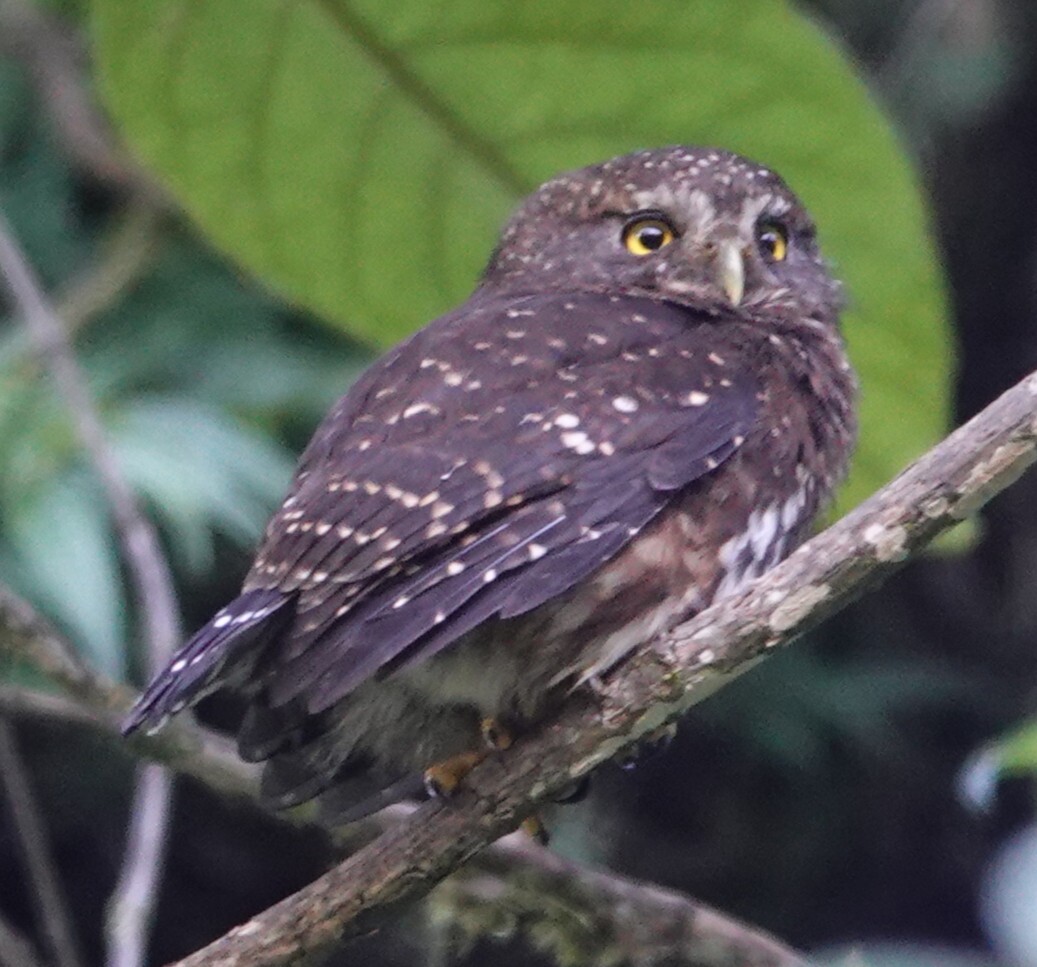
The Andean Pygmy Owl is the pygmy owl of the higher montane forests of the northern Andes, up to the treeline. In the guide area it occurs only in the Andes of western Venezuela. It is also active by day and is often found because small birds mob it noisily.
Voice
A long series of fast, even, hollow notes, poop-poop-poop, sometimes preceded by two whistles. Sings by day and at night.
Recording: Juan Freile — CC BY-NC-SA 4.0 · shortened to the first 60 s, mono · xeno-canto
Identification
15–16 cm, with a round head without ear tufts, yellow eyes, white eyebrows, a white 'moustache' and a broad white throat. There is a dark brown morph with white markings and a chestnut morph with buff markings. The crown has small white spots, the back pale spots. On the nape a black-and-white pattern of 'false eyes'. The tail has pale bands, white in the brown and buff in the rufous morph. The sides of the breast are dark with pale markings, the rest of the underparts white with heavy brown streaks. The sexes are alike.
Confusion species
Ferruginous Pygmy Owl Glaucidium brasilianum lives lower, in more open and drier country, has a streaked rather than spotted crown and a longer tail, and sings a slower series of whistled notes. Buff-fronted Owl Aegolius harrisii is larger, with a short tail, plain ochre-yellow underparts and a pale, black-rimmed facial disc. Screech owls such as White-throated Screech Owl Megascops albogularis are larger, are active almost only at night and lack 'false eyes'.
Habitat
Cloud forest, elfin forest at the treeline and sometimes forest edges and pasture with scattered trees, from the middle levels to the canopy, in Venezuela mainly above about 2000 m. It hunts by day and at night for invertebrates, small birds and small mammals. It nests in tree cavities, such as old woodpecker holes.
Where the bird is most at home, classified by the vegetation units of Amazonia and the Guianas.

Range and movements
In Venezuela in the Andes of Trujillo, Mérida and Táchira and in the Serranía de Perijá. Not in Brazil and the Guianas. Outside the guide area in the Andes of Colombia, Ecuador and northern Peru.
- Resident
- dark = core range, pale = thinly spread
How and when to look
Listen by day in cloud forest and along the treeline in the Andes of Mérida, for example in the Sierra Nevada National Park, for the series of notes, and watch for alarmed flocks of hummingbirds, tanagers and other small birds. It often perches on an open branch at the forest edge.
Conservation status
Least Concern. In Venezuela its habitat is small, and deforestation and fires in the Andes may locally affect the population.
Scientific name
Glaucidium jardinii | (Bonaparte, 1855)
Bonaparte described the species in 1855 as Phalaenopsis jardinii; because it was later moved to another genus, the author and year stand in brackets. The genus Glaucidium was introduced in 1826 by Boie. Glaucidium is Greek glaukidion 'little owl' or 'owlet', a diminutive of glaux 'owl'. jardinii honours the Scottish naturalist Sir William Jardine (1800–1874). The specimen the first description was based on came from Andes near Quito, Ecuador.