All species › Passerines › Manakins › Araripe Manakin
Araripe Manakin | Chiroxiphia bokermanni
Araripemanakin | Saltarín de Araripe | Soldadinho-do-araripe
The Araripe Manakin was discovered only in 1996 and described in 1998, and lives only on the northern slope of the Chapada do Araripe in southern Ceará. The male is mostly white, with a red crest and red band from the forehead to the middle of the back and black wings and tail. With a population of a few hundred birds it is among the rarest songbirds of Brazil.

Voice
Short, clear whistles and a rattling call, often repeated near the water. The song is little described in the literature.
No recording with a suitable Creative Commons licence is available for this species yet.
Identification
14–15 cm, a fairly large, stocky manakin with a forward-pointing crest on the forehead. The male is white, with a carmine patch that runs from the frontal crest over the crown to the middle of the back; flight feathers and tail are black. The iris is red. The female is olive green, paler below, with a smaller olive frontal crest. Young males resemble the female and gradually acquire white and red.
Confusion species
Within its small range the male cannot be confused with any other species. Helmeted Manakin Chiroxiphia galeata, whose male is black with red, occurs in the cerrado further south and west but not on the Chapada do Araripe; the females of the two species are very similar. Other green birds in the forest, such as females of smaller manakins, lack the frontal crest.
Habitat
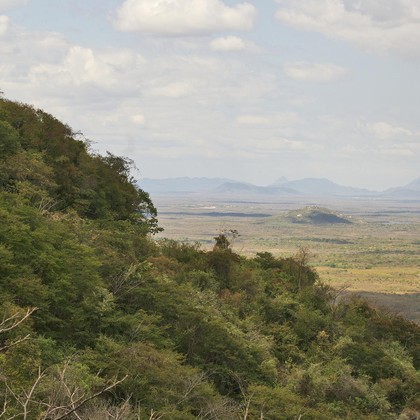
Humid evergreen forest on the slope of the Chapada do Araripe, at about 600 to 800 m, especially along springs and streams that rise from the limestone, and also in adjacent secondary forest. It lives in the lower and middle storeys and eats mainly small fruit, supplemented with insects. The nest is a cup in a twig fork, often above a stream; the clutch is one or two eggs and breeding falls in the rainy season.
Where the bird is most at home, classified by the vegetation units of Amazonia and the Guianas.
Range and movements
Endemic to Brazil and known only from a narrow strip of forest on the northern edge of the Chapada do Araripe in southern Ceará, around Crato, Barbalha and Missão Velha. Resident. Not in Venezuela, Guyana, Suriname and French Guiana. The species does not occur outside the guide area.
- Resident
- dark = core range, pale = thinly spread
How and when to look
Visit the forest around the springs at the foot of the Chapada do Araripe near Crato or Barbalha, where local conservation projects work with guides. Wait near a stream in the morning; the birds forage there in the lower storey and by the water.
Conservation status
Critically Endangered. The population is estimated at a few hundred adult birds in a very small area. Threats are the tapping and diversion of spring water, deforestation, fires and the construction of recreation facilities and roads at the springs.
Scientific name
Chiroxiphia bokermanni | (Coelho & Silva, 1998)
Coelho & Silva described the species in 1998 as Antilophia bokermanni; because it was later moved to another genus, the author and year stand in brackets. The genus Chiroxiphia was introduced in 1847 by Cabanis. Chiroxiphia is Greek, from kheir 'hand' and xiphos 'sword', after the narrow, sword-shaped outer primaries of the males. bokermanni honours the Brazilian zoologist and wildlife filmmaker Werner Bokermann (1929–1995). The specimen the first description was based on came from Chapada do Araripe near Barbalha, Ceará, Brazil.