All species › Parrots › African and New World parrots › Bald Parrot
Bald Parrot | Pyrilia aurantiocephala
Kaalkoppapegaai | Lorito calvo | Papagaio-careca
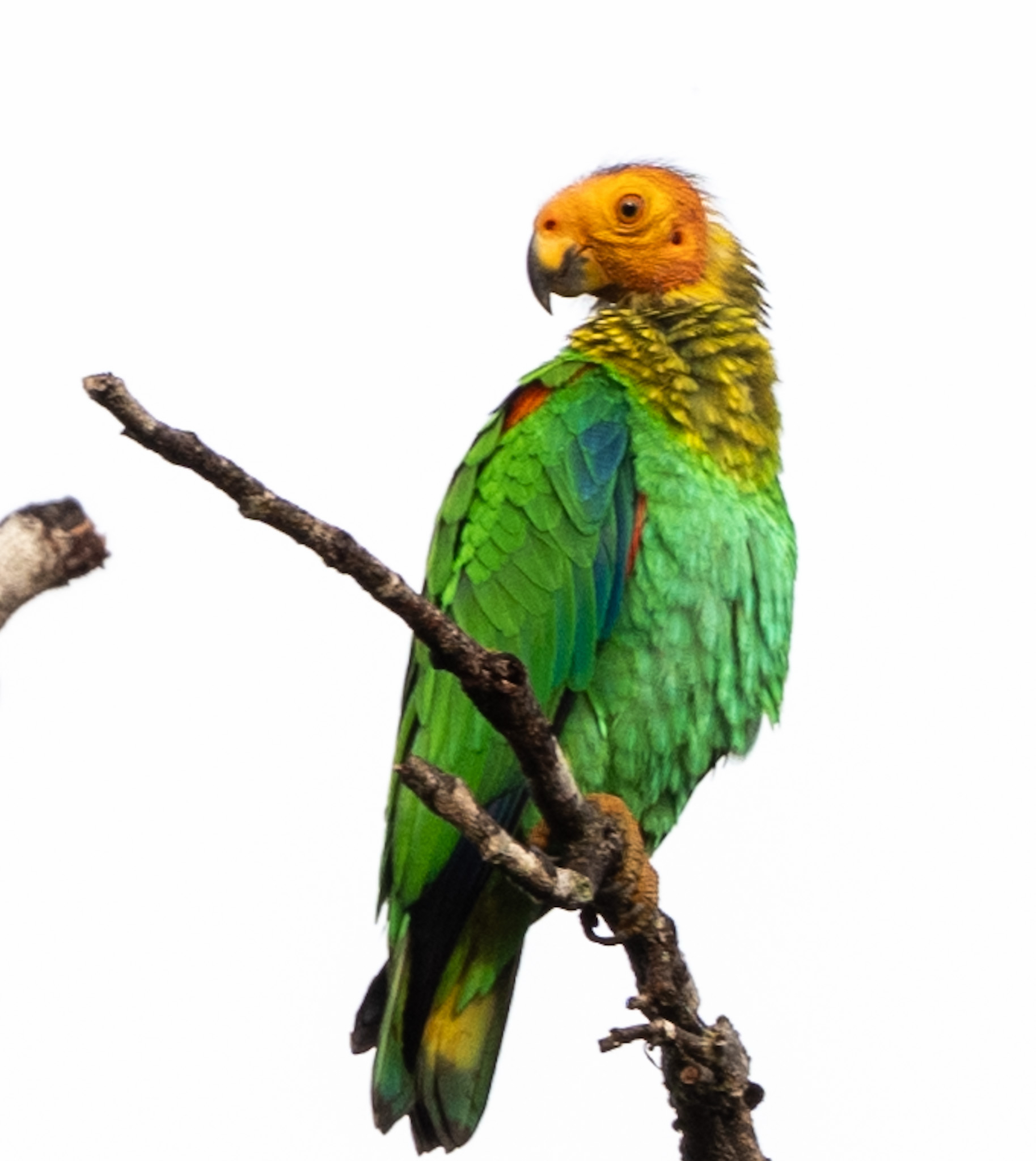
The Bald Parrot is a medium-sized, compact, short-tailed parrot of the genus Pyrilia, found only in central Brazilian Amazonia. Adults have an almost bare, orange head. For a long time they were mistaken for young Vulturine Parrots; the species was described only in 2002.
Voice
Hoarse, somewhat grating calls, repeated in flight, and softer chattering from perched birds; similar to those of the other Pyrilia species.
Recording: Dante Buzzetti — CC BY-NC-SA 4.0 · xeno-canto
Identification
23 cm, compact, with a short, square tail and a pale, horn-coloured bill. The head is almost unfeathered, with bright orange to brownish-orange skin; around the eye the skin is paler and more yellow. There is a blackish band on the hindneck. The body is green, olive on the breast. The shoulder and underwing coverts are red to orange-red and the primaries blackish with blue. The sexes are alike. Juveniles have a more feathered, greenish head with less orange.
Confusion species
Vulturine Parrot Pyrilia vulturina has a bare black head and a yellow collar; young Vulturine Parrots have a green, feathered head with yellow around the eye. Orange-cheeked Parrot Pyrilia barrabandi, further west, has a feathered black head with an orange cheek patch. White-bellied Parrot Pionites leucogaster has a yellow to orange head, but a white breast and belly and a longer tail.
Habitat
Humid lowland terra firme rainforest, also forest edges, old secondary forest and riverside forest. It feeds on fruit, seeds and flowers in the canopy. Little is known about its breeding biology; it probably nests in tree holes.
Where the bird is most at home, classified by the vegetation units of Amazonia and the Guianas.



Range and movements
Only in Brazil, in central Amazonia south of the Amazon, in the basins of the lower Madeira and of the Tapajós, including the Teles Pires, in Amazonas, Pará and northern Mato Grosso. Absent from Venezuela, Guyana, Suriname and French Guiana. Does not occur outside the guide area.
- Resident
- dark = core range, pale = thinly spread
How and when to look
In forest along the Teles Pires in northern Mato Grosso and along the upper Tapajós, from canopy towers and clearings above the canopy, where pairs and small groups fly quickly past. With birds flying over, watch for the orange head.
Conservation status
Near Threatened. The species has a small range that coincides with the arc of deforestation along the southern edge of Amazonia; forest there is being lost to cattle ranching, farming, roads and gold mining.
Scientific name
Pyrilia aurantiocephala | (Gaban-Lima, Raposo & Höfling, 2002) (GBIF: Pionopsitta aurantiocephala)
Gaban-Lima, Raposo & Höfling described the species in 2002 as Pionopsitta aurantiocephala; because it was later moved to another genus, the author and year stand in brackets. The genus Pyrilia was introduced in 1856 by Bonaparte. Pyrilia comes from the species name pyrilia: Greek pur 'fire' and Latin ilia 'flanks', after the orange-red underwing and flanks. aurantiocephala combines Latin aurantius 'orange' with Greek kephalē 'head', after the bare orange head. The specimen the first description was based on came from not established (no entry in the source).