All species › Passerines › Antbirds › Band-tailed Antbird
Band-tailed Antbird | Hypocnemoides maculicauda
Oevermierkruiper | Hormiguero colibandeado | Solta-asa
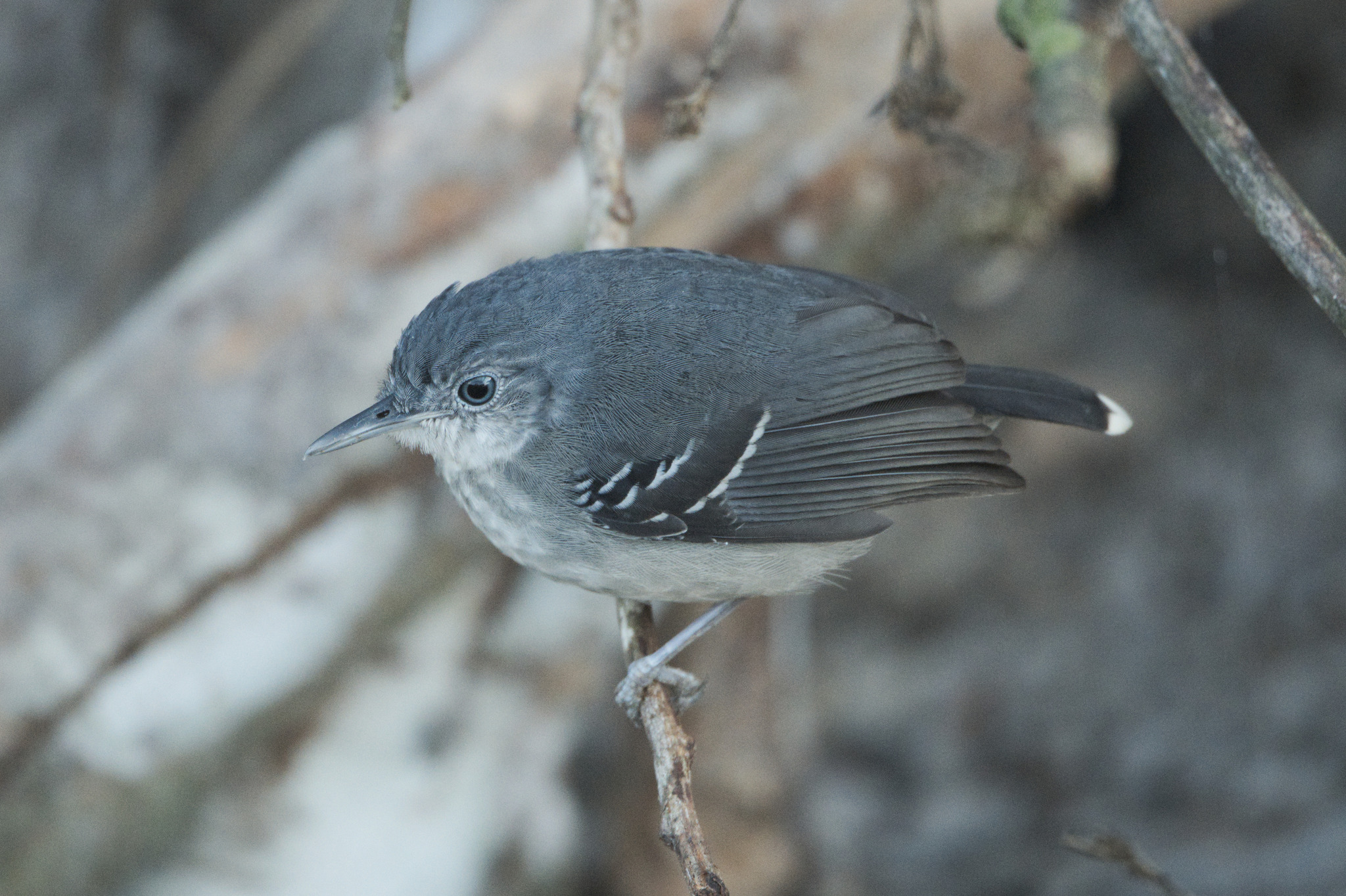
The Band-tailed Antbird is a small grey antbird of flooded forest along rivers and lakes south of the Amazon. Pairs forage just above the water, in low branches and shrubs overhanging the bank. The broad white tips to the tail feathers give the species its English name.
Voice
The song is a strong, accelerating series of loud, raspy notes that rises to a sharp rattle, then falls and slows. Calls: quiet whiny and chuckling notes, a descending hoarse hew and a sneezy tzew.
Recording: JAYRSON ARAUJO DE OLIVEIRA — CC BY-NC-SA 4.0 · xeno-canto
Identification
12 cm. The male is leaden grey above, with a large, usually hidden white patch between the scapulars, and has a slate-grey tail with broad white tips. The throat is black, the rest of the underparts paler grey with a white belly; the bill is black. The female matches the male above, but has a white throat and mostly white underparts with grey-edged breast feathers, grey sides and a slight buff tinge on breast and belly. Iris grey, legs blue-grey.
Confusion species
Black-chinned Antbird Hypocnemoides melanopogon is very similar but has narrow white tail tips; it lives mainly north of the Amazon, and south of it between the Purus and the Tocantins. Silvered Antbird Sclateria naevia lives in the same kind of forest but is larger, with a longer bill and long pink legs, and its underparts are white with grey streaks or mottling.
Habitat
Lowland forest, almost always várzea along large rivers, smaller watercourses and lake shores; also gallery forest along rivers in the transition zone to the Cerrado. It favours low vegetation overhanging the water. Pairs and family groups forage on the ground and up to about 4 m, usually near or over water, taking insects by gleaning from leaves or with short sallies. It sometimes follows army ant swarms. Little is known about the nest.
Where the bird is most at home, classified by the vegetation units of Amazonia and the Guianas.



Range and movements
Brazil: south of the Amazon, from Acre and southern Amazonas east through Rondônia, Mato Grosso and Pará to Tocantins, northern Goiás along the Araguaia and western Maranhão. Not in Venezuela, Guyana, Suriname or French Guiana. Outside the guide area in eastern Peru, northern Bolivia and the far south of Colombia.
- Resident
- dark = core range, pale = thinly spread
How and when to look
Travel by boat or on foot along wooded banks of rivers and lakes in southern Amazonia, for example in northern Mato Grosso or along the Araguaia. Listen for the loud, accelerating rattle from the low vegetation over the water.
Conservation status
Least Concern. The range is large; locally riverside forest is lost to logging, dams and the expansion of farming in southern Amazonia.
Scientific name
Hypocnemoides maculicauda | (Pelzeln, 1868)
Pelzeln described the species in 1868 as Hypocnemis maculicauda; because it was later moved to another genus, the author and year stand in brackets. The genus Hypocnemoides was introduced in 1918 by Bangs & Penard. Hypocnemoides is the genus Hypocnemis plus Greek -oidēs 'resembling', after its likeness to those antbirds. maculicauda is Latin, from macula 'spot' and cauda 'tail', after the white-tipped tail. The specimen the first description was based on came from Cáceres area, Mato Grosso, Brazil.