All species › Tinamous › Tinamous › Bartlett's Tinamou
Bartlett's Tinamou | Crypturellus bartletti
Bartletts tinamoe | Tinamú de Bartlett | Inhambu-anhangaí
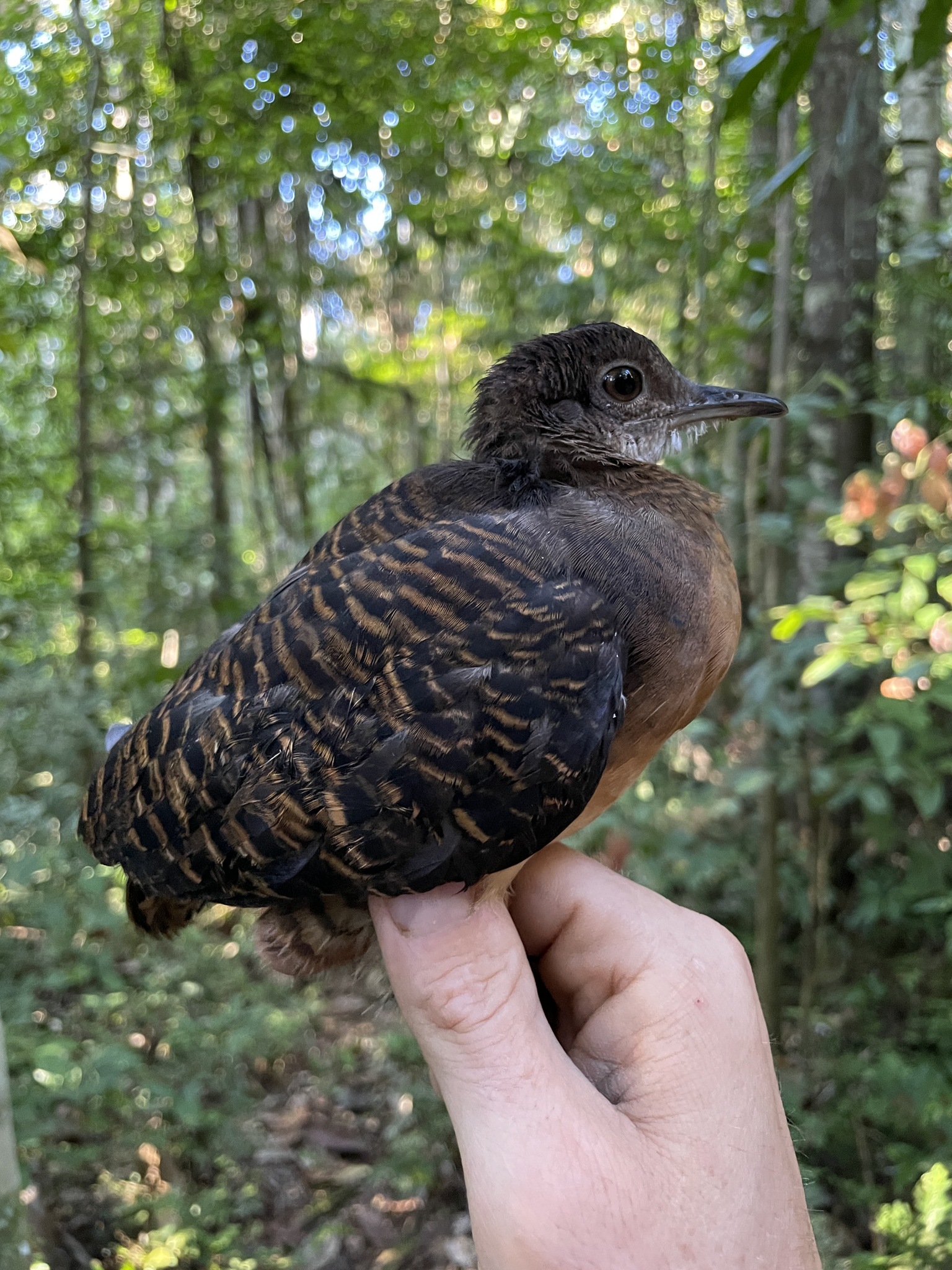
Bartlett's Tinamou is a medium-sized, dark tinamou of the western Amazonian lowlands. It lives on the floor of tall forest and reveals itself mainly by its call. In the guide area it occurs only in western Brazilian Amazonia.
Voice
A series of tremulous whistles that rises in pitch and accelerates, mainly at dawn and dusk, sometimes also during the day.
Recording: JAYRSON ARAUJO DE OLIVEIRA — CC BY-NC-SA 4.0 · xeno-canto
Identification
25–27 cm, with a small head, a thin bill and almost no tail. The head is dark greyish brown, with a whitish throat. The neck and breast are rufous to cinnamon-brown, the belly paler buff. The back and wings are brown with dark and pale barring; the flanks are also dark-barred. The sexes are similar; females are usually more heavily barred on the back.
Confusion species
Variegated Tinamou Crypturellus variegatus has a blackish crown, a brighter rufous neck and breast and a back with contrasting black and buff bars. Black-capped Tinamou Crypturellus atrocapillus in Acre has a black crown and red legs. Little Tinamou Crypturellus soui is smaller and has an unbarred back. Undulated Tinamou Crypturellus undulatus is larger and greyer, with fine wavy lines, and more often lives in riverine forest. Brazilian Tinamou Crypturellus strigulosus has a greyer breast and a less heavily barred back, and a long, sustained whistle as its call.
Habitat
The floor of humid terra firme lowland forest, also seasonally flooded forest, forest edges and older secondary forest, locally bamboo forest; mainly below about 600 m. It walks over the forest floor searching for fallen fruit, seeds and insects. The nest is on the ground; the male incubates the eggs.
Where the bird is most at home, classified by the vegetation units of Amazonia and the Guianas.




Range and movements
In Brazil in western Amazonia, in Acre and western Amazonas state, mainly south of the Solimões and east to about the Madeira. Absent from Venezuela, Guyana, Suriname and French Guiana. Outside the guide area in the Amazonian lowlands of extreme southern Colombia, Ecuador, Peru and Bolivia.
- Resident
- dark = core range, pale = thinly spread
How and when to look
Listen at dawn along forest trails in the lowlands of Acre or western Amazonas for the rising series of whistles. Birds walk calmly across the trail or stand still in the undergrowth.
Conservation status
Least Concern (LC). Locally hunted and affected by forest loss; still common in large, unbroken forests.
Scientific name
Crypturellus bartletti | (Sclater & Salvin, 1873)
Sclater & Salvin described the species in 1873 as Crypturus bartletti; because it was later moved to another genus, the author and year stand in brackets. The genus Crypturellus was introduced in 1914 by Brabourne, WWK-H & Chubb. Crypturellus is a diminutive of the older tinamou genus Crypturus (Greek kruptos 'hidden' and oura 'tail'): 'little hidden-tail'. bartletti honours the English zoologist Edward Bartlett (1844–1908), who collected in Amazonia in 1865–1869. The specimen the first description was based on came from Santa Cruz, eastern Peru.