All species › Passerines › Cotingas › Bearded Bellbird
Bearded Bellbird | Procnias averano
Baardklokvogel | Campanero barbudo | Araponga-do-nordeste
The Bearded Bellbird is a large cotinga of northern South America; the male has an extremely loud, metallic call. The male has a beard of black, string-like wattles on its bare throat. In the guide area it lives in the mountains of northern Venezuela, in the Guiana Highlands and, as a separate subspecies, in north-eastern Brazil.

Voice
From a high perch the male gives an extremely loud, dry bock, like a hammer striking an anvil, and series of metallic tink notes. The call carries over long distances.
Recording: JAYRSON ARAUJO DE OLIVEIRA — CC BY-NC-SA 4.0 · xeno-canto
Identification
27–28 cm, stocky, with a broad, flat bill. The male is greyish white, with a coffee-brown head, black wings and a bare throat from which hangs a cluster of black, string-like skin wattles. The female is olive-green above and yellow below with broad olive-green streaks, and has yellow undertail-coverts. Young males resemble the female and acquire adult plumage only after several years.
Confusion species
The male White Bellbird Procnias albus, in the Guiana Highlands and southern Venezuela, is entirely white, with a single long wattle above the bill. The male Bare-throated Bellbird Procnias nudicollis, in the Atlantic Forest south of the range, is entirely white with a bare, blue-green throat. The females of the bellbirds are very similar. The streaked female can also suggest a large olive-green flycatcher, but is larger and stockier, with a broad bill and yellow undertail-coverts.
Habitat
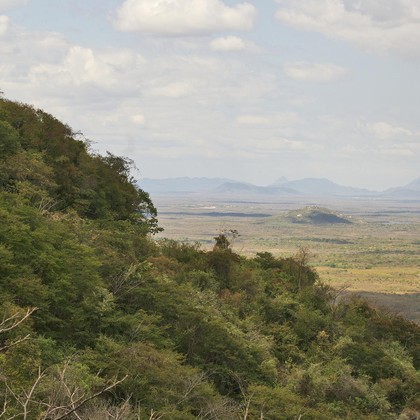
Humid montane and foothill forest, also tall lowland forest and forest edges, in north-eastern Brazil mainly humid forest on mountains and plateaus amid the caatinga and forest remnants in the coastal region; from sea level to about 1900 m. Some birds move to lower forest after breeding. It feeds mainly on fruit, especially of the laurel family, which it plucks in the crown. The nest is a shallow, loose cup of twigs in a tree; the female incubates and raises the young alone.
Where the bird is most at home, classified by the vegetation units of Amazonia and the Guianas.




Range and movements
In Venezuela in the northern mountains, from Lara and Falcón east along the coastal range to Sucre and the Paria Peninsula, also on the northern end of the Serranía de Perijá, and south of the Orinoco in the Guiana Highlands of Bolívar. In western Guyana in the Pakaraima Mountains and in the far north of Roraima. A separate subspecies lives in north-eastern Brazil, from Maranhão and Piauí through Ceará to Pernambuco and Alagoas. There are only a few records from French Guiana; the species is absent from Suriname. Outside the guide area in the far north-east of Colombia and on Trinidad.
- Resident
- dark = core range, pale = thinly spread
How and when to look
In the morning, listen for the hammer blows of calling males, which give the bird away from afar. In Venezuela the species occurs on the Paria Peninsula and in the Guiana Highlands of Bolívar, among other places; in Brazil in the forested mountains of Ceará, such as the Serra de Baturité.
Conservation status
Near Threatened. The species is trapped for the cage-bird trade, especially in north-eastern Brazil, and the forest in the mountains and coastal region of the north-east is heavily fragmented.
Scientific name
Procnias averano | (Hermann, 1783)
Hermann described the species in 1783 as Ampelis Averano; because it was later moved to another genus, the author and year stand in brackets. The genus Procnias was introduced in 1811 by Illiger. Procnias refers to Procne of Greek mythology, who was transformed into a swallow. averano is the name 'Averano' given to this bellbird by Buffon, derived from Portuguese ave de verão 'summer bird'. The specimen the first description was based on came from northeastern Brazil.