All species › Passerines › Tityras, becards and allies › Black-and-white Becard
Black-and-white Becard | Pachyramphus albogriseus
Eksterbekarde | Cabezón blanquinegro | Caneleiro-alvinegro
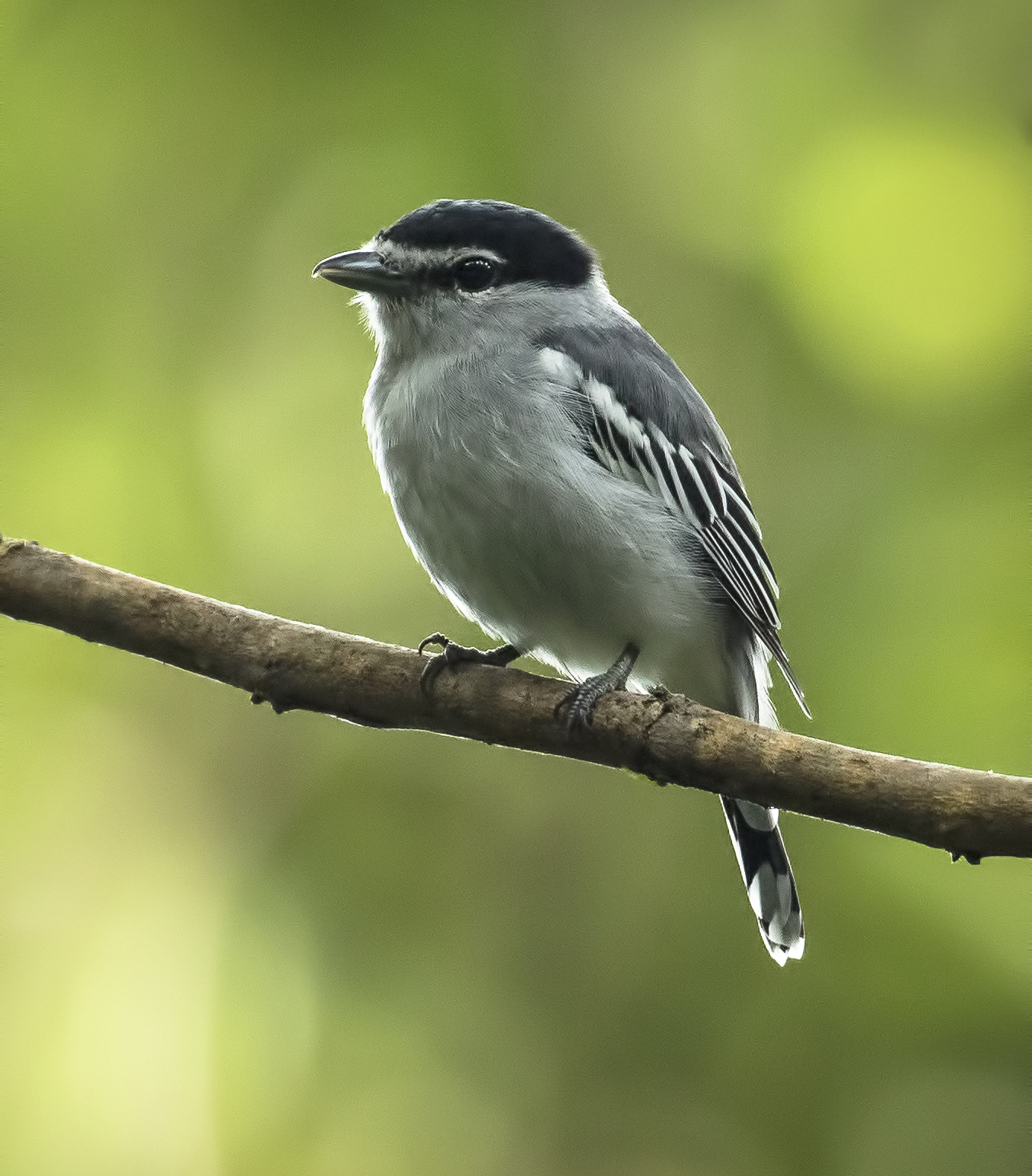
The Black-and-white Becard is a grey, black and white becard of humid montane forest. In the guide area it lives only in the mountains of northern and western Venezuela. Since the split of Cryptic Becard Pachyramphus salvini (outside this area), which includes part of the former species in the Andes of Ecuador and Peru, the species has been treated more narrowly; the Venezuelan birds belong to Black-and-white Becard.
Voice
The song is a calm series of a variable number of soft notes ending in a long, mostly rising note. Also a short, fast trill of a few descending notes.
Recording: rudy gelis — CC BY-NC-SA 4.0 · shortened to the first 60 s, mono · xeno-canto
Identification
14–15 cm, with a large head and a short, thick bill. The male has a glossy blue-black crown, black lores with a white stripe above them, a grey back and whitish to pale grey underparts, often slightly greyer on the breast. The wings are black with white edges and a broad white upper wing bar. The female has a chestnut crown edged black, a black eye-stripe, an olive-green back, blackish wings with cinnamon edges and pale yellow to greenish-yellow underparts with a white throat.
Confusion species
The male White-winged Becard Pachyramphus polychopterus has a black back and lacks the white eyebrow. The male Cinereous Becard Pachyramphus rufus lives lower and has a white forehead edge without distinct wing bars. Barred Becard Pachyramphus versicolor is smaller, with finely barred underparts, and lives higher in the Andes. The female Green-backed Becard Pachyramphus viridis has a grey head and a yellow collar.
Habitat
Humid foothill and montane forest, cloud forest and their edges with a dense understorey, in Venezuela mostly between 900 and 2200 m. It takes insects and fruit from the upper understorey to the canopy, often in mixed flocks. The nest is a large, globular structure with a side entrance, on a branch high above the ground.
Where the bird is most at home, classified by the vegetation units of Amazonia and the Guianas.


Range and movements
In Venezuela in the Cordillera de la Costa, in the Andes from Táchira to Lara and in the Serranía de Perijá. Absent south of the Orinoco and from Brazil; a few unconfirmed reports come from French Guiana, and the species is otherwise absent from the Guianas. Outside the guide area in Costa Rica, Panama, Colombia and on the eastern slope of the Andes in Ecuador and Peru.
- Resident
- dark = core range, pale = thinly spread
How and when to look
Search mixed flocks in the cloud forest of Henri Pittier in the coastal range and along mountain roads in Mérida. Listen for the calm song with its long final note.
Conservation status
Least Concern. The species depends on montane forest; clearing for farming and pasture affects numbers locally in the Venezuelan mountains.
Scientific name
Pachyramphus albogriseus | Sclater, 1857
Sclater described the species in 1857 and placed it straight away in the genus where it still stands. The genus Pachyramphus was introduced in 1840 by Gray. Pachyramphus is Greek, from pakhus 'thick' and rhamphos 'bill', after the stout, broad bill. albogriseus is Latin, from albus 'white' and griseus 'grey', after the black, white and grey male. The specimen the first description was based on came from 'Bogotá', Colombia (trade skin).