All species › Passerines › Antbirds › Black-bellied Antwren
Black-bellied Antwren | Formicivora melanogaster
Zwartbuikmiersluiper | Hormiguerito ventrinegro | Formigueiro-de-barriga-preta
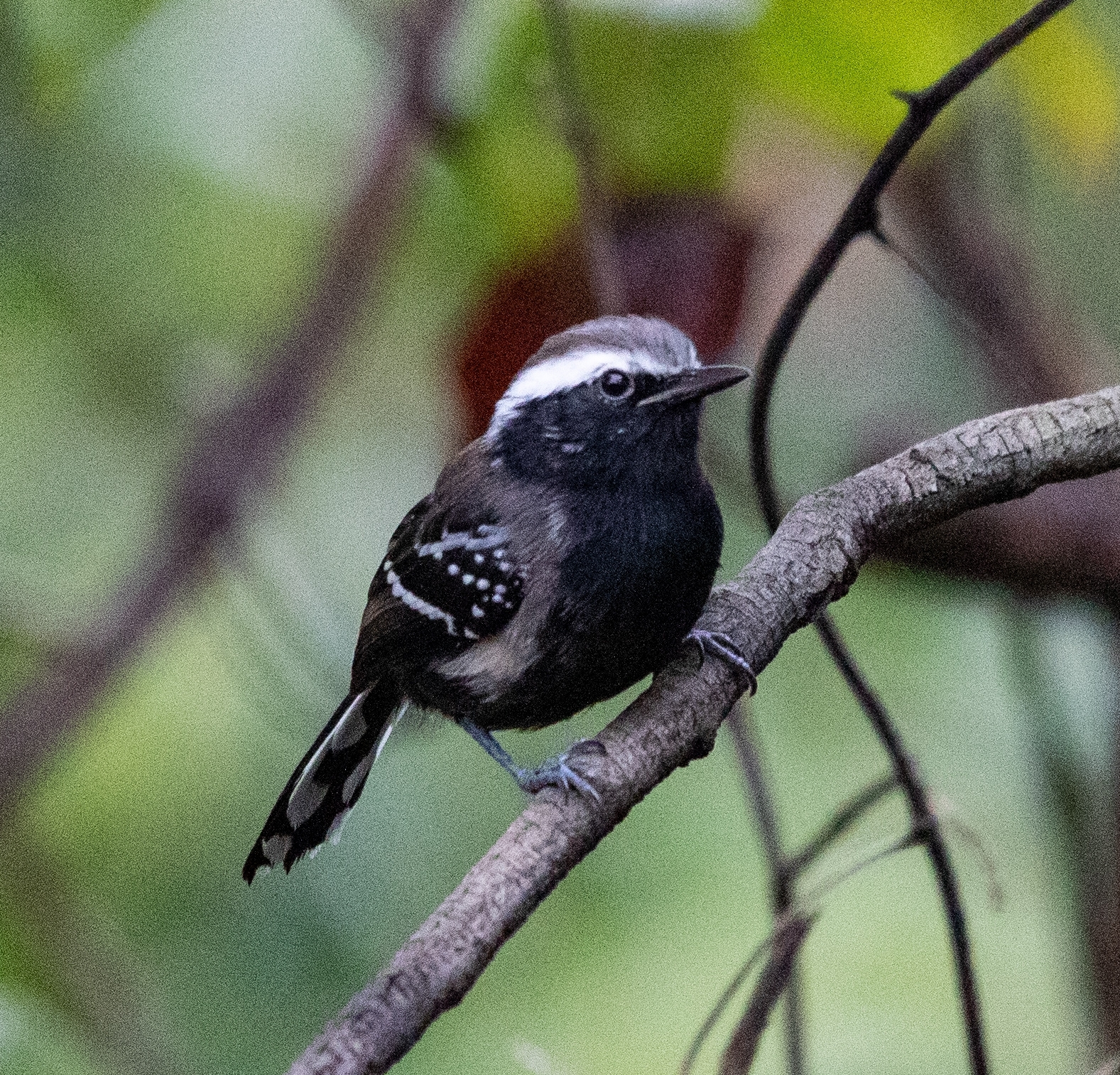
The Black-bellied Antwren is a long-tailed antwren of caatinga, dry forest and dense scrub in the interior of Brazil. The male is black from throat to belly, with a white band running from the eyebrow along the sides of the neck and breast. Pairs keep low in dense vegetation and often sing in duet.
Voice
The song is a fast series of identical short notes, something like choo-choo-choo-choo, often in duet. The call is a dry chup and a short rattle.
Recording: JAYRSON ARAUJO DE OLIVEIRA — CC BY-NC-SA 4.0 · xeno-canto
Identification
13–14 cm, slender, with a thin bill and a long, graduated tail. The male is grey-brown above; face, throat, breast and belly are deep black, bordered by a broad white band from the eyebrow to the flanks. The wing coverts are black with white spots and the tail is black with white tips. The female has a black mask through the eye with a white supercilium above it, grey-brown upperparts, the same wing pattern and white, unstreaked underparts. Young males at first resemble the female.
Confusion species
Southern White-fringed Antwren Formicivora grisea has a shorter tail; the female is buff below and lacks a black mask. Rusty-backed Antwren Formicivora rufa has a rufous back and lives in open, grassy cerrado; the female has black streaks on the breast and flanks. Narrow-billed Antwren Formicivora iheringi of interior Bahia and Minas Gerais has a shorter tail and lives in more humid forest; the male lacks the white side band.
Habitat
Caatinga, semi-deciduous dry forest, cerradão and dense scrub at forest edges, in the lowlands and on low plateaus up to about 1000 m. Pairs glean insects and spiders in dense undergrowth and vines, low above the ground, often moving the tail. The nest is a small cup low in a shrub.
Where the bird is most at home, classified by the vegetation units of Amazonia and the Guianas.




Range and movements
Brazil: in the interior of the north-east and centre, in the caatinga of Piauí, Pernambuco and Bahia among others, and in dry forest of Minas Gerais, Goiás and Tocantins west to Mato Grosso and Mato Grosso do Sul. Absent from Venezuela, Guyana, Suriname and French Guiana. Outside the guide area in eastern Bolivia and northern Paraguay.
- Resident
- dark = core range, pale = thinly spread
How and when to look
Search the caatinga and dry forest of the interior, for example in the Chapada Diamantina or Serra da Capivara, for pairs in dense shrubs and vines along roads and forest edges. The fast duets usually give away their position.
Conservation status
Least Concern. The species has a large range and tolerates some disturbance, but caatinga and dry forest are being lost in many places to cattle ranching, agriculture and logging.
Scientific name
Formicivora melanogaster | Pelzeln, 1868
Pelzeln described the species in 1868 and placed it straight away in the genus where it still stands. The genus Formicivora was introduced in 1824 by Swainson. Formicivora is Latin, from formica 'ant' and -vorus '-eating': 'ant-eating'. melanogaster is Greek, from melas 'black' and gastēr 'belly', after the male's black underparts. The specimen the first description was based on came from the town of Goiás, Goiás, Brazil.