All species › Passerines › Antbirds › Black-capped Antwren
Black-capped Antwren | Herpsilochmus atricapillus
Zwartkopmiersluiper | Tiluchí plomizo | Chorozinho-de-chapéu-preto
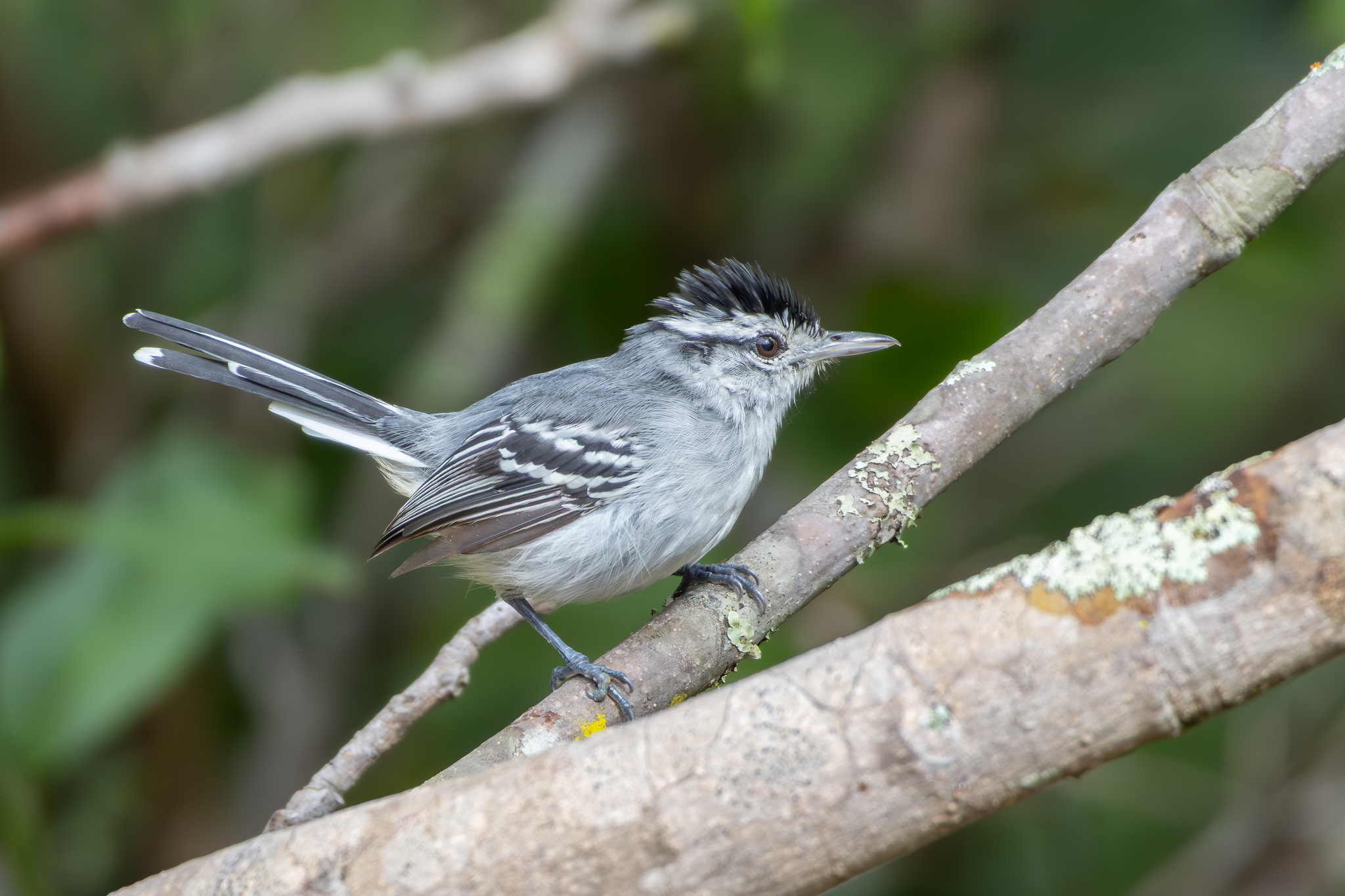
The Black-capped Antwren is a small antwren with a black cap and a white supercilium, widespread in the dry and semi-deciduous forests of central and eastern Brazil. It lives mainly in the middle storey and the canopy and often joins mixed flocks. It was formerly considered one species with the Bahia Antwren.
Voice
The song varies regionally, but usually begins with one or two separate notes, followed by a fast series that changes in pitch and slows at the end. There is also a rattle song of short, complex notes. Calls are an abrupt, sharply descending note and a longer note that rises and falls.
Recording: Robson Silva e Silva — CC BY-NC-SA 4.0 · converted to mono · xeno-canto
Identification
11–12 cm, with a fairly short, thin bill and a medium-length tail. The male has a black crown and nape, a long whitish to pale grey supercilium and a black eye-stripe. The upperparts are grey, with white-edged blackish scapulars and a white patch between the shoulders; the wings are black with white tips to the coverts, the tail black with large white tips. The underparts are grey to pale grey, with a white belly. The female has a buff forehead and a black-and-white streaked crown, grey upperparts with an olive tinge, an ochre breast and otherwise pale buff underparts. Both sexes vary regionally in the intensity of their colours.
Confusion species
Bahia Antwren Herpsilochmus pileatus lives only in the coastal forests of Bahia and is whiter below; the song is the best feature. Caatinga Antwren Radinopsyche sellowi has a longer bill, and the female has a black, unstreaked crown. Large-billed Antwren Herpsilochmus longirostris of gallery forest in the cerrado is larger, with a longer bill; the male has white spots in the black crown, the female a rufous head.
Habitat
All levels of deciduous, semi-deciduous and evergreen forest and gallery forest; in the north-east mainly in tall caatinga, mata-de-cipó and humid forest. Mostly from sea level to about 800 m. It forages alone, in pairs or in family groups, often in mixed flocks, mostly 7–20 m above the ground, lower at forest edges. It picks insects and probably spiders from leaves, vines and branches, with short lunges. Little is known about the nest; adults have been seen with young in January and February.
Where the bird is most at home, classified by the vegetation units of Amazonia and the Guianas.




Range and movements
Brazil: from Maranhão, Piauí and Rio Grande do Norte south through Bahia, Goiás, the Distrito Federal and Minas Gerais to Mato Grosso, Mato Grosso do Sul, São Paulo and western Paraná. Not in most of Amazonia, in Venezuela or the Guianas. Outside the guide area in south-eastern Bolivia, north-western Argentina (Jujuy and Salta) and northern and eastern Paraguay.
- Resident
- dark = core range, pale = thinly spread
How and when to look
Search seasonal and gallery forest in the interior, such as Iguaçu National Park and around the Chapada dos Guimarães, and tall caatinga in the north-east. Follow mixed flocks in the canopy and listen for the fast song that slows at the end.
Conservation status
Least Concern. A fairly common to common species with a very large range that also occurs in moderately disturbed forest. The population size is unknown and probably decreasing because of deforestation; the range includes several large protected areas.
Scientific name
Herpsilochmus atricapillus | Pelzeln, 1868
Pelzeln described the species in 1868 and placed it straight away in the genus where it still stands. The genus Herpsilochmus was introduced in 1847 by Cabanis. Herpsilochmus is Greek, from herpō 'to creep' and lokhmē 'thicket': 'thicket-creeper'. atricapillus is Latin, from ater 'black' and capillus 'hair of the head', after the black crown. The specimen the first description was based on came from Porto do Rio Paraná, São Paulo, Brazil.