All species › Passerines › Swallows › Black-collared Swallow
Black-collared Swallow | Pygochelidon melanoleuca
Zwartkraagzwaluw | Golondrina collareja | Andorinha-de-coleira
Black-collared Swallow is a small steel-blue and white swallow with a narrow black breast band and a long, deeply forked tail. It is tied to rocks, rapids and waterfalls in lowland rivers. At high water, when the rocks are submerged, birds locally leave their regular sites.

Voice
A disorganised series of buzzy zr notes and a short, buzzy djit.
Recording: JAYRSON ARAUJO DE OLIVEIRA — CC BY-NC-SA 4.0 · xeno-canto
Identification
14 cm, with a long, deeply forked tail. The upperparts are glossy steel-blue to blue-black. Throat, breast and belly are bright white, with a narrow black band across the breast. The undertail-coverts are black. The sexes are alike. Juveniles are duller and browner above, with a brownish breast band and a shorter tail.
Confusion species
White-banded Swallow Atticora fasciata is blue-black with a white breast band, the reverse pattern. Blue-and-white Swallow Pygochelidon cyanoleuca lacks the black breast band and has a less deeply forked tail. White-winged Swallow Tachycineta albiventer has white wing patches and a white rump, without a breast band. Bank Swallow Riparia riparia also has a dark breast band but is brown above.
Habitat
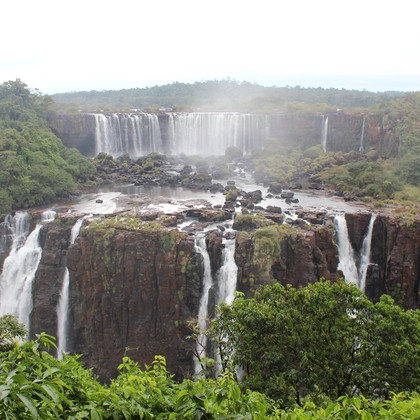
Rocks, rapids and waterfalls in rivers of the lowlands and lower hills, both blackwater and whitewater, to about 500 m. Hunts low over the water for flying insects and rests in small groups on rocks in the current. Nests in crevices and cavities in rocks or in banks, mainly at low water.
Where the bird is most at home, classified by the vegetation units of Amazonia and the Guianas.


Range and movements
Local along rocky rivers in much of the guide area. In Venezuela along the Orinoco and its rocky tributaries in Bolívar and Amazonas, such as the Caura, the Caroní and the Atabapo. In Guyana, Suriname and French Guiana at rapids in the rivers of the interior. In Brazil at rapids in Amazonia, including the Rio Negro, the Tapajós, the Xingu and the Tocantins, and south along the rivers of central Brazil to the Paraná basin. Outside the guide area in eastern Colombia, the far north-east of Bolivia, Paraguay and north-eastern Argentina.
- Resident
- dark = core range, pale = thinly spread
How and when to look
At rapids and waterfalls, such as the Orinoco rapids near Puerto Ayacucho and the cachoeiras of the Amazon tributaries, especially in the dry season when the rocks are above water. Birds sit in small groups on the rocks and hunt low over the fast-flowing water.
Conservation status
Least Concern. The species is locally common but depends on rapids, which can disappear when dams are built.
Scientific name
Pygochelidon melanoleuca | (Wied-Neuwied, 1820) (GBIF: Atticora melanoleuca)
Wied-Neuwied described the species in 1820 as Hirundo melanoleuca; because it was later moved to another genus, the author and year stand in brackets. The genus Pygochelidon was introduced in 1865 by Baird. Pygochelidon is Greek, from pugē 'rump' and khelidōn 'swallow': 'rump-swallow'. melanoleuca is Greek, from melas 'black' and leukos 'white', after the black-and-white plumage. The specimen the first description was based on came from Rio Jequitinhonha (Rio Grande de Belmonte), Bahia, Brazil.