All species › Passerines › Cotingas › Black-headed Berryeater
Black-headed Berryeater | Carpornis melanocephala
Zwartkopbesseneter | Comebayas cabecinegro | Sabiá-pimenta
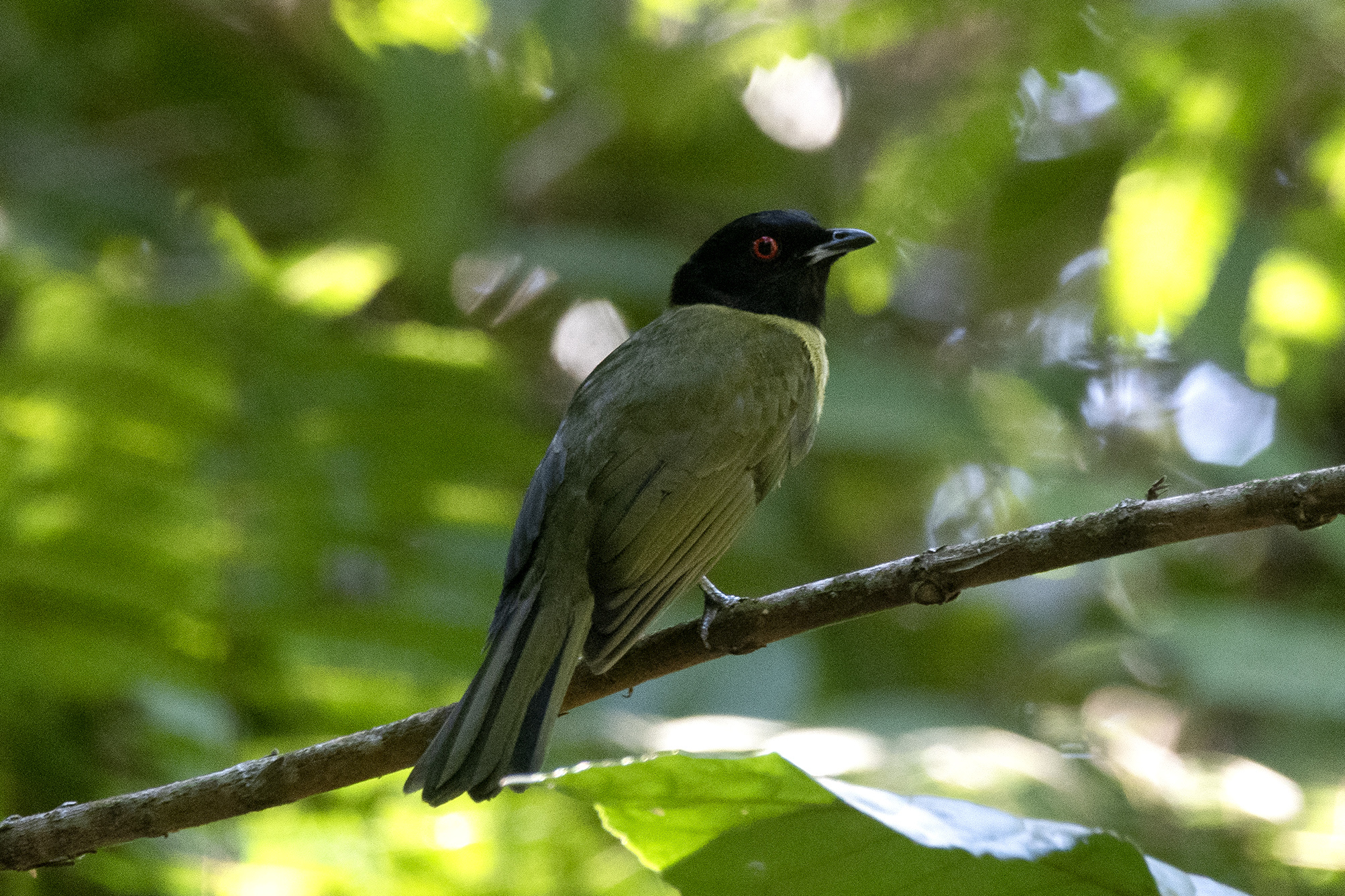
The Black-headed Berryeater is a medium-sized cotinga of the lowland forest on the Atlantic coast of Brazil. The male has a black head, a red iris and an olive-green and yellow body. It lives high in the forest and reveals itself mainly by its loud whistle.
Voice
A loud, clear and slightly falling whistle, often in two parts, repeated at intervals for long periods from a hidden perch in the canopy: weee-oo. The song carries far and is heard much more often than the bird is seen.
Recording: Dante Buzzetti — CC BY-NC-SA 4.0 · xeno-canto
Identification
21 cm, with a fairly large head and a short, broad, greyish bill; the iris is red. The male has a black head and throat and is otherwise olive-green above, with darker wings and tail; the underparts are olive-yellow, with fine, faint dark barring on the breast and flanks. The female resembles the male, but the head is duller, more dark olive-grey than black. Young birds are duller and have a dark iris.
Confusion species
Hooded Berryeater Carpornis cucullata is larger, has a black hood extending over the breast and a chestnut-brown mantle, and lives higher in the mountains; both species occur where the lowland meets the mountain slopes. Females of tanagers and thrushes lack the red iris and the stocky build.
Habitat
Humid lowland forest along the coast, also tall restinga forest on sand and older secondary forest, mostly below 600 m. It lives in the middle storey and canopy and feeds mainly on fruit, including that of palms such as the palmito Euterpe edulis, laurels and myrtles. The nest is a shallow cup of twigs on a branch.
Where the bird is most at home, classified by the vegetation units of Amazonia and the Guianas.



Range and movements
Found only in the guide area, in eastern Brazil: from Alagoas south through the coastal region of Bahia and Espírito Santo to Rio de Janeiro, São Paulo and eastern Paraná, with a few records in eastern Minas Gerais. Most records come from the coastal lowlands of São Paulo and southern Bahia. Absent from Venezuela, Guyana, Suriname and French Guiana.
- Resident
- dark = core range, pale = thinly spread
How and when to look
Listen for the loud whistle in the coastal lowlands of São Paulo, for example around Ubatuba and Picinguaba, or in the Reserva Natural Vale near Linhares in Espírito Santo. Then search around fruiting palms and trees in the canopy; the bird often sits still for long periods.
Conservation status
Near Threatened (NT). The lowland forest on the Atlantic coast has largely disappeared to farming, towns and tourism; the species survives in the remaining forest tracts and reserves. Cutting of the palmito for palm hearts locally reduces the food supply.
Scientific name
Carpornis melanocephala | (Wied-Neuwied, 1820)
Wied-Neuwied described the species in 1820 as Procnias melanocephalus; because it was later moved to another genus, the author and year stand in brackets. The genus Carpornis was introduced in 1846 by Gray. Carpornis is Greek, from karpos 'fruit' and ornis 'bird': 'fruit bird', after its berry diet. melanocephala is Greek, from melas 'black' and kephalē 'head', after the black head. The specimen the first description was based on came from southern Espírito Santo, Brazil.