All species › Parrots › African and New World parrots › Black-headed Parrot
Black-headed Parrot | Pionites melanocephalus
Zwartkopcaique | Loro coroninegro | Marianinha-de-cabeça-preta
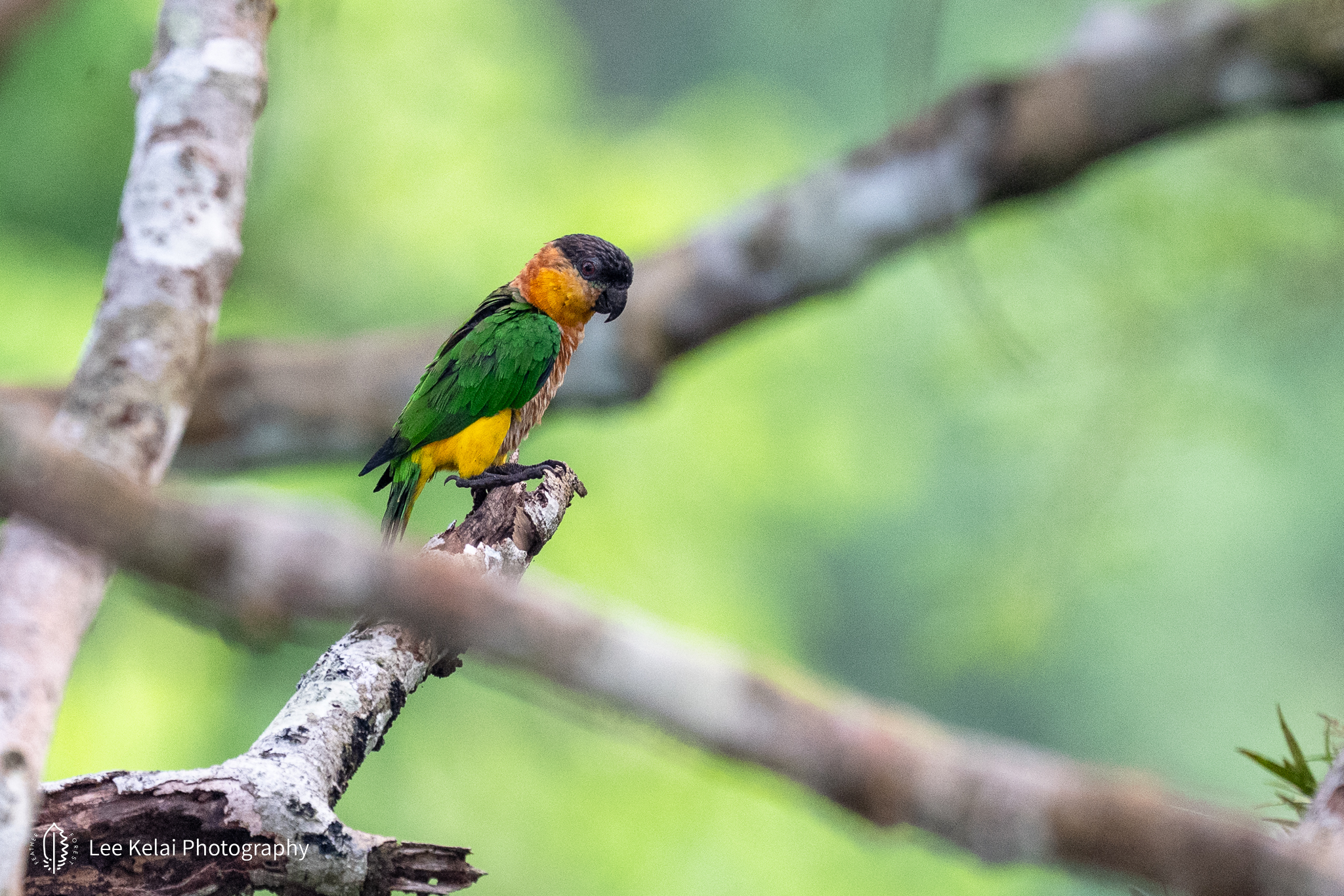
The Black-headed Parrot is a stocky, noisy parrot with a black cap and a white belly, of the genus Pionites. In the guide area it lives in the lowlands north of the Amazon and the Solimões, into the Guianas and southern Venezuela; south of the river it is replaced by White-bellied Parrot. Small groups move nimbly through the canopy, often hanging and clambering.
Voice
High, shrill, screeching calls such as a repeated klee-ak, and a wide variety of whistles and chatter. Groups are noisy both in flight and when perched.
Recording: Juan Freile — CC BY-NC-SA 4.0 · shortened to the first 60 s, mono · xeno-canto
Identification
23 cm, stocky, with a short, square tail. The crown is black, with a narrow green streak below the eye. The cheeks, throat and nape are yellowish orange. The back, wings and tail are green, the flight feathers partly blue. The breast and belly are creamy white; the thighs and undertail coverts are yellow to orange-yellow, paler yellow in birds from the west of the range. The bill is black, the eye orange-red. The sexes are alike; juveniles have a buffy wash on the belly and a dark eye.
Confusion species
White-bellied Parrot Pionites leucogaster has no black cap but an apricot crown and a pale bill; it lives south of the Amazon. Caica Parrot Pyrilia caica has a black head, but a green breast and belly and a golden collar; it lives in the same area in the Guianas and north-eastern Brazil. Orange-cheeked Parrot Pyrilia barrabandi has a black head with an orange-yellow cheek patch and a green breast and belly. Blue-headed Parrot Pionus menstruus is larger, with a blue head and a green belly.
Habitat
Humid lowland rainforest on terra firme and in várzea, also white-sand forest, forest edges and tall secondary forest, mostly below 1000 m. It feeds on fruit, seeds and blossoms high in the canopy. It lives in pairs and groups of five to ten birds. The nest is in a tree cavity.
Where the bird is most at home, classified by the vegetation units of Amazonia and the Guianas.




Range and movements
In Venezuela south of the Orinoco, in Amazonas and Bolívar. Widespread in the forested parts of Guyana, Suriname and French Guiana. In Brazil north of the Amazon and the Solimões, in Roraima, northern Amazonas, Amapá and northern Pará. Outside the guide area in eastern Colombia, eastern Ecuador and north-eastern Peru.
- Resident
- dark = core range, pale = thinly spread
How and when to look
Watch from canopy towers and along forest edges, for example around Manaus north of the river or in the interior of Suriname and French Guiana; small groups give themselves away by their shrill calls.
Conservation status
Least Concern. The species has a large range in largely intact forest; locally it is trapped for the cage-bird trade.
Scientific name
Pionites melanocephalus | (Linnaeus, 1758)
Linnaeus described the species in 1758 as Psittacus melanocephalus; because it was later moved to another genus, the author and year stand in brackets. The genus Pionites was introduced in 1890 by Heine. Pionites is formed from the genus Pionus and Greek -itēs 'resembling': 'like a Pionus'. melanocephalus is Greek, from melas 'black' and kephalē 'head': 'black-headed', after the black crown. The specimen the first description was based on came from Caracas, Venezuela (originally given in error as Mexico).