All species › Passerines › Royal flycatchers and allies › Black-tailed Myiobius
Black-tailed Myiobius | Myiobius atricaudus
Zwartstaarttiran | Mosquerito colinegro | Assanhadinho-de-cauda-preta
The Black-tailed Myiobius is a small Myiobius with a yellow rump, a black tail and an ochre breast. In the guide area it lives mainly in Brazil: in the Atlantic Forest, in the humid woods and gallery forests of the northeast and the Cerrado, and in Amazonia mostly in forest along rivers. Like its relatives it forages with a spread tail and drooped wings.

Voice
Sharp, short calls such as psit or tseek, often repeated while foraging.
Recording: Rodrigo Dela Rosa de Souza — CC BY-NC-SA 3.0 · xeno-canto
Identification
12–13 cm, with a broad, flat bill with bristles. The upperparts are olive-green to olive-brown, the rump bright yellow and the tail black. The throat is paler; the breast and flanks are uniform ochre to cinnamon, the belly pale yellow. The male has a small concealed yellow crown patch.
Confusion species
Whiskered Myiobius Myiobius barbatus is very similar, but has a more olive, less uniform breast and, in the male, a larger crown patch; it lives mainly in the interior of terra firme forest. Both species occur in the Atlantic Forest, and there voice, habitat and the uniform ochre breast help. Ruddy-tailed Flycatcher Terenotriccus erythrurus has a rufous tail and no yellow rump.
Habitat
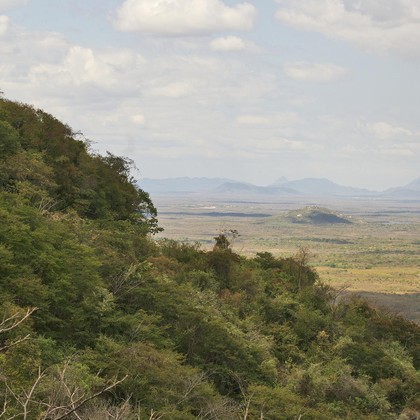
The undergrowth of humid and semi-humid forest, forest edges and old secondary forest, often near water: in the Atlantic Forest lowland forest and semi-deciduous forest, in the Cerrado gallery forest along streams, in the northeast the humid brejos on ridges, and in Amazonia mainly várzea, riverine forest and forest along streams. From the lowlands up to about 1400 m. It catches small insects with short sallies, often in mixed flocks.
Where the bird is most at home, classified by the vegetation units of Amazonia and the Guianas.





Range and movements
Brazil: in the Atlantic Forest from Bahia south through Espírito Santo, Minas Gerais, Rio de Janeiro and São Paulo to Santa Catarina; in the northeast in Ceará, Piauí and Maranhão, including the hill forests of Baturité and Ibiapaba; in gallery forest of the Cerrado in Goiás, the Distrito Federal and Tocantins; and scattered in Amazonia, mainly south of the Amazon in Amazonas and Pará. Venezuela: very locally in Bolívar; there are few records. Absent from Guyana, Suriname and French Guiana. Outside the guide area in Costa Rica and Panama, west of the Andes in Colombia, Ecuador and Peru, and locally in the Amazon basin of Colombia and Peru.
- Resident
- dark = core range, pale = thinly spread
How and when to look
Search along streams and forest edges in the Atlantic Forest of São Paulo or Rio de Janeiro, or in the brejos of Ceará, and follow mixed flocks in the undergrowth; watch for the yellow rump and the uniform ochre breast.
Conservation status
Least Concern. Much of its forest has disappeared in the Atlantic Forest and the northeast, but the species also occurs in forest remnants and old secondary forest.
Scientific name
Myiobius atricaudus | Lawrence, 1863
Lawrence described the species in 1863 and placed it straight away in the genus where it still stands. The genus Myiobius was introduced in 1839 by Gray. Myiobius is Greek, from muia 'fly' and bios 'life': 'living on flies'. atricaudus is Latin, from ater 'black' and cauda 'tail', after the black tail. The specimen the first description was based on came from Lion Hill, Isthmus of Panama.