All species › Passerines › Tapaculos › Blackish Tapaculo
Blackish Tapaculo | Scytalopus latrans
Zwarte tapaculo | Churrín negruzco | Macuquinho-enegrecido
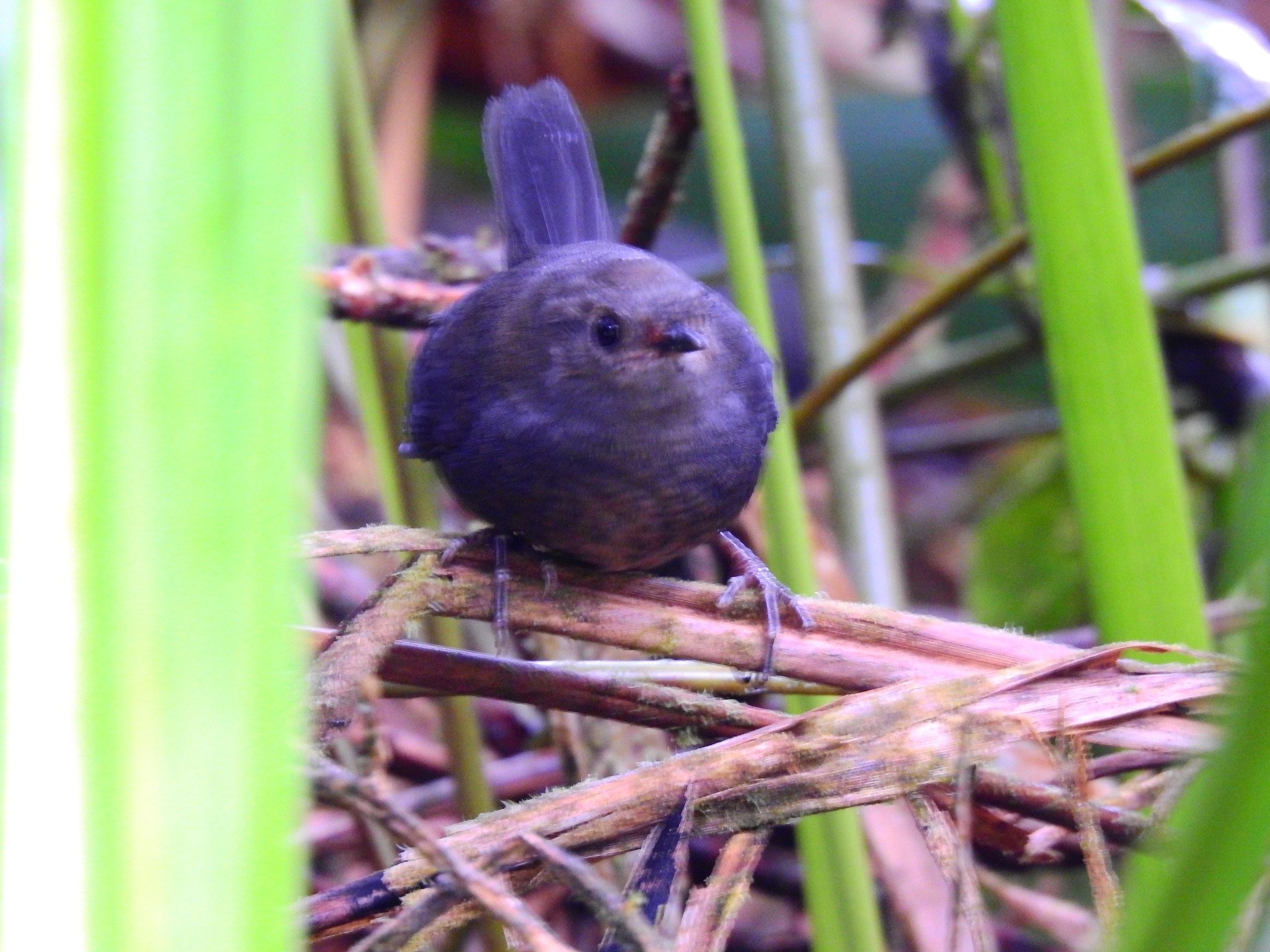
The Blackish Tapaculo is a small, almost entirely black tapaculo of the undergrowth of humid montane forest in the northern Andes. In the guide area it lives only in western Venezuela. It also occurs in forest edges, shrubbery and bamboo and sings from dense cover.
Voice
The song is a long series of even, low notes at a regular pace, often kept up for a long time from dense cover. The song varies by region. It also gives short, sharp calls.
Recording: Juan Freile — CC BY-NC-SA 4.0 · shortened to the first 60 s, mono · xeno-canto
Identification
12 cm, round, with a short, often cocked tail, short wings, a thin bill and fairly long legs. The male is almost uniformly blackish, without barred flanks. The female is dark grey with a browner tinge, especially on the rear flanks. Juveniles are brown with dark bars.
Confusion species
White-crowned Tapaculo Scytalopus atratus has a white crown patch and rufous, barred flanks and usually lives lower. Merida Tapaculo Scytalopus meridanus and Pale-bellied Tapaculo Scytalopus griseicollis are greyer, with a paler throat and breast and rufous, barred flanks. Perija Tapaculo Scytalopus perijanus is grey with ochre-yellow flanks. In tapaculos, song is the main feature.
Habitat
Undergrowth and edges of humid montane forest and cloud forest, old secondary forest, dense shrubbery, Chusquea bamboo and overgrown clearings, at about 1000–3500 m. It searches on or just above the ground for insects and other small arthropods. As in related species, the nest is placed in a cavity in an earth bank or among roots.
Where the bird is most at home, classified by the vegetation units of Amazonia and the Guianas.

Range and movements
In the guide area only in western Venezuela: in the Andes of Táchira, Mérida and Trujillo and in the Serranía de Perijá. Not in Brazil or the Guianas. Outside the guide area in the Andes of Colombia and Ecuador and in northern Peru.
- Resident
- dark = core range, pale = thinly spread
How and when to look
Listen in forest edges and shrubbery along mountain roads in the Andes of Mérida and Táchira for the long series of low notes. Wait quietly at a gap in the vegetation; the bird sometimes crosses briefly or appears on a fallen log.
Conservation status
Least Concern. The species is widespread, also occurs in secondary growth and tolerates a degree of forest disturbance.
Scientific name
Scytalopus latrans | Hellmayr, 1924
Hellmayr described the species in 1924 and placed it straight away in the genus where it still stands. The genus Scytalopus was introduced in 1837 by Gould. Scytalopus is Greek, from skutalē 'stick, cudgel' and pous 'foot', after the stout legs. latrans is Latin for 'barking', after the barking call. The specimen the first description was based on came from Cerro Munchique, west of Popayán, Colombia.