All species › Parrots › African and New World parrots › Blue-headed Macaw
Blue-headed Macaw | Primolius couloni
Blauwkopara | Guacamayo cabeciazul | Maracanã-de-cabeça-azul
The Blue-headed Macaw is a small macaw with a blue head, restricted to south-western Amazonia. Almost its whole range lies in eastern Peru; in the guide area it occurs only in the far west of Brazil. It lives in pairs or small groups at forest edges and along rivers and is seen everywhere in small numbers.
Voice
Hoarse, grating screeches, mainly in flight, higher and weaker than those of the large macaws.
Recording: Jacob Wijpkema — CC BY-NC-SA 4.0 · xeno-canto
Identification
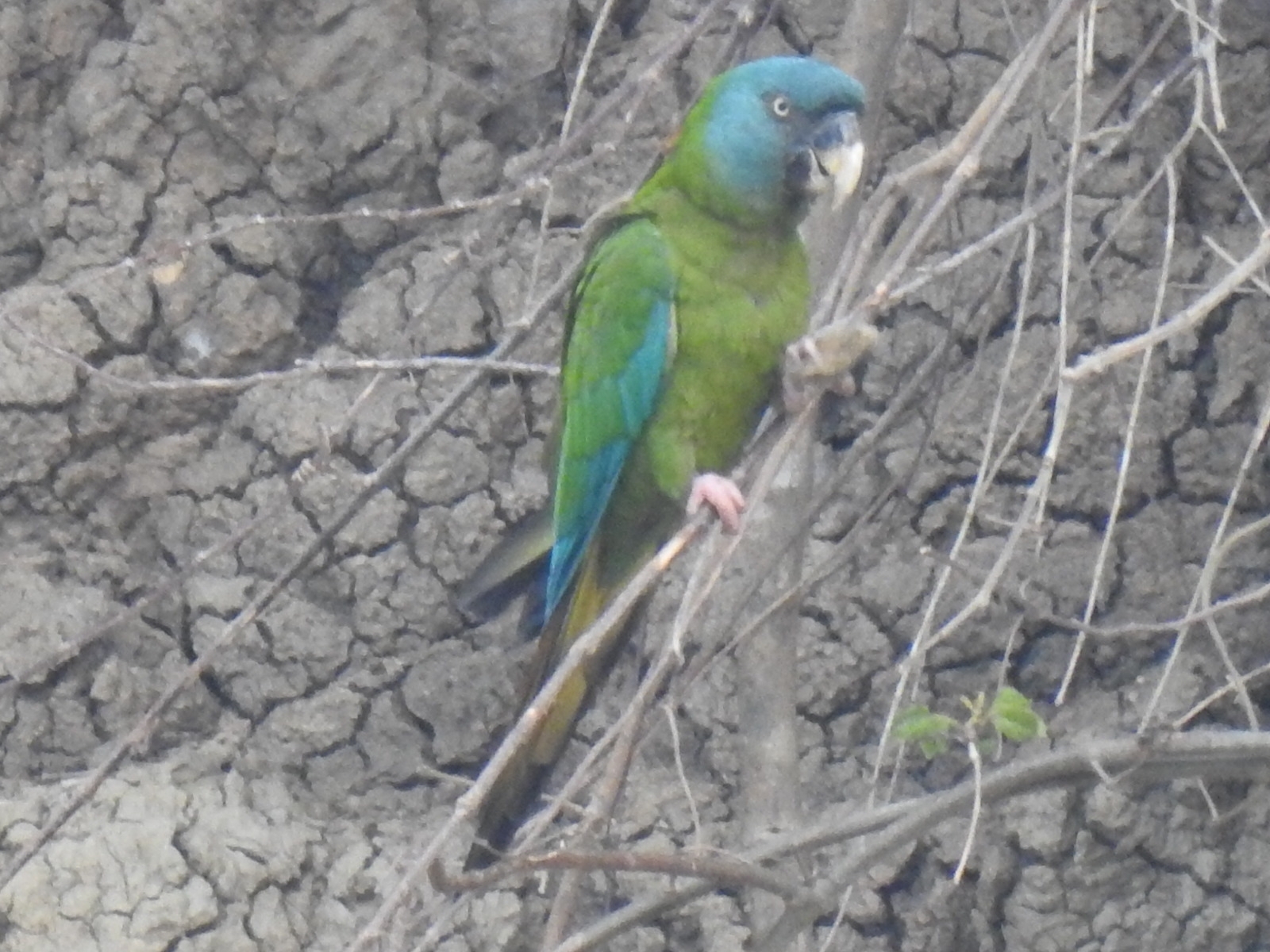
41 cm, with a long, pointed tail and a dark bill with a paler tip. The whole head is blue; the bare skin around the eye and at the base of the bill is grey. The body is green, the flight feathers blue. The tail is maroon above with a blue tip, and olive-yellow below, as is the underwing. The eye is yellow. The sexes are alike; juveniles have a dark eye.
Confusion species
Chestnut-fronted Macaw Ara severus is larger, with a chestnut forehead, a bare white face and red underwing coverts. Red-bellied Macaw Orthopsittaca manilatus has a bare yellowish face and a red belly patch. Blue-winged Macaw Primolius maracana has a red forehead and a red belly patch and lives far to the east. Parakeets such as White-eyed Parakeet Psittacara leucophthalmus are all green, without a blue head.
Habitat
Forest edges, clearings and secondary forest, riverside forest and bamboo forest, in the guide area in the lowlands below 400 m. It eats seeds, fruit and flowers and visits clay licks along rivers. It nests in tree cavities.
Where the bird is most at home, classified by the vegetation units of Amazonia and the Guianas.




Range and movements
In Brazil only in western Acre, mainly in the upper Juruá and Purus drainages, with few records. Absent from Venezuela, Guyana, Suriname and French Guiana. Outside the guide area mainly in eastern Peru, from San Martín to Madre de Dios and Puno, and in north-western Bolivia.
- Resident
- dark = core range, pale = thinly spread
How and when to look
In Acre along rivers and at forest edges in the west of the state, for example around Cruzeiro do Sul and in the Serra do Divisor, sometimes at clay licks with other parrots. Pairs usually fly low and calling along the river.
Conservation status
Vulnerable. Numbers are declining through trapping for the cage-bird trade and deforestation; the species is listed on CITES Appendix I. In Brazil its occurrence is small and little studied.
Scientific name
Primolius couloni | (Sclater, 1876)
Sclater described the species in 1876 as Ara couloni; because it was later moved to another genus, the author and year stand in brackets. The genus Primolius was introduced in 1857 by Bonaparte. Primolius honours Count Pietro Primoli di Foglia (1821–1883), son-in-law of the French ornithologist Charles Lucien Bonaparte, who described the genus. couloni honours the Swiss zoologist Paul Louis de Coulon (1804–1894), director of the Neuchâtel museum. The specimen the first description was based on came from eastern Peru.