All species › Waterfowl › Ducks, swans and geese › Brazilian Merganser
Brazilian Merganser | Mergus octosetaceus
Braziliaanse zaagbek | Pato serrucho | Pato-mergulhão
Brazilian Merganser is a slender, dark merganser of clear rivers in the cerrado and one of the rarest waterfowl in the world; the global population is estimated at a few hundred birds. It is the only surviving merganser of the Southern Hemisphere. Pairs hold a long stretch of river all year.

Voice
Usually silent. In flight and when disturbed a short, harsh croak; soft, rough calls between partners.
Recording: Dante Buzzetti — CC BY-NC-SA 4.0 · shortened to the first 60 s, mono · xeno-canto
Identification
49–56 cm; a slender duck with a long, narrow, black, serrated bill and a long, ragged crest on the hindcrown, longer in the male than in the female. The head and neck are black with a green gloss. The upperparts are dark greyish brown; the underparts are grey, finely barred with darker grey. In flight a large white wing speculum. The legs are orange-red. The female is smaller, with a shorter crest. Juveniles are duller, with a short crest.
Confusion species
There are no other mergansers in the guide area. Neotropic Cormorant Nannopterum brasilianum also swims low in the water, but has a hooked bill and is all black. Muscovy Duck Cairina moschata is much larger, without a crest, with white wing patches. Anhinga Anhinga anhinga has a dagger-shaped bill and a long tail.
Habitat
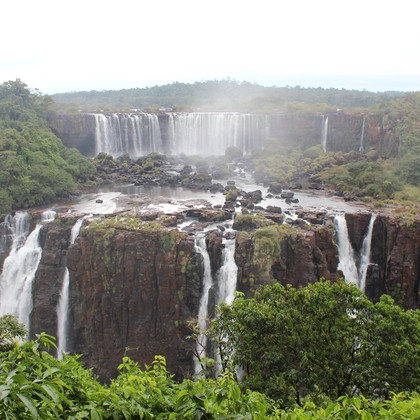
Clear, fast-flowing rivers and streams with rapids, waterfalls and deeper pools, lined with gallery forest in the cerrado; between about 200 and 1300 m. It dives in clear water for fish, mainly small species, and also for aquatic insects. The nest is in a tree cavity or rock crevice along the river.
Where the bird is most at home, classified by the vegetation units of Amazonia and the Guianas.


Range and movements
Endemic to central Brazil and very local: the main population lives in and around Serra da Canastra National Park and in the Alto Paranaíba region (Minas Gerais); smaller populations in the Chapada dos Veadeiros (Goiás) and the Jalapão (Tocantins). Formerly also in Paraná, Santa Catarina and São Paulo, where it has disappeared. Absent from Venezuela and the Guianas. Outside the guide area formerly in Misiones (Argentina) and eastern Paraguay, where it is probably extinct.
- Resident
- dark = core range, pale = thinly spread
How and when to look
Along the upper Rio São Francisco and its tributaries near the Serra da Canastra, in the early morning; pairs fish in quiet pools below rapids or fly low over the water. Keep your distance and stay on trails to avoid disturbance.
Conservation status
Critically Endangered (IUCN). The global population is very small and fragmented. Threats are dams, siltation of rivers from mining and agriculture, clearing of riverbank forest and disturbance from recreation; conservation and captive-breeding programmes are under way.
Scientific name
Mergus octosetaceus | Vieillot, 1817
Vieillot described the species in 1817 and placed it straight away in the genus where it still stands. The genus Mergus was introduced in 1758 by Linnaeus. Mergus is the Latin word for an unidentified waterbird mentioned by Pliny the Elder and other authors; some have taken it to be a cormorant or Scopoli's shearwater. octosetaceus is Latin, from octo 'eight' and setaceus 'bristled': Vieillot described a crest of eight feathers. The specimen the first description was based on came from Brazil.