All species › Gannets and cormorants › Boobies and gannets › Brown Booby
Brown Booby | Sula leucogaster
Bruine gent | Piquero pardo | Atobá-pardo
The Brown Booby is the most widespread booby of tropical coasts and the commonest booby of the guide area, from the Venezuelan islands to southern Brazil. It fishes closer to shore than most other boobies and often dives at a slant from a fairly low height. It often rests on buoys, rocks and ship rigging.
Voice
The male gives a thin, hissing whistle, the female a loud, hoarse honking or quacking; mainly in the colony.
Recording: JAYRSON ARAUJO DE OLIVEIRA — CC BY-NC-SA 4.0 · xeno-canto
Identification
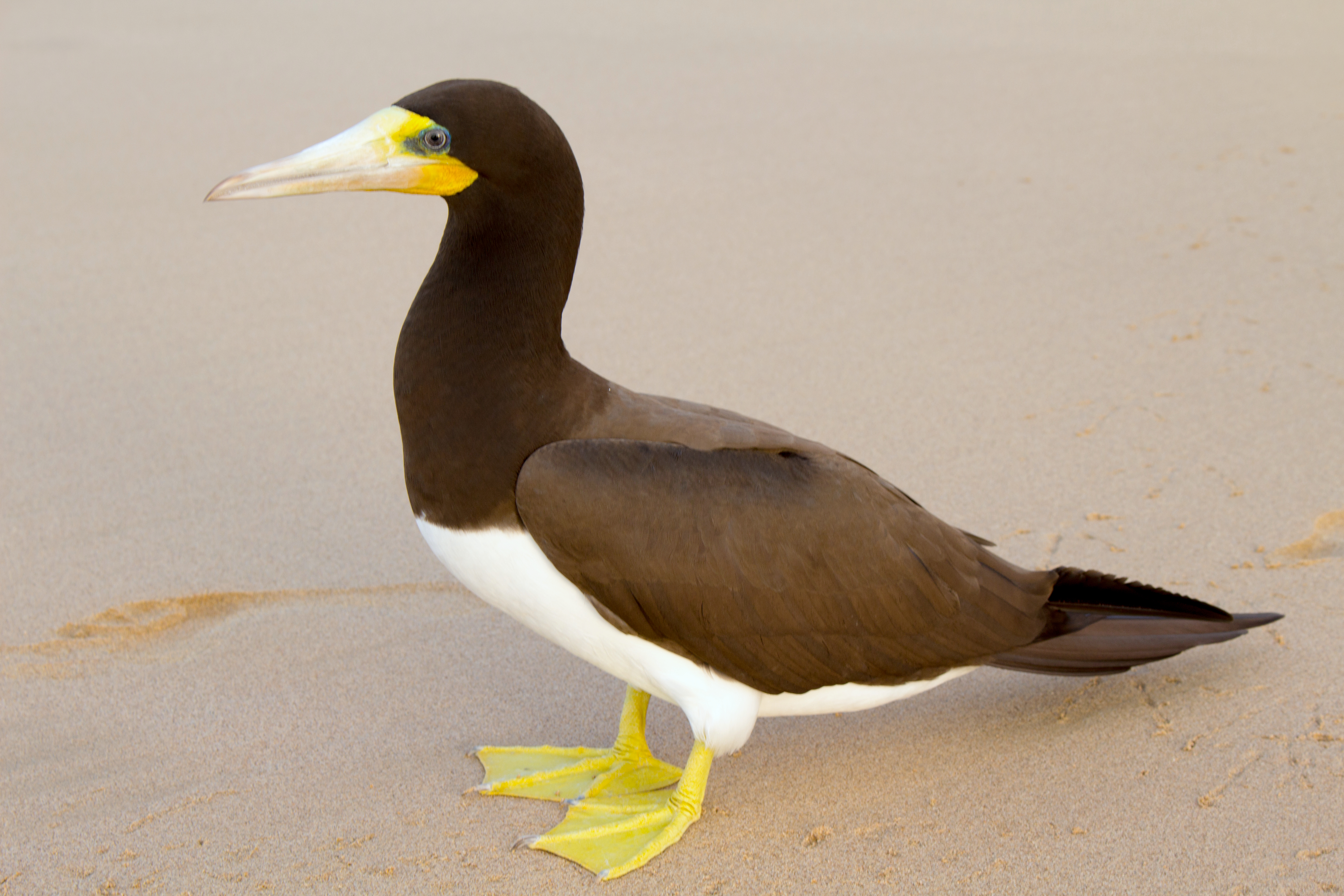
64–74 cm, with a pointed, yellow to greyish-yellow bill, narrow wings and a pointed tail. The head, neck, breast and upperparts are uniform dark chocolate brown; the white belly contrasts sharply with the brown breast. The underwing is white with a broad brown margin. The feet are yellow. The female has a yellow bill and yellow face, the male a bluish-grey to greenish face. Juveniles are brown with a dingy brown belly in which the sharp breast border is faintly visible.
Confusion species
Young Red-footed Boobies Sula sula and the brown morph of Red-footed Booby are uniformly brown without a sharply demarcated white belly. Young Masked Boobies Sula dactylatra have a white neck collar and a white breast. The young Northern Gannet Morus bassanus, a very rare vagrant, is larger and finely speckled white.
Habitat
Warm inshore waters, bays and the water around islands and rocks, usually not far from the coast. It dives for shoals of small fish and squid, often at a slant and from a low height; it also follows fishing boats. It breeds in colonies on the ground, on rocky islands and cliffs, in a shallow scrape with some plant material.
Where the bird is most at home, classified by the vegetation units of Amazonia and the Guianas.



Range and movements
In Brazil along almost the entire coast, from Amapá to Santa Catarina, scarcer further south; colonies include the St Paul's Rocks, Fernando de Noronha, Atol das Rocas, the Abrolhos and islands off São Paulo, Paraná and Santa Catarina. In Venezuela common along the Caribbean coast and around the islands, with colonies on Los Roques and Las Aves among others. Scarce off the coasts of Suriname and French Guiana, hardly known from Guyana. Outside the guide area widespread on tropical coasts and islands of the Atlantic, the Indian Ocean and the western Pacific.
- Resident
- dark = core range, pale = thinly spread
How and when to look
Along the coast of southeastern Brazil, for example at Ubatuba and Ilhabela or from ferries in Guanabara Bay, Brown Boobies fish close inshore and rest on rocks and buoys. On Fernando de Noronha and at Los Roques they sit on rocks along the water near the colonies.
Conservation status
Least Concern. Threats are disturbance of breeding islands, introduced predators, entanglement in fishing gear and overfishing of the fish shoals on which the species depends.
Scientific name
Sula leucogaster | (Boddaert, 1783)
Boddaert described the species in 1783 as Pelecanus Leucogaster; because it was later moved to another genus, the author and year stand in brackets. The genus Sula was introduced in 1760 by Brisson. Sula goes back to súla, the Old Norse and Icelandic word for the gannet; the name passed to the boobies. leucogaster is Greek, from leukos 'white' and gastēr 'belly', after the white underparts. The specimen the first description was based on came from Cayenne, French Guiana.