All species › Parrots › African and New World parrots › Brown-throated Parakeet
Brown-throated Parakeet | Eupsittula pertinax
Maïsparkiet | Perico carisucio | Periquito-de-bochecha-parda
The Brown-throated Parakeet is in the guide area the common parakeet of the open, dry country of Venezuela and of the coastal plain of the Guianas. Flocks move through scrub, savanna and farmland with loud chattering and often come into villages, gardens and towns. The species has many subspecies, which differ mainly in the colour of the face.
Voice
Shrill, rolling calls such as kree-kree in flight; a continuous chattering while feeding.
Recording: JAYRSON ARAUJO DE OLIVEIRA — CC BY-NC-SA 4.0 · xeno-canto
Identification
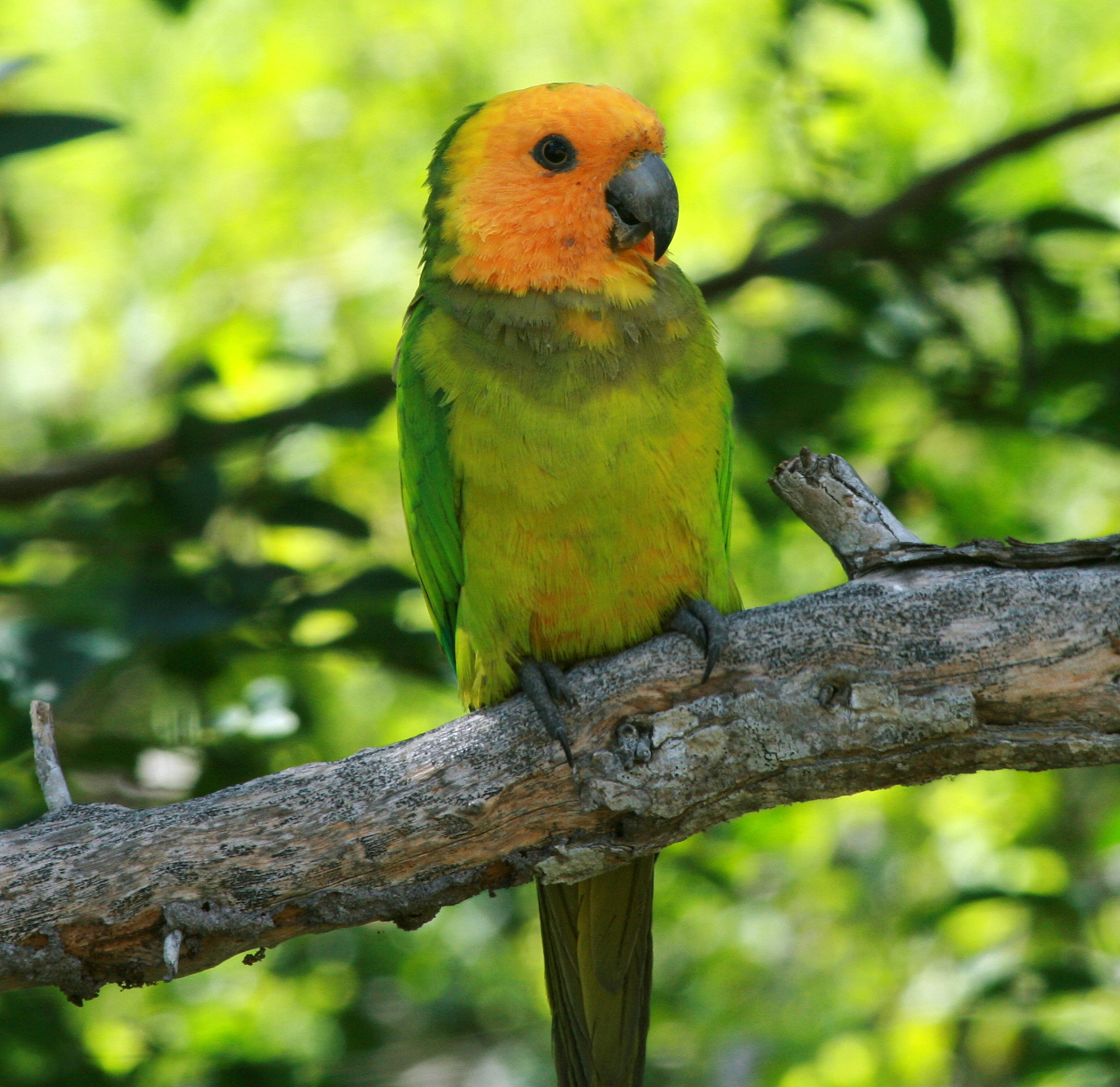
23–25 cm, with a long, pointed tail and a dark, greyish bill. The plumage is green. The face, throat and breast are olive-brown to greyish brown; around the eye is a narrow pale ring. In birds from the Guianas and northern Brazil the forehead and face are partly orange-yellow, in those from Venezuela mainly brown. The crown is bluish green, the belly yellowish green, sometimes with an orange patch. The primaries are bluish. The sexes are alike.
Confusion species
Peach-fronted Parakeet Eupsittula aurea has a distinct orange forehead and eye-ring and a bluish crown, and lives mainly south of the Amazon. Orange-chinned Parakeet Brotogeris jugularis is smaller, with a short, pointed tail, an orange chin spot and brown shoulders. Scarlet-fronted Parakeet Psittacara wagleri is larger, with a red forehead and a pale bill, and lives mainly in the mountains. Chestnut-fronted Macaw Ara severus is much larger, with a bare white face and reddish-brown underwings.
Habitat
Dry scrub, cactus scrub, savanna with woodland patches, forest edges, mangroves, secondary forest and farmland with trees, also villages, gardens and parks, mainly in the lowlands up to roughly 1200 m. It feeds on seeds, fruit, flowers and maize. It nests in a cavity in an arboreal termite nest.
Where the bird is most at home, classified by the vegetation units of Amazonia and the Guianas.






Range and movements
In Venezuela widespread in the north and in the llanos, also on Margarita and other offshore islands, and locally in open areas south of the Orinoco. In Guyana, Suriname and French Guiana mainly on the coastal plain and in the savannas of the interior. In Brazil in the north: in Roraima, Amapá, along the upper Rio Negro and locally in open areas in Pará. Outside the guide area in Panama, Colombia and on the islands off the Venezuelan coast such as Aruba, Curaçao and Bonaire.
- Resident
- dark = core range, pale = thinly spread
How and when to look
In Venezuela almost anywhere in the open lowlands, for example in the llanos or at the foot of the coastal range around Maracay. In Suriname in the gardens and parks of Paramaribo, where flocks visit fruiting and flowering trees.
Conservation status
Least Concern. The species is common and tolerates farmland and built-up areas; locally birds are trapped for the cage-bird trade.
Scientific name
Eupsittula pertinax | (Linnaeus, 1758) (GBIF: Aratinga pertinax)
Linnaeus described the species in 1758 as Psittacus pertinax; because it was later moved to another genus, the author and year stand in brackets. The genus Eupsittula was introduced in 1853 by Bonaparte. Eupsittula combines Greek eu 'good, true' with Modern Latin psittacula 'little parrot': 'true parakeet'. pertinax is Latin for 'tenacious, persistent'. The specimen the first description was based on came from Curaçao.