All species › Passerines › Antbirds › Caatinga Antwren
Caatinga Antwren | Radinopsyche sellowi
Caatingamiersluiper | Tiluchí de caatinga | Chorozinho-da-caatinga
The Caatinga Antwren is a small, long-billed antwren of the dry forests of north-eastern Brazil. It was only described in 2000, as Herpsilochmus sellowi, and since 2021 it has been placed in its own genus, Radinopsyche. It lives mainly in the canopy of semi-deciduous forest, often in mixed flocks.
Voice
The song is a very high, short, fast rattle. Calls are a short series of wheep notes and a rattle of about one second, preceded by a slightly longer, descending note.
No recording with a suitable Creative Commons licence is available for this species yet.
Identification
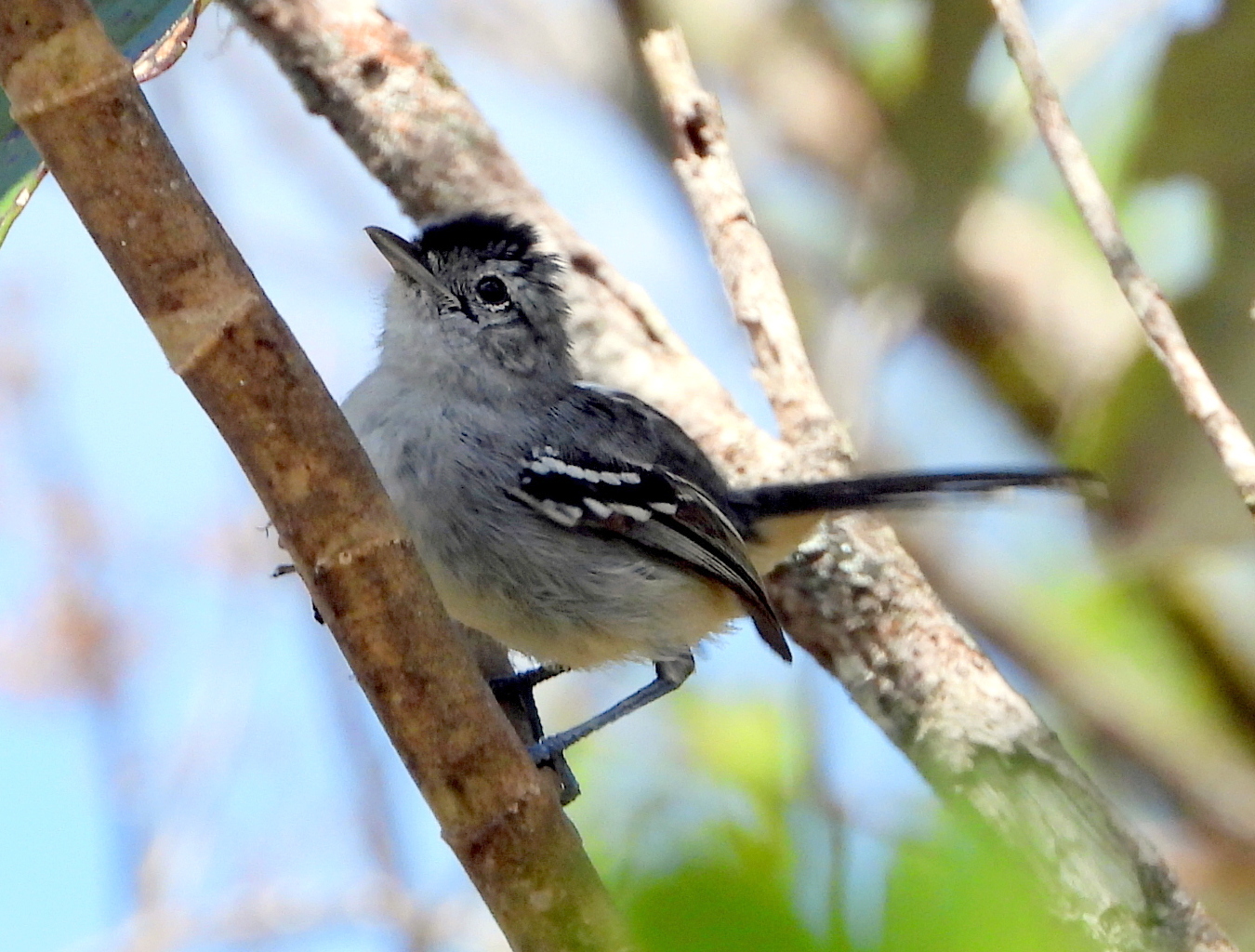
10.5–11.5 cm, slender, with a fairly long, thin bill and a medium-length tail. The male has a black crown and nape, white lores and a long white to pale grey supercilium, with a short blackish streak behind the eye. The upperparts are grey with a white patch between the shoulders; the wings are black with white edges, the tail black with large white tips. The underparts are white with a grey wash. The female resembles the male but has dull buff edges to the forehead feathers, a fainter eye-stripe, an olive tinge to the upperparts and pale buff underparts.
Confusion species
Black-capped Antwren Herpsilochmus atricapillus, which also occurs in part of the range, has a shorter bill; the female has a black-and-white streaked crown instead of a black one. Bahia Antwren Herpsilochmus pileatus lives only in the coastal forests of Bahia. The male Black-bellied Antwren Formicivora melanogaster of the same dry forests has black underparts, and the female has a white supercilium on a brown head; that species forages lower in the scrub.
Habitat
Semi-deciduous forest, mata-de-cipó and the transition from caatinga to cerrado; it usually avoids humid evergreen forest and the driest scrub. Mainly between 300 and 900 m, locally to 1100 m. It forages alone, in pairs or in family groups, often in mixed flocks, mostly in the middle storey and canopy up to about 12 m, lower at forest edges and in mata-de-cipó. It picks insects and spiders from leaves and stems. Almost nothing is known about the nest; nearly fledged young have been seen in February.
Where the bird is most at home, classified by the vegetation units of Amazonia and the Guianas.



Range and movements
Endemic to Brazil: from Maranhão and Piauí east to Ceará and Rio Grande do Norte and south to Bahia and just into northern Minas Gerais; also a few isolated localities in southern Pará. Not in Venezuela or the Guianas.
- Resident
- dark = core range, pale = thinly spread
How and when to look
Search tall dry forest and mata-de-cipó in the interior of the north-east, for example in Bahia and Piauí. The bird usually stays high in the canopy; the fast, high rattle and mixed flocks in the treetops are the best clues.
Conservation status
Least Concern. The species was listed as Near Threatened until 2011. The population size is unknown and probably decreasing because of clearance for agriculture, ranching and settlement, and locally oil extraction. It occurs in at least three protected areas, but most of its range is unprotected.
Scientific name
Radinopsyche sellowi | (Whitney & Pacheco, 2000) (GBIF: Herpsilochmus sellowi)
Whitney & Pacheco described the species in 2000 as Herpsilochmus sellowi; because it was later moved to another genus, the author and year stand in brackets. The genus Radinopsyche was introduced in 2021 by Whitney, Bravo, Belmonte-Lopes, Bornschein, Pie & Brumfield. Radinopsyche (2021) is probably from Greek rhadinos 'slender, slim' and psukhē 'soul, spirit' (also 'butterfly'); the authors' explanation could not be checked. sellowi honours the Prussian naturalist Friedrich Sellow (1789–1831), who collected in Brazil, Uruguay and Argentina from 1814 to 1831. The specimen the first description was based on came from Boa Nova, Bahia, Brazil.