All species › Passerines › Antbirds › Caura Antbird
Caura Antbird | Myrmelastes caurensis
Cauramiervogel | Hormiguero del Caura | Formigueiro-do-caura
The Caura Antbird is a large antbird of the Guiana Shield, named after the Caura River in Venezuela. It lives on the forest floor of hills and lower tepui slopes, among large moss-covered boulders. Almost all of its range lies in Venezuela; in Brazil it occurs only along the border.

Voice
The song is a slow series of shrill, slightly buzzy, strongly modulated notes that descend gradually. Calls: snarls, jeea and jeer notes and a rough chatter.
Recording: GABRIEL LEITE — CC BY-NC-SA 4.0 · shortened to the first 60 s, mono · xeno-canto
Identification
18–19 cm, with a long tail. The male is slate grey with a slight brown tinge to the upperparts, white tips to the wing coverts and a deep red iris; in the southern subspecies australis the crown feathers are pale-edged and the brown tinge is absent. The female has a mainly dark grey head, dark rufous-brown upperparts and wings with cinnamon tips to the coverts, a blackish-grey tail and deep rufous underparts, browner on the flanks and undertail coverts; the iris is dark brown.
Confusion species
Roraiman Antbird Myrmelastes saturatus of the eastern tepuis is smaller and has a different song. Spot-winged Antbird Myrmelastes leucostigma is smaller, lives lower down along streams, and the female has paler underparts. Sooty Antbird Hafferia fortis lives in lowland forest, is sooty black without obvious wing spots, and its female is brown.
Habitat
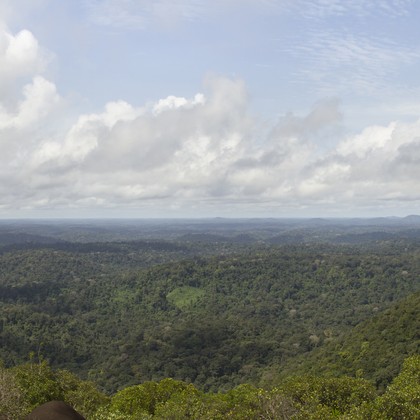
Floor and understorey of humid evergreen and semi-deciduous forest in the foothills and on the lower slopes of tepuis, especially where large moss- and fern-covered boulders lie in a fairly open understorey; up to about 1500 m. It forages in pairs low near the ground and among the rocks for arthropods. Little is known about the nest.
Where the bird is most at home, classified by the vegetation units of Amazonia and the Guianas.


Range and movements
Venezuela: in western Bolívar and northern Amazonas (nominate), and in southern Amazonas (australis). Brazil: only along the border, in northern Roraima and the adjacent north of Amazonas. Not in Guyana, Suriname or French Guiana. The species does not occur outside the guide area.
- Resident
- dark = core range, pale = thinly spread
How and when to look
Search hill forest with large boulders along the Caura and Ventuari or on the lower slopes of tepuis in Amazonas. Listen for the slow, descending series of shrill notes; the bird hops among the mossy rocks.
Conservation status
Least Concern. The population size is unknown and probably declining; the range is remote, and gold mining is the main threat.
Scientific name
Myrmelastes caurensis | (Hellmayr, 1906) (GBIF: Schistocichla caurensis)
Hellmayr described the species in 1906 as Sclateria schistacea caurensis; because it was later moved to another genus, the author and year stand in brackets. The genus Myrmelastes was introduced in 1858 by Sclater. Myrmelastes is Greek, from murmēx 'ant' and lēstēs 'robber': 'ant-robber'. caurensis refers to the Río Caura in Venezuela, where the species was discovered. The specimen the first description was based on came from Caura River valley, Bolívar, Venezuela.