All species › Passerines › Gnateaters › Ceara Gnateater
Ceara Gnateater | Conopophaga cearae
Cearamuggeneter | Jejenero de Ceará | Cuspidor-do-nordeste
The Ceara Gnateater is a gnateater of the humid hill forests in the dry north-east of Brazil. It was long treated as a subspecies of Rufous Gnateater and has been recognised as a species on the basis of genetic studies. It is endemic to Brazil.

Voice
As far as known the voice does not differ clearly from that of Rufous Gnateater: a series of high, shrill notes and a short, sneezy call, to which the local name cuspidor (spitter) refers. Males produce a whirring sound in flight with modified primaries, in display and in territory defence.
Recording: GABRIEL LEITE — CC BY-NC-SA 4.0 · xeno-canto
Identification
12–13 cm, round, with a fairly short tail, on long legs. It resembles Rufous Gnateater, but the throat and breast are paler, apricot rather than dull orange-rufous, the white breast crescent is lacking, the crown is brighter and the tail shorter. The upperparts are olive-brown, the belly is white. The male has a white tuft behind the eye that it raises in display. The female closely resembles the male.
Confusion species
Rufous Gnateater Conopophaga lineata, further south in the Atlantic Forest, has a darker orange-rufous throat and breast and a white crescent on the breast. The male Black-cheeked Gnateater Conopophaga melanops in the coastal forest of the north-east has a black mask and a grey breast. The male Hooded Gnateater Conopophaga roberti, in north-western Ceará, has a black hood.
Habitat
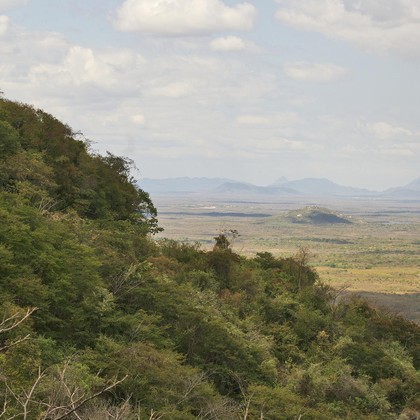
Dense understorey of evergreen forest on hills and plateaus (the brejos de altitude) in the caatinga region and humid forest in the north-east. Pairs stay together all year in a small territory and eat small arthropods on or just above the ground. The nest is a camouflaged cup of twigs and leaves low in a shrub; the clutch is two eggs and both parents incubate.
Where the bird is most at home, classified by the vegetation units of Amazonia and the Guianas.


Range and movements
Brazil: only in the north-east, in Ceará (including the Serra de Baturité), Rio Grande do Norte, Paraíba, Pernambuco and Alagoas, in isolated forest areas. Not in Venezuela, Guyana, Suriname or French Guiana. Resident. Endemic to Brazil.
- Resident
- dark = core range, pale = thinly spread
How and when to look
In the early morning, search the dense understorey along trails in the hill forests of the Serra de Baturité in Ceará, and listen for the sneezy call and the whirring of the wings.
Conservation status
Near Threatened. Its habitat consists of small, isolated forests on hills and plateaus that are being further fragmented by logging, agriculture and fire; the population is thought to be stable but has been little studied.
Scientific name
Conopophaga cearae | Cory, 1916
Cory described the species in 1916 and placed it straight away in the genus where it still stands. The genus Conopophaga was introduced in 1816 by Vieillot. Conopophaga is Greek, from kōnōps 'gnat' and -phagos '-eating': 'gnat-eater'. cearae refers to the Brazilian state of Ceará, where the type was collected. The specimen the first description was based on came from Serra de Baturité, Ceará, Brazil.