All species › Passerines › Tityras, becards and allies › Cinereous Mourner
Cinereous Mourner | Laniocera hypopyrra
Grauwe treurtiran | Plañidera cinérea | Chorona-cinza
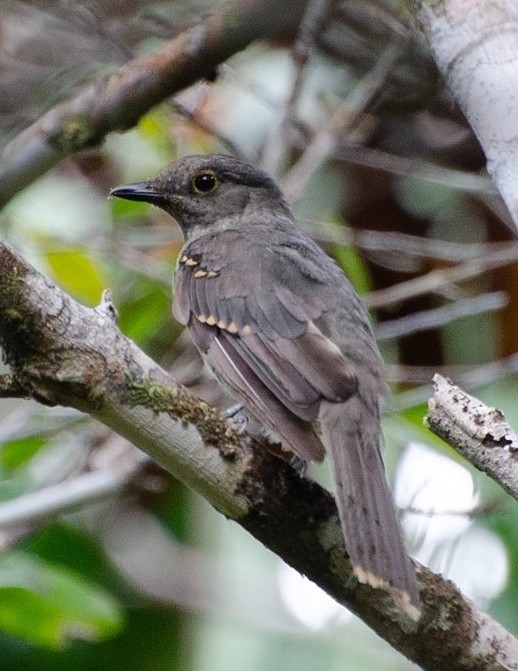
The Cinereous Mourner is a medium-sized, grey bird of the lowland rainforest of Amazonia and the Guianas, with a separate population in the Atlantic Forest. It sits still in the middle level for long periods and is noticed mainly by its song, a long series of clear whistles. Males sing at fixed sites, sometimes in loose groups.
Voice
A long series of clear, somewhat plaintive two-syllable whistles, something like tee-yoo, tee-yoo, tee-yoo, repeated with short pauses.
Recording: Jacob Wijpkema — CC BY-NC-SA 4.0 · shortened to the first 60 s, mono · xeno-canto
Identification
20–21 cm, with a fairly large, rounded head, a straight, dark bill and a fairly long tail. Mainly ash-grey, the belly slightly paler. The wing coverts and tertials have cinnamon tips forming rows of spots. On the side of the breast there is an orange to yellow tuft of feathers, often hidden under the wing. Juveniles have rufous spots on the underparts. The sexes are almost alike.
Confusion species
Greyish Mourner Rhytipterna simplex is slightly smaller and more uniformly grey, without cinnamon wing spots, and has red eyes. Screaming Piha Lipaugus vociferans is larger and plain grey, without wing spots, and has a very loud, whistled call. Pale-bellied Mourner Rhytipterna immunda has a pale, yellowish belly and lives in forest and scrub on white sand.
Habitat
Humid lowland terra firme forest, also forest on sandy soils and the edges of várzea, up to about 700 m; in the Atlantic Forest in lowland forest near the coast. It stays in the middle level. It eats fruit and large insects, often snatched from leaves in flight. Little is known about the nest.
Where the bird is most at home, classified by the vegetation units of Amazonia and the Guianas.




Range and movements
In Brazil widespread in Amazonia, from Amazonas and Roraima east to Amapá, Pará and western Maranhão and south to Rondônia and northern Mato Grosso; a separate population in the Atlantic Forest of southern Bahia and Espírito Santo. In Venezuela in the lowlands south of the Orinoco, in Amazonas and Bolívar. Scattered in Guyana, Suriname and French Guiana. Outside the guide area in the Amazonian lowlands of Colombia, Ecuador, Peru and Bolivia.
- Resident
- dark = core range, pale = thinly spread
How and when to look
Listen in tall lowland forest for the repeated whistled series; the singer often stays on the same branch in the middle level for a long time, so you can track it down with patience. Known sites include the forests around Manaus and the interior of French Guiana and Suriname.
Conservation status
Least Concern. Widespread in the guide area, but dependent on large, continuous forest. The Atlantic Forest population is small and suffers from fragmentation of lowland forest.
Scientific name
Laniocera hypopyrra | (Vieillot, 1817)
Vieillot described the species in 1817 as Ampelis hypopyrra; because it was later moved to another genus, the author and year stand in brackets. The genus Laniocera was introduced in 1841 by Lesson. Laniocera combines Lanius (shrike) with Greek keras 'horn', here 'bill': a bird with a shrike-like bill. hypopyrra is Greek, from hupo 'beneath' and pur 'fire': 'with secret fire', probably after the orange-rufous spots in the otherwise grey plumage. The specimen the first description was based on came from Cayenne, French Guiana.