All species › Parrots › African and New World parrots › Diademed Amazon
Diademed Amazon | Amazona diadema
Diadeemamazone | Amazona diademada | Papagaio-diadema
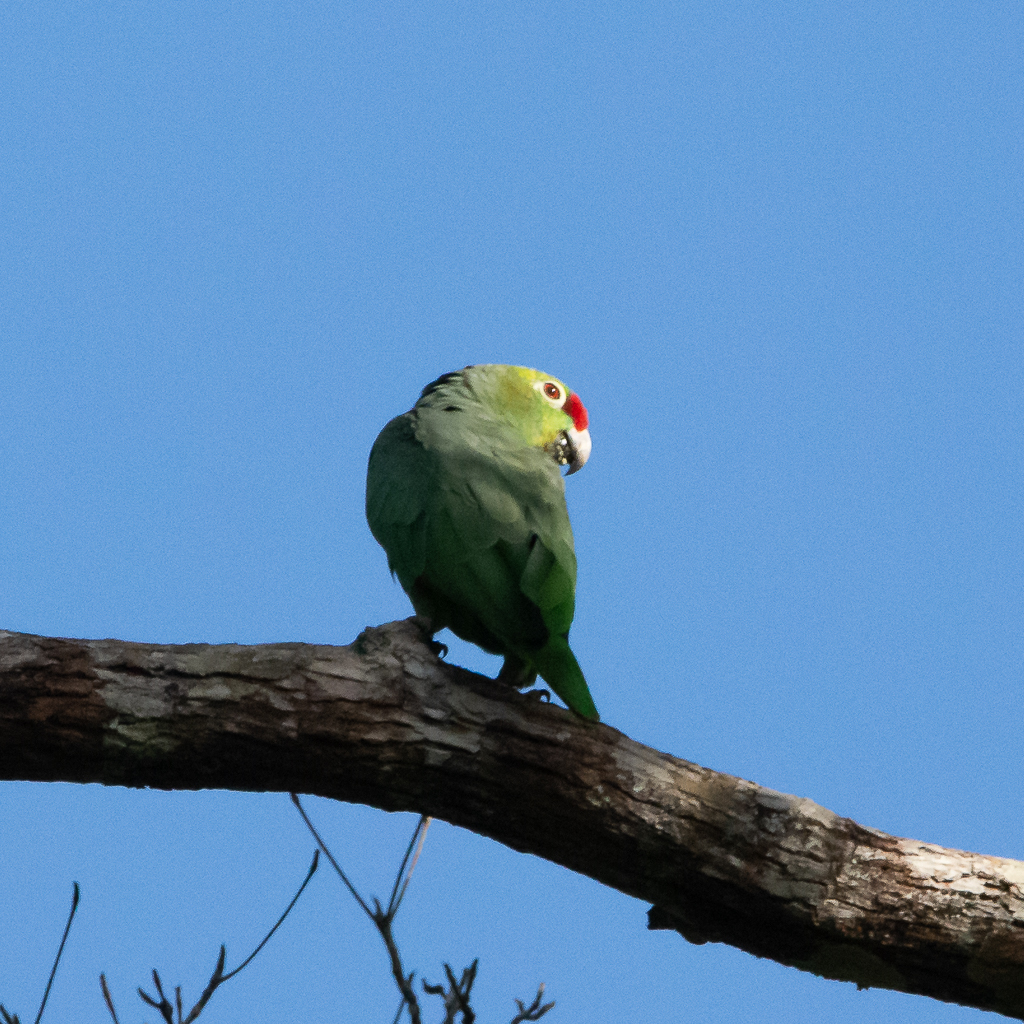
The Diademed Amazon is an amazon with a small range in the central Brazilian Amazon, along the lower Rio Negro and the Amazon. It was long regarded as a subspecies of the Red-lored Amazon of Central America and northwestern South America and occurs only in the guide area. The red band across the forehead and lores gave it its name.
Voice
Loud, hoarse and grating calls, mainly in flight, in pairs or groups; perched birds also give chattering and whistled notes. As in other amazons, noisy at the roost.
Recording: JAYRSON ARAUJO DE OLIVEIRA — CC BY-NC-SA 4.0 · xeno-canto
Identification
33 cm. Green, many feathers with dark edges, giving a finely scaled look. Forehead, lores and the skin above the bill red; the red does not continue above the eye as a brow. Cheeks, crown and nape green. In flight a red speculum at the base of the inner secondaries; the primaries blackish. The tail green with yellowish-green tips and red at the base of the outer feathers. The bill is dark grey, the bare eye-ring white, the eye orange. The sexes are alike.
Confusion species
Festive Amazon Amazona festiva also has red on the forehead and lores, but a blue brow, a red rump that shows in flight and no red wing speculum. Orange-winged Amazon Amazona amazonica has yellow and blue on the head and an orange speculum. Yellow-crowned Amazon Amazona ochrocephala has yellow on the forehead and crown. Mealy Amazon Amazona farinosa and Kawall's Amazon Amazona kawalli are larger and have no red on the head.
Habitat
Humid lowland forest, both terra firme and flooded forest along rivers, forest edges, river islands and semi-open country with scattered trees and plantations. It keeps to the canopy. It feeds on fruit, seeds and flowers. It nests in tree cavities.
Where the bird is most at home, classified by the vegetation units of Amazonia and the Guianas.




Range and movements
Only in Brazil, in the state of Amazonas: along the lower Rio Negro and along the Amazon in the region of Manaus. Absent from Venezuela, Guyana, Suriname and French Guiana. The species occurs only in the guide area.
- Resident
- dark = core range, pale = thinly spread
How and when to look
Around Manaus, for example in and near the Adolpho Ducke forest reserve, or from a boat on the Rio Negro, search early in the morning for pairs and small groups flying over the forest calling.
Conservation status
Least Concern. The range is small, but the species is locally common around Manaus. Threats are deforestation for cattle ranching and crops and trapping for the cage-bird trade. Whether the species differs enough genetically from Red-lored Amazon to be a separate species is still under study.
Scientific name
Amazona diadema | (Spix, 1824) (GBIF: Amazona autumnalis)
Spix described the species in 1824 as Psittacus diadema; because it was later moved to another genus, the author and year stand in brackets. The genus Amazona was introduced in 1830 by Lesson. Amazona comes from 'Amazone', the French name Buffon gave to various tropical American parrots because they came from the Amazon region. diadema is Latin (from Greek) for 'diadem, crown band', after the red band on the forehead. The specimen the first description was based on came from Rio Solimões, Brazil.