All species › Passerines › Antbirds › Dusky Antbird
Dusky Antbird | Cercomacroides tyrannina
Tiranmiervogel | Hormiguero tirano | Chororó-escuro
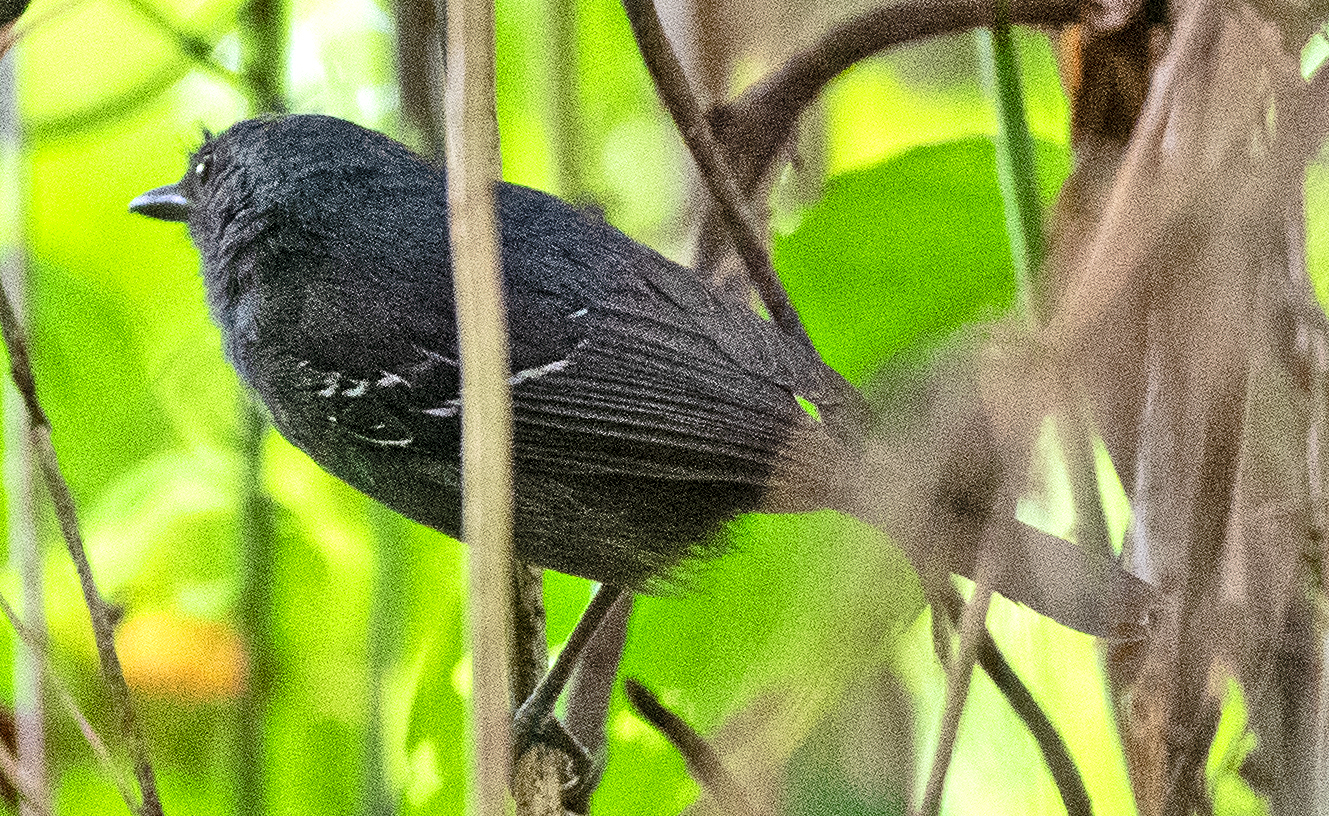
The Dusky Antbird is a small, slim antbird of dense shrubbery at forest edges and in secondary forest. The male is grey with black-and-white wing coverts, the female olive-brown with buff underparts. Pairs often sing in duet. In the guide area it lives in northern Amazonia, the Guianas and Venezuela, with a separate occurrence in north-western Venezuela.
Voice
The male's song is an accelerating, rising series of clear whistles; the female often answers with a shorter, higher series, creating a duet. Also a dry chek and a short rattle.
Recording: Juan Freile — CC BY-NC-SA 4.0 · converted to mono · xeno-canto
Identification
14 cm. Male: slate grey, underparts slightly paler; wing coverts blackish with narrow white edges; tail grey with narrow white tips. Female: upperparts olive-brown, wing coverts with faint pale edges; underparts warm buff to ochre-brown. Bill fine and black.
Confusion species
Willis's Antbird Cercomacroides laeta in Brazilian Amazonia is very similar and is separated mainly by song; the male has more distinct white wing edges. The male Blackish Antbird Cercomacroides nigrescens is darker, blackish grey; the female has a rufous forehead and face. The male Jet Antbird Cercomacra nigricans is deep black with clear white wing bars and broad white tail tips. Grey Antbird Cercomacra cinerascens lives higher up, in the canopy, and has broad white tail tips.
Habitat
Dense shrubbery, vines and undergrowth at forest edges, clearings, along streams and in secondary forest bordering taller forest, in humid lowlands and foothills; in Venezuela up to about 1800 m, mostly below 1200 m, in Brazil up to about 1200 m. It eats insects picked from leaves, low in the vegetation.
Where the bird is most at home, classified by the vegetation units of Amazonia and the Guianas.




Range and movements
Venezuela: south of the Orinoco widespread in Bolívar, Amazonas and Delta Amacuro, and separately in the north-west at the foot of the Andes and the Serranía de Perijá. Guyana, Suriname and French Guiana: widespread in the interior and at forest edges in the coastal plain. Brazil: north of the Amazon, in Roraima, northern Amazonas, northern Pará and Amapá. Outside the guide area from south-eastern Mexico through Central America to Colombia and western Ecuador.
- Resident
- dark = core range, pale = thinly spread
How and when to look
The duet gives the pair away in dense shrubbery along forest trails and at the edges of clearings. Wait patiently until one of the birds perches in an opening.
Conservation status
Least Concern. Common at forest edges and in secondary forest, as long as taller forest is nearby.
Scientific name
Cercomacroides tyrannina | (Sclater, 1855) (GBIF: Cercomacra tyrannina)
Sclater described the species in 1855 as Pyriglena tyrannina; because it was later moved to another genus, the author and year stand in brackets. The genus Cercomacroides was introduced in 2014 by Tello & Raposo. Cercomacroides is the genus Cercomacra ('long-tail') plus Greek -oidēs 'resembling'. tyrannina refers to the kingbird genus Tyrannus with Latin -inus 'resembling'. The specimen the first description was based on came from Bogotá, Colombia.