All species › Parrots › African and New World parrots › Dusky Parrot
Dusky Parrot | Pionus fuscus
Bruin margrietje | Loro morado | Maitaca-roxa
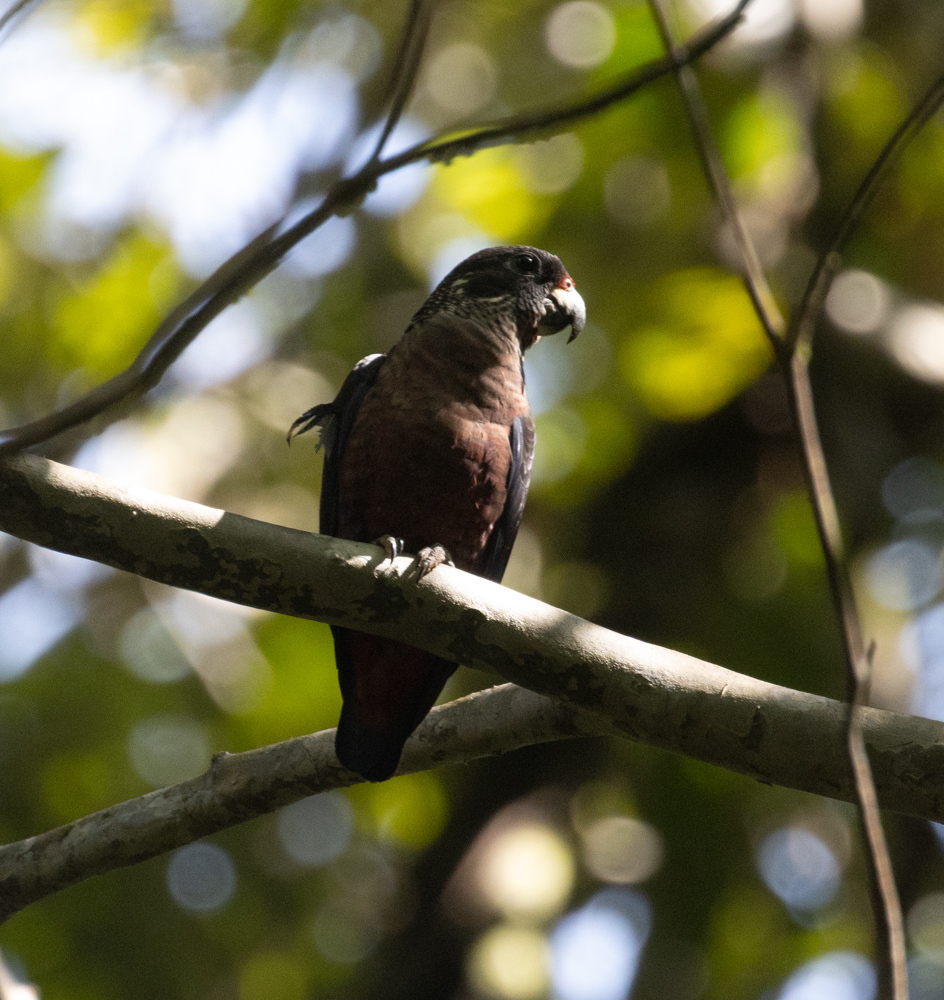
The Dusky Parrot is a medium-sized, short-tailed parrot of lowland forest in the Guianas, eastern Venezuela and the northeastern Brazilian Amazon. It is the darkest of the Pionus parrots: in shade the bird looks almost black. In flight the blue wings and the deep wingbeats, reaching far below the body, stand out, as in all Pionus parrots.
Voice
Sharp, high and somewhat metallic calls, rapidly repeated in flight; higher and less hoarse than in the amazons. Perched birds also give softer chattering.
Recording: Rainforest Connection — CC BY-NC-SA 4.0 · xeno-canto
Identification
24–26 cm. Dark greyish-brown, with a slaty, blue-tinged head, blackish ear area and a patch of creamy-white feathers on the side of the neck. The underparts brown with a pinkish-red to purplish wash on breast and belly; the undertail coverts red. Flight feathers and tail blue, the tail with red at the base; the underwing deep blue. The bill is dark with yellow at the base of the upper mandible, the bare eye-ring grey. The sexes are alike; juveniles are duller and tinged greener.
Confusion species
Blue-headed Parrot Pionus menstruus has a blue head and breast and a green body. Bronze-winged Parrot Pionus chalcopterus resembles this species in colour, but has a white throat patch, bronze wing coverts and a pale bill, and lives in montane forest outside the range of this species. Mealy Amazon Amazona farinosa and other amazons are larger and green, with shallow wingbeats.
Habitat
Humid terra firme forest in the lowlands, forest edges and clearings with tall trees, less often várzea and igapó; mostly below 600 m. It lives in pairs and small groups in the canopy. It feeds on fruit, seeds and flowers. It nests in cavities in tall trees.
Where the bird is most at home, classified by the vegetation units of Amazonia and the Guianas.




Range and movements
Widespread in the lowlands of Guyana, Suriname and French Guiana. In Venezuela east and south of the Orinoco, in Delta Amacuro and Bolívar. In Brazil north of the Amazon in Roraima, Amapá and northern Pará and Amazonas, south of the river eastwards through Pará to northwestern Maranhão. A supposed isolated population in the Serranía de Perijá on the Venezuela–Colombia border rests on specimens later found to be Bronze-winged Parrots; there are no confirmed records there.
- Resident
- dark = core range, pale = thinly spread
How and when to look
In the Guianas and eastern Pará, watch early in the morning for pairs and small groups flying high over the forest, with their deep wingbeats and dark silhouette, and for birds in fruiting trees at the forest edge.
Conservation status
Least Concern. The species is widespread and locally common in large tracts of continuous forest. Locally it is declining through deforestation and trapping for the cage-bird trade.
Scientific name
Pionus fuscus | (Müller, 1776)
Müller described the species in 1776 as Psittacus fuscus; because it was later moved to another genus, the author and year stand in brackets. The genus Pionus was introduced in 1832 by Wagler. Pionus is Greek, from piōn, pionos 'fat', after the stocky build. fuscus is Latin for 'dusky, brownish', after the dark brownish plumage. The specimen the first description was based on came from Cayenne, French Guiana.