All species › Passerines › Tityras, becards and allies › Dusky Purpletuft
Dusky Purpletuft | Iodopleura fusca
Zwartkapdwergcotinga | Yodopleura oscura | Anambé-fusco
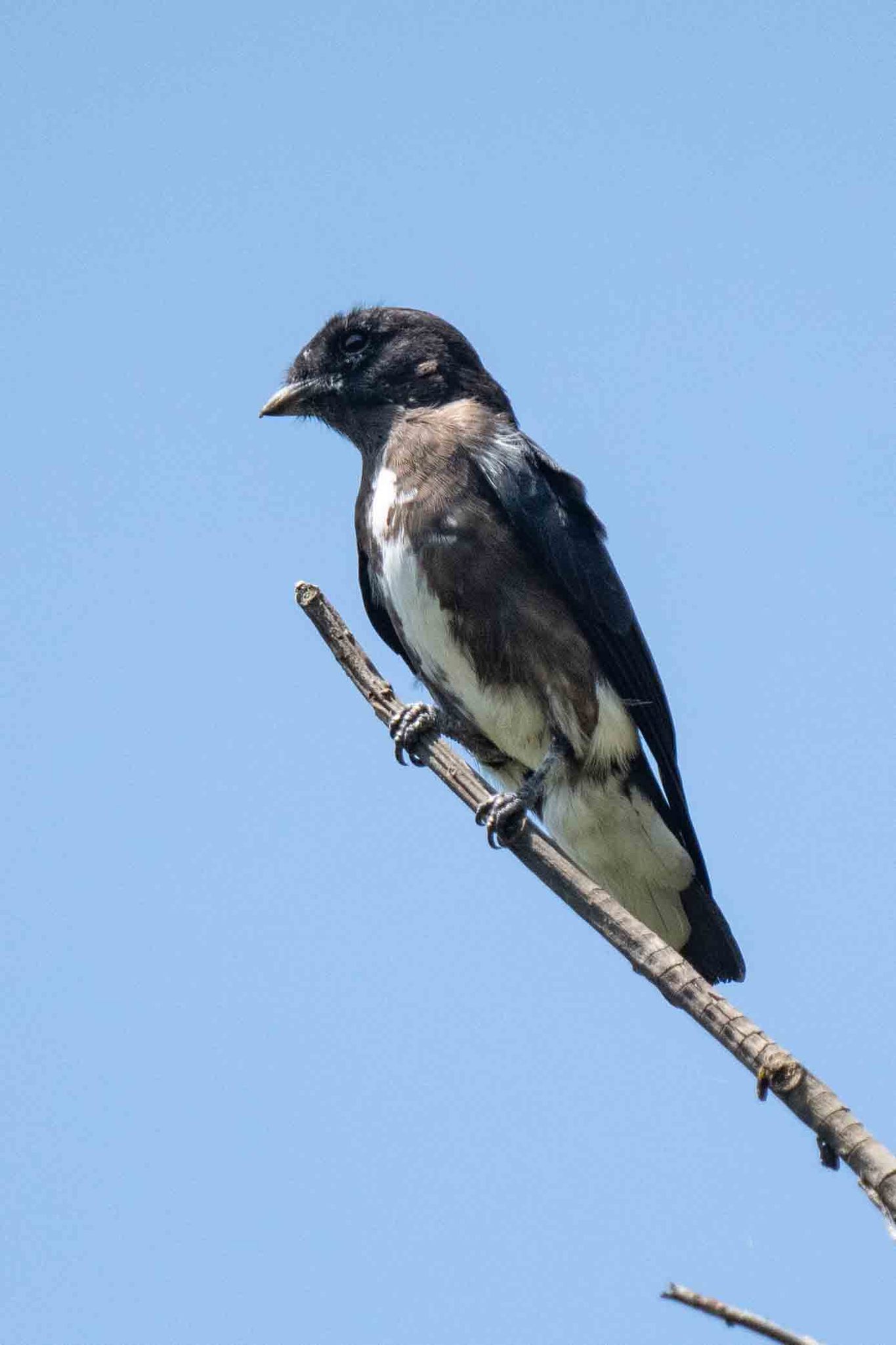
Dusky Purpletuft is a small, dark bird of the canopy of humid forest in the Guianas and adjacent parts of Venezuela and Brazil. With its long, pointed wings and short tail it resembles in silhouette a swallow sitting on a branch. It often perches for long periods on bare branches high in tall trees and is probably under-reported.
Voice
Usually silent. It gives soft trilled notes and high, thin whistles, such as a fine tsee, similar to those of White-browed Purpletuft.
Recording: Michel Giraud-Audine — CC BY-NC-SA 3.0 · xeno-canto
Identification
About 11 cm, with a short, broad bill, long wings and a short tail. Head, back, wings and tail are slaty grey to blackish, with a narrow white band across the rump. The underparts are smoky brown, with white down the centre of breast and belly. The male has a small tuft of violet feathers on the upper flank, the female a white tuft; otherwise the sexes are alike. Juveniles have white tips to the dark feathers.
Confusion species
White-browed Purpletuft Iodopleura isabellae of southern Venezuela and most of Brazilian Amazonia is paler greyish brown, with white stripes on the head and a white throat. Swallow-winged Puffbird Chelidoptera tenebrosa perches on the same kind of bare branches and also has a white rump, but is larger, with a black bill and a rufous belly. Swallows resting on branches have a longer, forked tail and a smaller head.
Habitat
The canopy and edges of humid lowland forest, also clearings and riverbanks with tall trees; up to about 500 m. It eats small fruits, including those of mistletoes, and insects caught in short sallies from a high perch. The nest is a tiny cone-shaped cup straddling a horizontal branch high in a tree; in French Guiana breeding starts in December.
Where the bird is most at home, classified by the vegetation units of Amazonia and the Guianas.


Range and movements
In Guyana, Suriname and French Guiana scattered through forested lowlands. In Venezuela only in the far east and south-east of Bolívar, known from a few specimens and sightings. In Brazil rare, with scattered records north of the Amazon, including around Manaus, and possibly in Amapá. The species does not occur outside the guide area.
- Resident
- dark = core range, pale = thinly spread
How and when to look
Scan the bare tops of tall trees from canopy walkways, towers and forest edges, for example at the Iwokrama canopy walkway in Guyana or along forest edges in French Guiana. A telescope helps: the bird often sits upright for a long time on a protruding branch and makes short sallies.
Conservation status
Least Concern. The range is large and largely forested; numbers are thought to be declining slowly. Because the species lives in the canopy of continuous forest, it is probably under-represented in records.
Scientific name
Iodopleura fusca | (Vieillot, 1817)
Vieillot described the species in 1817 as Ampelis fusca; because it was later moved to another genus, the author and year stand in brackets. The genus Iodopleura was introduced in 1839 by Lesson. Iodopleura is Greek, from ioeidēs 'purple-coloured' and pleura 'sides', after the male's purple flank tufts. fusca is Latin for 'dusky', after the dark, blackish-brown plumage. The specimen the first description was based on came from Cayenne, French Guiana.