All species › Tinamous › Tinamous › Dwarf Tinamou
Dwarf Tinamou | Taoniscus nanus
Dwergtinamoe | Tinamú enano | Inhambu-carapé
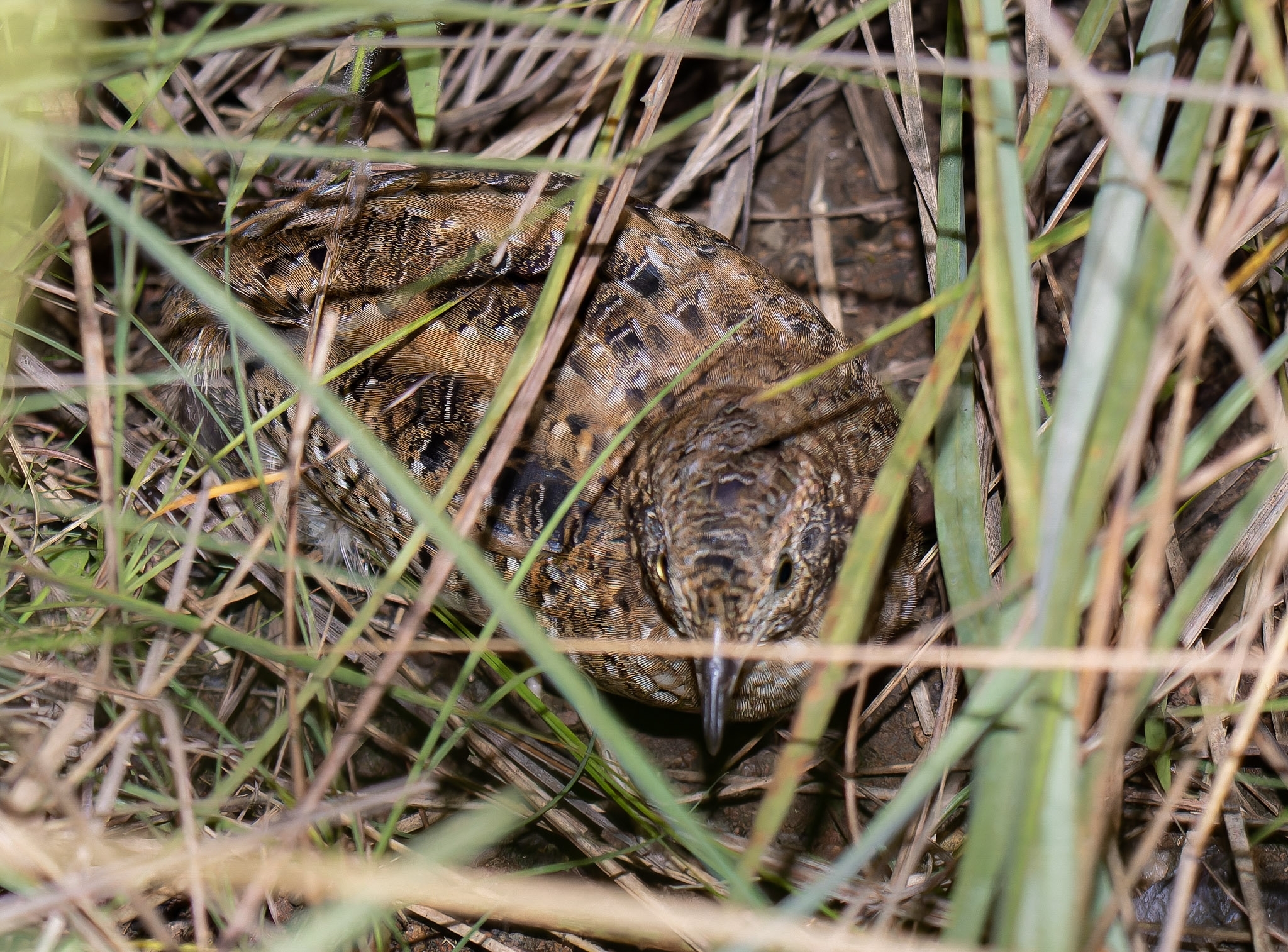
Dwarf Tinamou is the smallest tinamou and the only member of the genus Taoniscus. It lives in open cerrado grassland in central Brazil and, because of its size and insect-like call, is heard more often than seen. Its habitat is shrinking rapidly as grassland is converted to cropland.
Voice
A high, shrill, insect-like chirping or twittering, often repeated, mainly in the early morning and late afternoon. The sound resembles a grasshopper more than a bird.
Recording: Jacob Wijpkema — CC BY-NC-SA 4.0 · converted to mono · xeno-canto
Identification
15–16 cm, with a short, thin bill and almost no tail; roughly the size of a quail. The upperparts are brown, spotted and barred with black and buff, with pale longitudinal streaks on the back. The crown is dark with fine pale spots. The throat and belly are pale buff; the breast and flanks are buff with black spots and bars. The legs are yellowish to flesh-coloured. The sexes are nearly alike.
Confusion species
Lesser Nothura Nothura minor lives in the same grassland, but is larger and heavier, with a longer bill and coarser streaking on the breast. Spotted Nothura Nothura maculosa is larger still and shows barred primaries when flushed. Quails and small crakes in tall grass do not flush in such short, low flights.
Habitat
Open and semi-open cerrado grassland (campo limpo and campo sujo), often with tall grass and scattered small shrubs, also damp grassland near veredas; up to about 1200 m. It walks on the ground and feeds on seeds, grass seed and small insects such as termites. The nest is on the ground in a grass tussock.
Where the bird is most at home, classified by the vegetation units of Amazonia and the Guianas.



Range and movements
Endemic to central Brazil: scattered and local in the cerrado of the Distrito Federal, Goiás, Minas Gerais (including the Serra da Canastra), Tocantins, Mato Grosso do Sul and Mato Grosso; formerly also in São Paulo and Paraná, where it is now probably absent. Absent from Venezuela and the Guianas. Outside the guide area there are old reports from Misiones (Argentina).
- Resident
- dark = core range, pale = thinly spread
How and when to look
In the early morning, listen for the insect-like calls in protected grassland such as Brasília National Park, the Águas Emendadas Ecological Station or the Serra da Canastra; birds flush briefly and quickly drop back into the grass.
Conservation status
Endangered (IUCN). The population is small and fragmented; the main threat is conversion of cerrado grassland to soybean fields, pasture and plantations, along with too frequent fires.
Scientific name
Taoniscus nanus | (Temminck, 1815)
Temminck described the species in 1815 as Tinamus nanus; because it was later moved to another genus, the author and year stand in brackets. The genus Taoniscus was introduced in 1842 by Gloger. Taoniscus is a Greek diminutive of taōs 'peacock': 'little peacock', for this smallest tinamou. nanus is Latin (from Greek nanos) for 'dwarf', after its very small size. The specimen the first description was based on came from Paraguay.