All species › Parrots › African and New World parrots › Fiery-shouldered Parakeet
Fiery-shouldered Parakeet | Pyrrhura egregia
Roodschouderparkiet | Cotorra egregia | Tiriba-de-cauda-roxa
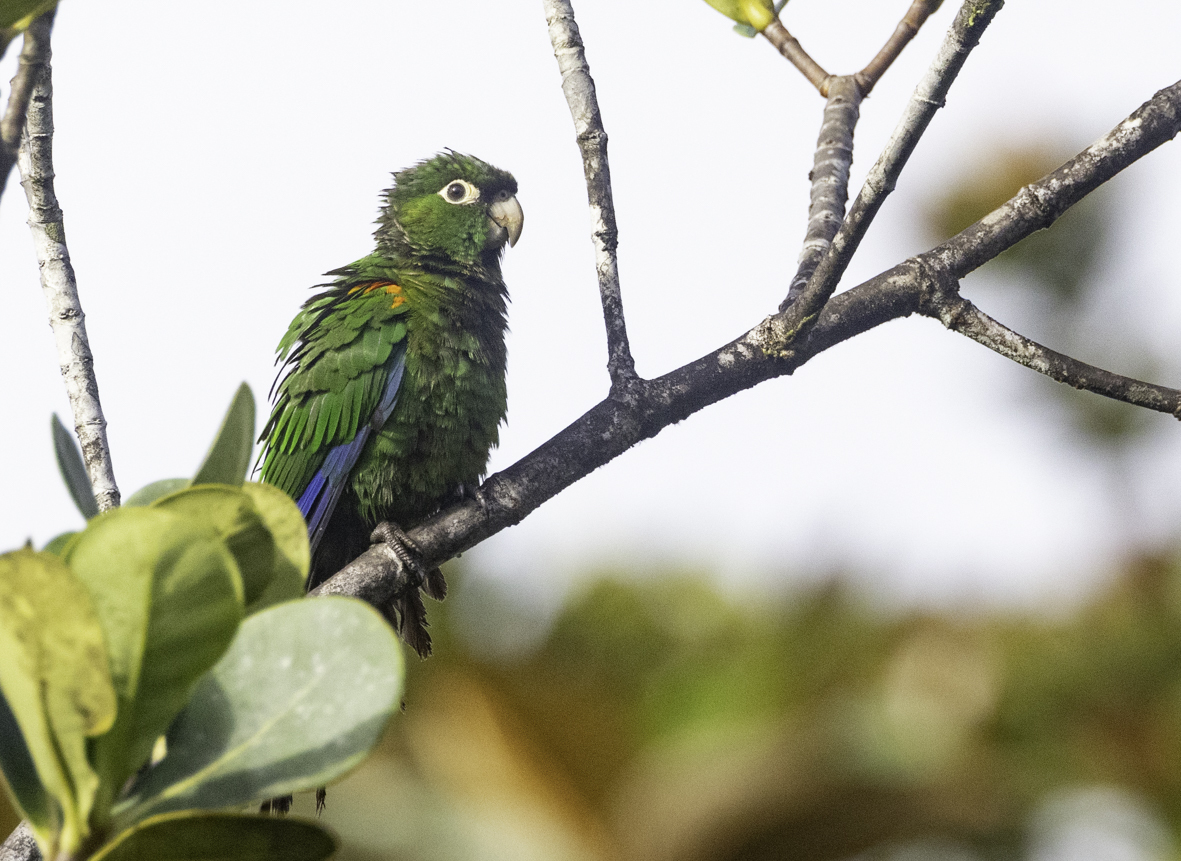
The Fiery-shouldered Parakeet is the Pyrrhura parakeet of the tepuis and highlands of the Guiana Shield, where Venezuela, Guyana and Brazil meet. It lives in the montane forest on the slopes. Characteristic is the orange-red and yellow bend of the wing, which shows mainly in flight. Flocks fly fast and call as they cross the forest.
Voice
Shrill, grating calls such as kreek-kreek, repeated rapidly in flight by the whole flock, and soft chattering from groups in the canopy.
Recording: GABRIEL LEITE — CC BY-NC-SA 4.0 · xeno-canto
Identification
25 cm, slim, with a long, graduated tail. The plumage is mostly green. The crown and hindcrown are brown, the ear region reddish brown. The throat and breast are greenish with fine pale and dark barring. There is a reddish-brown patch in the centre of the belly. The bend of the wing and the underwing coverts are orange-red to yellow, the primaries blue. The tail is reddish brown above, dark below. There is a bare, whitish ring around the eye. The sexes are alike; juveniles show less orange and yellow at the bend of the wing.
Confusion species
Painted Parakeet Pyrrhura picta has a blue forehead, a pale ear patch and a red instead of orange and yellow bend of the wing, and lives mainly lower, in lowland forest. Golden-winged Parakeet Brotogeris chrysoptera also has orange in the wing, but is smaller, with a short, pointed tail and no scaling on the breast.
Habitat
Humid montane forest and its edges on the slopes of the tepuis and highlands, also taller lowland forest at the foot of the mountains, mainly between 700 and 1800 m. It feeds on fruit, seeds and blossoms in the canopy. It lives in flocks of five to twenty birds. The nest is in a tree cavity.
Where the bird is most at home, classified by the vegetation units of Amazonia and the Guianas.


Range and movements
In Venezuela in south-eastern Bolívar, on the tepuis and highlands around the Gran Sabana and the Sierra de Lema. In Guyana in the Pakaraima Mountains in the west. In Brazil only in the far north of Roraima, around Mount Roraima. Absent from Suriname and French Guiana. Does not occur outside the guide area.
- Resident
- dark = core range, pale = thinly spread
How and when to look
Search along the road through the Sierra de Lema to the Gran Sabana in Bolívar, where flocks fly over the montane forest and along forest edges; also in the Pakaraima Mountains of Guyana.
Conservation status
Least Concern. The montane forest of the tepuis is still largely intact and mostly far from roads; locally forest is lost to gold mining, fires and road building.
Scientific name
Pyrrhura egregia | (Sclater, 1881)
Sclater described the species in 1881 as Conurus egregius; because it was later moved to another genus, the author and year stand in brackets. The genus Pyrrhura was introduced in 1856 by Bonaparte. Pyrrhura is Greek, from purrhos 'red' and oura 'tail', after the maroon tail of many species. egregia is Latin for 'excellent, extraordinary', literally 'out of the herd' (ex + grex), after the splendid fiery shoulders. The specimen the first description was based on came from probably Demerara, Guyana.