All species › Passerines › Antpittas › Great Antpitta
Great Antpitta | Grallaria excelsa
Grote mierpitta | Tororoí excelso | Tovacuçu-grande
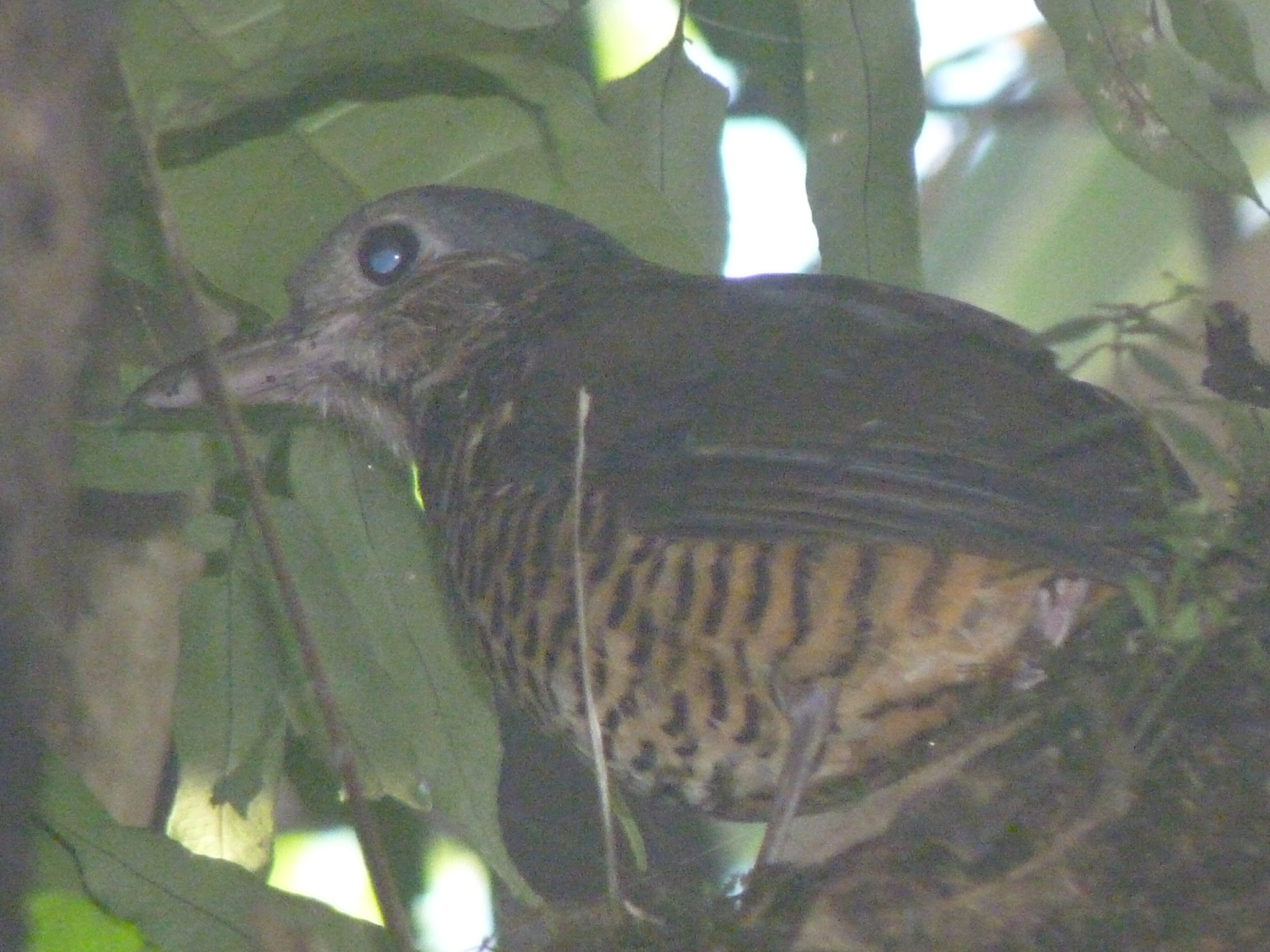
Great Antpitta is the largest species of the family, a heavy, round ground bird with ochre underparts barred with black. It occurs only in Venezuela, in the cloud forest of the Andes, the Sierra de Perijá and the Coastal Range. Its population is small and the species is rarely seen, even where it sings.
Voice
The song is a long, low trill of four to six seconds, with a rubber-lipped quality. There is also a low, hollow call of a few notes, du-du-du. It sings mainly from dawn into the early morning, mostly in the rainy season from April to November, from the ground or a perch up to about 4 m high.
Recording: Nick Athanas — CC BY-NC-SA 3.0 · xeno-canto
Identification
24–28 cm, round and short-tailed, on long grey legs, with a heavy bill. The forecrown is brown to olive-ochre, the crown and nape grey with faint black scaling, the upperparts olive-brown. The face is ochre to pale rufous with white lores, the throat white to pale buffy-white. The underparts are ochre to pale rufous with wavy black lines; the undertail coverts are unmarked warm ochre. The sexes are alike.
Confusion species
Undulated Antpitta Grallaria squamigera is very similar in shape and plumage, but is smaller, has a greyer back and a distinct black malar stripe and usually lives higher, above about 2300 m. Scaled Antpitta Grallaria guatimalensis is much smaller, with black-scaled upperparts and a dark malar stripe. Plain-backed Antpitta Grallaria haplonota is smaller, with a plain olive-brown back and unbarred ochre underparts.
Habitat
The understorey of humid cloud forest, especially along creeks and at the edges of gaps left by fallen trees, from about 1600 to 2300 m and most often above 2000 m. It lives on the forest floor and searches there for earthworms and other invertebrates. Little is known about the nest.
Where the bird is most at home, classified by the vegetation units of Amazonia and the Guianas.


Range and movements
Only in Venezuela. The nominate form lives in the Sierra de Perijá and in the Andes from Lara south to Táchira; another subspecies is known only from a few specimens from the Coastal Range near Colonia Tovar in Aragua. Not in Brazil or the Guianas. Does not occur outside the guide area.
- Resident
- dark = core range, pale = thinly spread
How and when to look
Listen at dawn in the rainy season in the cloud forest of Yacambú National Park in Lara, where the species is found most regularly, for the long, low trill. Then stand still near creeks and tree-fall gaps and look low near the ground.
Conservation status
Near Threatened. The population is estimated at 1000 to 2500 mature individuals and is thought to be declining. The main threat is the clearance of montane forest for farming in the Sierra de Perijá, the Mérida Andes and the Coastal Range, where much forest has already gone. The species may have disappeared from many places within its range.
Scientific name
Grallaria excelsa | Berlepsch, 1893
Berlepsch described the species in 1893 and placed it straight away in the genus where it still stands. The genus Grallaria was introduced in 1816 by Vieillot. Grallaria is from Latin grallae 'stilts', after the long legs. excelsa is Latin for 'lofty, eminent', probably after its size: it is one of the largest antpittas. The specimen the first description was based on came from Montaña de Aricagua, Mérida Andes, Venezuela.