All species › Passerines › Antbirds › Hairy-crested Antbird
Hairy-crested Antbird | Rhegmatorhina melanosticta
Haarkuifmiervogel | Hormiguero canoso | Mãe-de-taoca-cabeçuda
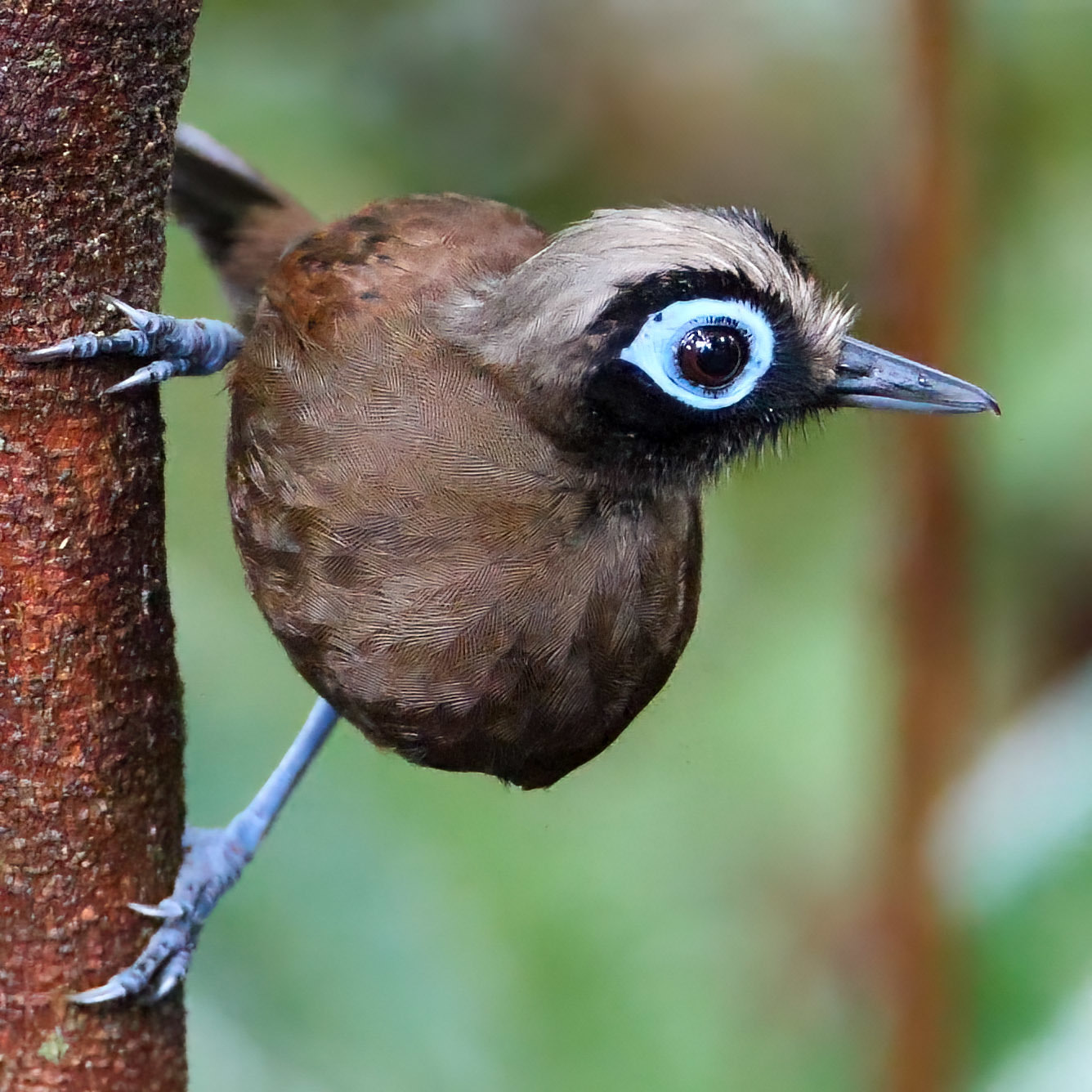
The Hairy-crested Antbird is an ant-follower of western Brazilian Amazonia, south of the Solimões. It has a bushy, greyish-white crest above a black face with bare bluish-white skin around the eye. Like the other Rhegmatorhina species it nearly always attends army-ant swarms.
Voice
The song is a series of clear, slightly downslurred whistles that drop in pitch and slow down at the end. At ant swarms also a harsh, rasping call and a dry rattle.
Recording: JAYRSON ARAUJO DE OLIVEIRA — CC BY-NC-SA 4.0 · xeno-canto
Identification
15 cm. Crown and crest greyish white to pale grey, the feathers hair-like and erectile; forehead, face and throat black; broad bare skin around the eye pale bluish white. Upperparts olive-brown; underparts rufous-brown to dark olive-brown. Male with a plain back. Female: mantle and back with black spots edged pale tawny-buff; the scientific name (melanosticta, 'black-spotted') refers to this.
Confusion species
Chestnut-crested Antbird Rhegmatorhina cristata north of the Japurá has a chestnut crest. White-breasted Antbird Rhegmatorhina hoffmannsi east of the Madeira has a white throat and breast. Black-spotted Bare-Eye Phlegopsis nigromaculata at the same swarms is larger, olive-brown with black spots across the upperparts, and has red bare skin around the eye.
Habitat
Understorey of tall terra firme forest, locally also bamboo forest and old secondary forest; in the guide area in the lowlands, further west up into the Andean foothills. It follows army-ant swarms and, from low vertical twigs, catches the insects and other arthropods fleeing ahead of the ants. Little is known about the nest.
Where the bird is most at home, classified by the vegetation units of Amazonia and the Guianas.



Range and movements
Brazil: western Amazonia south of the Solimões and west of the Madeira, in Acre, south-western Amazonas and Rondônia. Not in Venezuela, Guyana, Suriname or French Guiana. Outside the guide area in south-eastern Colombia, eastern Ecuador and Peru, and northern Bolivia.
- Resident
- dark = core range, pale = thinly spread
How and when to look
In Acre and Rondônia, look at army-ant swarms in tall forest. Follow the calls of the ant-followers and approach the swarm slowly; the birds perch low and hop between saplings.
Conservation status
Least Concern. The range is large and mostly forested. Deforestation in Rondônia and Acre removes habitat locally; as an army-ant follower the species disappears from small forest remnants.
Scientific name
Rhegmatorhina melanosticta | (Sclater & Salvin, 1880)
Sclater & Salvin described the species in 1880 as Pithys melanosticta; because it was later moved to another genus, the author and year stand in brackets. The genus Rhegmatorhina was introduced in 1888 by Ridgway. Rhegmatorhina is Greek, from rhēgma 'cleft' and rhis, rhinos 'nostril', after the narrow, slit-like nostrils. melanosticta is Greek, from melas 'black' and stiktos 'spotted', after the black spots in the plumage. The specimen the first description was based on came from Sarayacu, Ecuador.