All species › Passerines › Cotingas › Handsome Fruiteater
Handsome Fruiteater | Pipreola formosa
Sierlijke cotinga | Frutero hermoso | Anambé-formoso
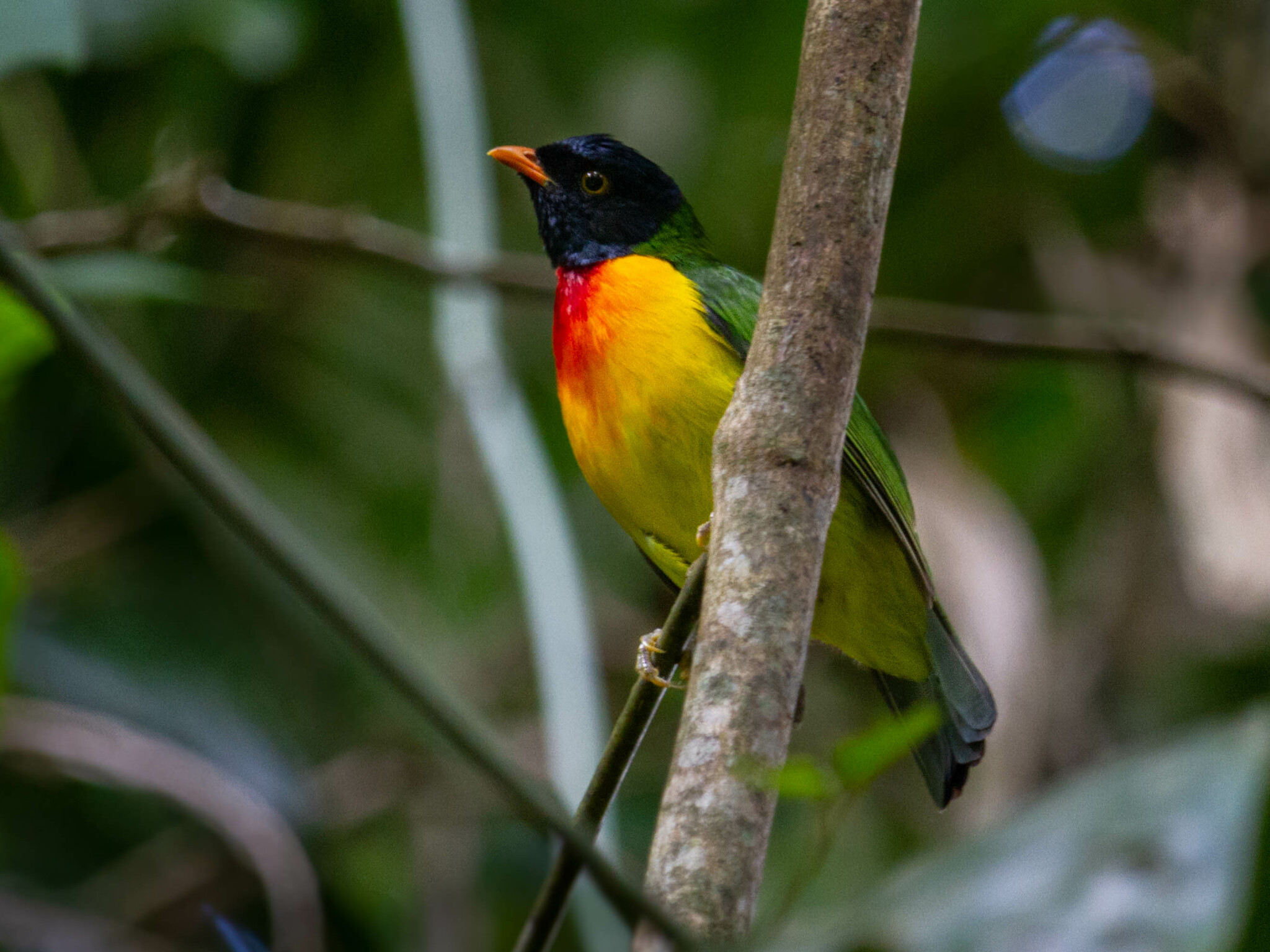
The Handsome Fruiteater is a stocky green fruiteater found only in the mountains of northern Venezuela. The male has a black head and an orange triangle on the yellow breast. It often sits motionless for long periods in the middle storey of the cloud forest moving little.
Voice
Sings mainly in the morning from a perch in the middle storey, but is seldom heard. The song is a high, almost single-pitched whistle that starts loud and slows towards the end: siiiiii. Also a high, thin pik and rapid series of thin, high notes.
Recording: Francisco contreras @francontreras.80 — CC BY-NC-SA 4.0 · shortened to the first 60 s, mono · xeno-canto
Identification
17–18 cm, stocky, with a short orange or orange-yellow bill. The male has a glossy bluish-black head and throat, green nape, back and tail, green wings with white tips to the tertials, and a deep orange triangular patch on the upper breast; the rest of the underparts is bright yellow. The female is green with a yellowish-green throat, an orange-yellow crescent on the upper breast and a yellow belly and flanks barred green; her bill is duller yellow. In the east (Sucre, Monagas, Paria) females have a yellow, finely barred throat and a redder breast patch. Young birds are mostly green.
Confusion species
Green-and-black Fruiteater Pipreola riefferii, also in the Coastal Range, has a dark green-black head with a yellow border in the male, but no orange breast patch, and green-streaked underparts. Golden-breasted Fruiteater Pipreola aureopectus has a green head and a golden-yellow throat and breast in the male. Females of the three species are alike; note the breast patch and the white tertial tips.
Habitat
Humid premontane forest and cloud forest at 800–2200 m. It lives in the middle storey and lower canopy, often among moss and epiphytes, and feeds mainly on berries and other small fruits, usually plucked from a perch. Breeding has been recorded from November to June; the nest has not been described.
Where the bird is most at home, classified by the vegetation units of Amazonia and the Guianas.

Range and movements
In the guide area only in Venezuela, where the species is endemic to the Coastal Range, in three separate parts: from Yaracuy and Carabobo east to Distrito Capital and Miranda (with one sight record in Falcón), in north-eastern Anzoátegui, western Sucre and northern Monagas, and on the Paria Peninsula. Absent from the Andes and from Brazil, Guyana, Suriname and French Guiana.
- Resident
- dark = core range, pale = thinly spread
How and when to look
Search the cloud forest of Henri Pittier, for example along the road over Rancho Grande, or around Colonia Tovar and El Ávila. Listen in the morning for the high whistle and look for green birds sitting motionless among the moss in the middle storey, often near fruiting shrubs.
Conservation status
Least Concern. The range is small and fragmented, but much of it lies within national parks; outside the parks cloud forest has been cleared locally for farming.
Scientific name
Pipreola formosa | (Hartlaub, 1849)
Hartlaub described the species in 1849 as Ampelis formosa; because it was later moved to another genus, the author and year stand in brackets. The genus Pipreola was introduced in 1838 by Swainson. Pipreola is a Latin diminutive of the manakin genus Pipra: 'little Pipra'. formosa is Latin for 'beautiful, handsome', after the finely coloured plumage. The specimen the first description was based on came from Caracas, Venezuela.