All species › Parrots › African and New World parrots › Kawall's Amazon
Kawall's Amazon | Amazona kawalli
Kawalls amazone | Amazona de Kawall | Papagaio-dos-garbes
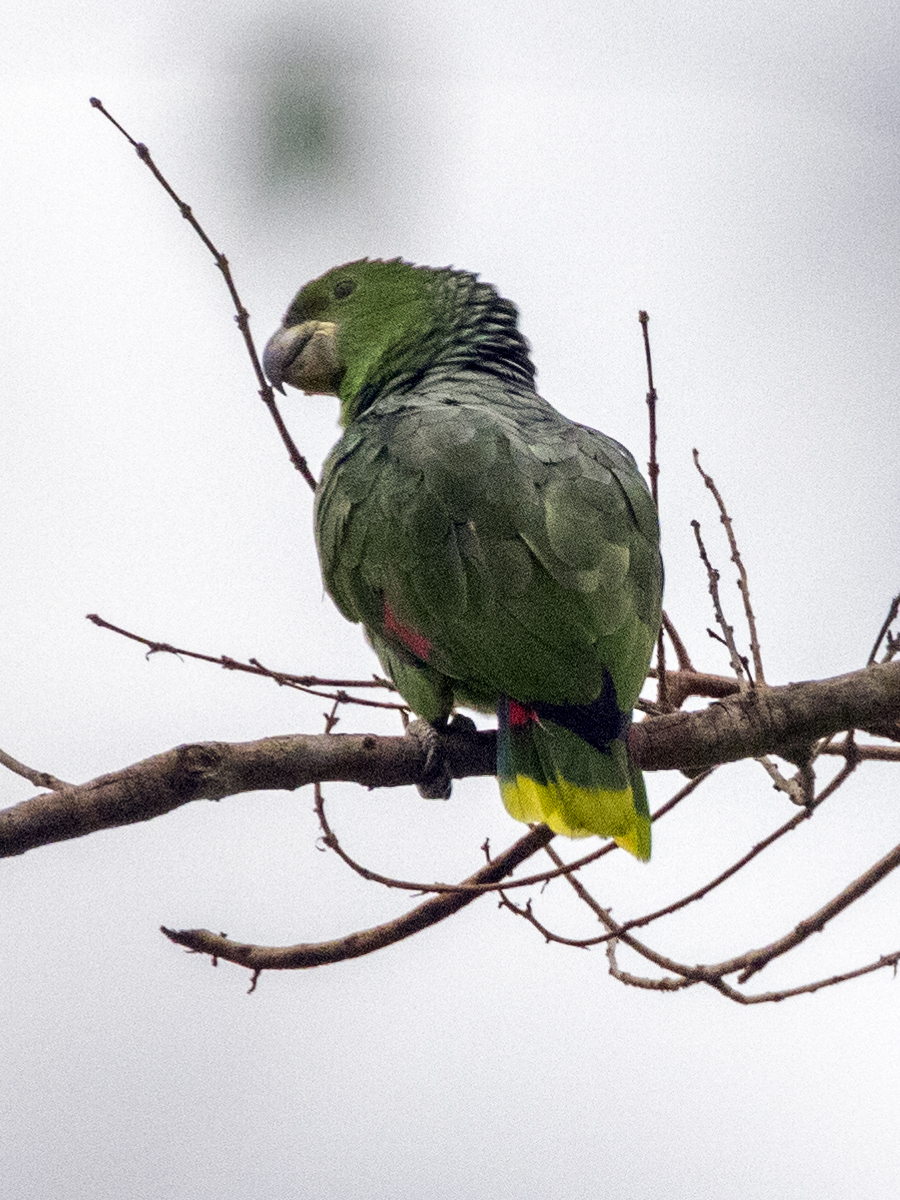
Kawall's Amazon is a large green amazon described as a separate species only in 1989 and long confused with Mealy Amazon. It occurs only in the Brazilian Amazon and is thus endemic to the guide area. It lives mainly in flooded forest along rivers.
Voice
Loud, harsh calls that differ from those of Mealy Amazon; the repertoire is still poorly described.
Recording: GABRIEL LEITE — CC BY-NC-SA 3.0 · xeno-canto
Identification
35–36 cm, with a short, square tail. The plumage is bright green, without the powdery bloom of Mealy Amazon. There is a bare white patch of skin at the base of the bill; the eye-ring is narrow and grey. The wing has a red speculum; the tail has red at the base of the outer feathers and a yellowish-green terminal band. The bill is horn-coloured. The sexes are alike.
Confusion species
Mealy Amazon Amazona farinosa is larger, with a broad white eye-ring and a powdery back, and has no bare patch at the base of the bill. Yellow-crowned Amazon Amazona ochrocephala has yellow on the forehead and crown and red at the bend of the wing. Festive Amazon Amazona festiva has a blue brow and a red rump and also lives in flooded forest along rivers.
Habitat
Humid lowland forest, especially seasonally or permanently flooded forest (várzea and igapó) and forest edges along rivers, also adjacent terra firme forest, in the lowlands. It feeds on fruit and seeds in the canopy. Little is known about breeding; the nest is presumably in a tree cavity.
Where the bird is most at home, classified by the vegetation units of Amazonia and the Guianas.




Range and movements
Only in Brazil, in the Amazon region of Amazonas and Pará, mainly south of the Amazon along the large tributaries, and south into northern Mato Grosso. The limits of the range are poorly known because the species is confused with Mealy Amazon. Absent from Venezuela, Guyana, Suriname and French Guiana, and not confirmed outside the guide area.
- Resident
- dark = core range, pale = thinly spread
How and when to look
In forest along rivers in the southern Brazilian Amazon, for example along the Tapajós or in northern Mato Grosso, check Mealy Amazons for a white patch at the base of the bill and red at the base of the tail. Document records with photographs or sound recordings.
Conservation status
Least Concern. The species is locally fairly common, but numbers are declining through deforestation in the southern Amazon, and some birds are trapped for the trade.
Scientific name
Amazona kawalli | Grantsau & Camargo, 1989
Grantsau & Camargo described the species in 1989 and placed it straight away in the genus where it still stands. The genus Amazona was introduced in 1830 by Lesson. Amazona comes from 'Amazone', the French name Buffon gave to various tropical American parrots because they came from the Amazon region. kawalli honours the Brazilian aviculturist Nelson Machado Kawall (1928–2006), in whose care the first distinctive birds were noticed. The specimen the first description was based on came from not stated.